AQA · A-Level · Business
Course version: 7132 · Version from Sept 2023
Improving organisational design and managing the human resource flow: How…
Full specification wording
Making human resource decisions: improving organisational design and managing the human resource flow: How managing the human resource flow helps meet human resource objectives (to include: Human resource flow to include: human resource plan, recruitment, training, redeployment, redundancy.)
This is the movement of people into a business, through it and out of it, and the plan is what keeps the decisions consistent with one another.
- Point 4 of 4
- 4 key terms
Study notes
From the teaching notes for this specification point.
The idea
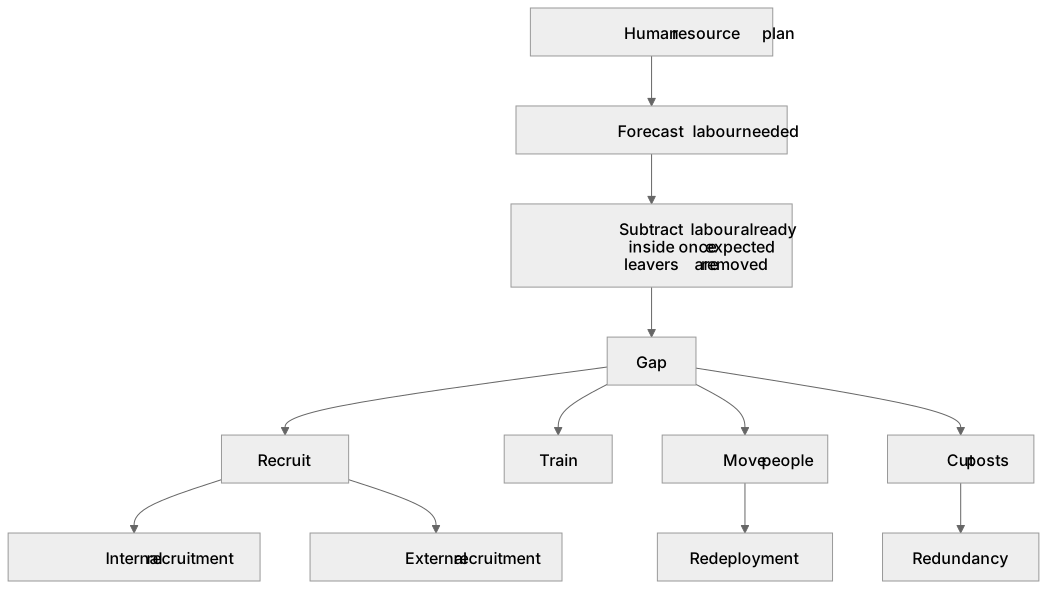
This is the movement of people into a business, through it and out of it, and the plan is what keeps the decisions consistent with one another. Forecast the labour needed, subtract the supply already inside once expected leavers are removed, and the gap says whether to hire, train, move people or cut posts. Recruiting internally is cheaper, faster and motivating because it shows a route upward, while an outside appointment brings ideas the firm does not have. Training lifts productivity and retention but costs money up front and makes the trained person more attractive to a rival. Moving staff to another role keeps knowledge the firm paid to build and avoids the cost of cutting posts, though it needs retraining and is often resisted. Cutting posts comes last because it is expensive, damages the employer's reputation and leaves survivors waiting for the next round.
What earns the marks
- Setting forecast labour needs against the labour the firm already expects to have, so the recommendation answers a measured gap.
- Comparing internal and external recruitment on cost, speed and effect on motivation rather than listing recruitment methods.
- Explaining why moving staff to another role may beat cutting posts in this case, for example where the skills transfer to a growing site.
- Recognising the full cost of redundancy, including notice, statutory payments and the effect on those who stay.
- Linking the decision back to a stated workforce objective such as retention or the skills mix the strategy needs.
Common mistakes and how to put them right
Treating redundancy as an immediate saving, when payments and lost output often make the first year more expensive than doing nothing.
Describing the stages of recruitment in detail when the question asked whether to recruit at all.
Assuming training pays for itself without asking whether those trained will stay long enough for the firm to collect the benefit.
Ignoring process and law, so a recommendation to cut staff never mentions consultation or selection criteria.
Exam tips
- Expect a recommend or justify question that hands you two options, so commit to one and explain why you rejected the other.
- Use the timeline in the case, since a short dip in demand argues for redeployment and shorter hours while the permanent loss of a contract argues for cutting posts.
- Finish by linking back to the workforce objective in the extract, because that is where the evaluation marks sit.
Try the lesson
The start of the Making human resource decisions: improving organisational design and managing the human resource flow: How managing the human resource flow helps meet human resource objectives (to include: Human resource flow to include: human resource plan, recruitment, training, redeployment, redundancy.) lesson, made from teaching notes for this specification point.
Have a go first
What is the main purpose of a human resource plan?
Listen
This is the movement of people into a business, through it and out of it, and the plan is what keeps the decisions consistent with one another. Forecast the labour needed, subtract the supply already inside once expected leavers are removed, and the gap says whether to hire, train, move people or cut posts. Recruiting internally is cheaper, faster and motivating because it shows a route upward, while an outside appointment brings ideas the firm does not have. Training lifts productivity and retention but costs money up front and makes the trained person more attractive to a rival. Moving staff to another role keeps knowledge the firm paid to build and avoids the cost of cutting posts, though it needs retraining and is often resisted. Cutting posts comes last because it is expensive, damages the employer's reputation and leaves survivors waiting for the next round. A strong answer earns marks for these points. Setting forecast labour needs against the labour the firm already expects to have, so the recommendation answers a measured gap. Comparing internal and external recruitment on cost, speed and effect on motivation rather than listing recruitment methods. Explaining why moving staff to another role may beat cutting posts in this case, for example where the skills transfer to a growing site. Recognising the full cost of redundancy, including notice, statutory payments and the effect on those who stay. Exam tip: Expect a recommend or justify question that hands you two options, so commit to one and explain why you rejected the other.
See it
Key words
Say what each word means before you turn the card.
human resource plan
Try answering aloud or in your head before turning the card.
internal and external recruitment
Try answering aloud or in your head before turning the card.
training investment
Try answering aloud or in your head before turning the card.
redeployment
Try answering aloud or in your head before turning the card.
See every definition
- human resource plan
- The plan that keeps the decisions about the movement of people into, through and out of a business consistent with one another.
- internal and external recruitment
- Recruiting internally is cheaper, faster and motivating because it shows a route upward, while an outside appointment brings ideas the firm does not have.
- training investment
- Lifts productivity and retention but costs money up front and makes the trained person more attractive to a rival.
- redeployment
- Moving staff to another role keeps knowledge the firm paid to build and avoids the cost of cutting posts, though it needs retraining and is often resisted.
Label the diagram
Some boxes have lost their names. Pick the right name for each number.
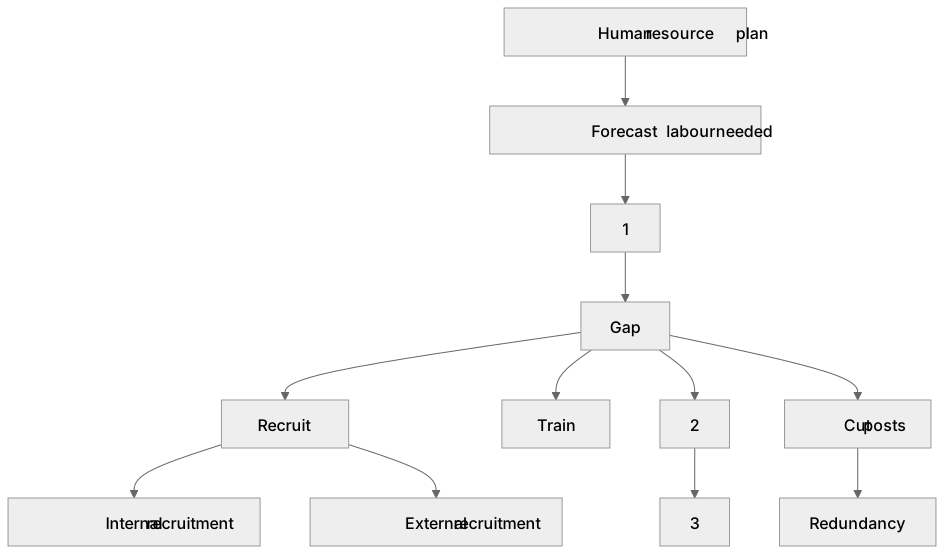
1Box 1
2Box 2
3Box 3
There is more to this lesson
The full lesson goes on to check your understanding and help you earn the marks. Create a free account to carry on, with your progress saved.
A week of Premium from your first lesson · Then the free plan continues · No card, no charge
Test your understanding of Making human resource decisions: improving organisational design and managing the human resource flow: How managing the human resource flow helps meet human resource objectives (to include: Human resource flow to include: human resource plan, recruitment, training, redeployment, redundancy.)
Active recall beats re-reading. Take an instant quiz now to test what you’ve learned and lock it into long-term memory.
A week of Premium from your first lesson · Then the free plan continues · No card, no charge