AQA · A-Level · Business
Course version: 7132 · Version from Sept 2023
Segmentation, targeting, positioning: Influences on choosing a target…
Full specification wording
Making marketing decisions: segmentation, targeting, positioning: Influences on choosing a target market and positioning (to include: Targeting may include niche and mass marketing. Positioning should include market mapping.)
Targeting is selecting a consumer group to aim products at; positioning is creating a distinct brand identity in their minds.
- Point 2 of 2
- 4 key terms
Study notes
From the teaching notes for this specification point.
The idea
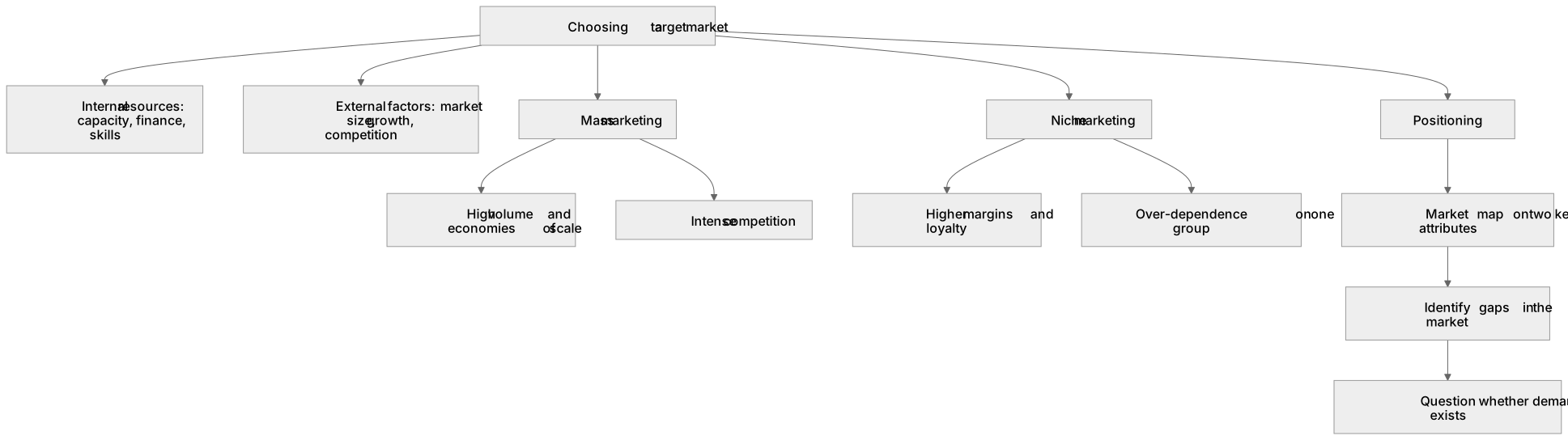
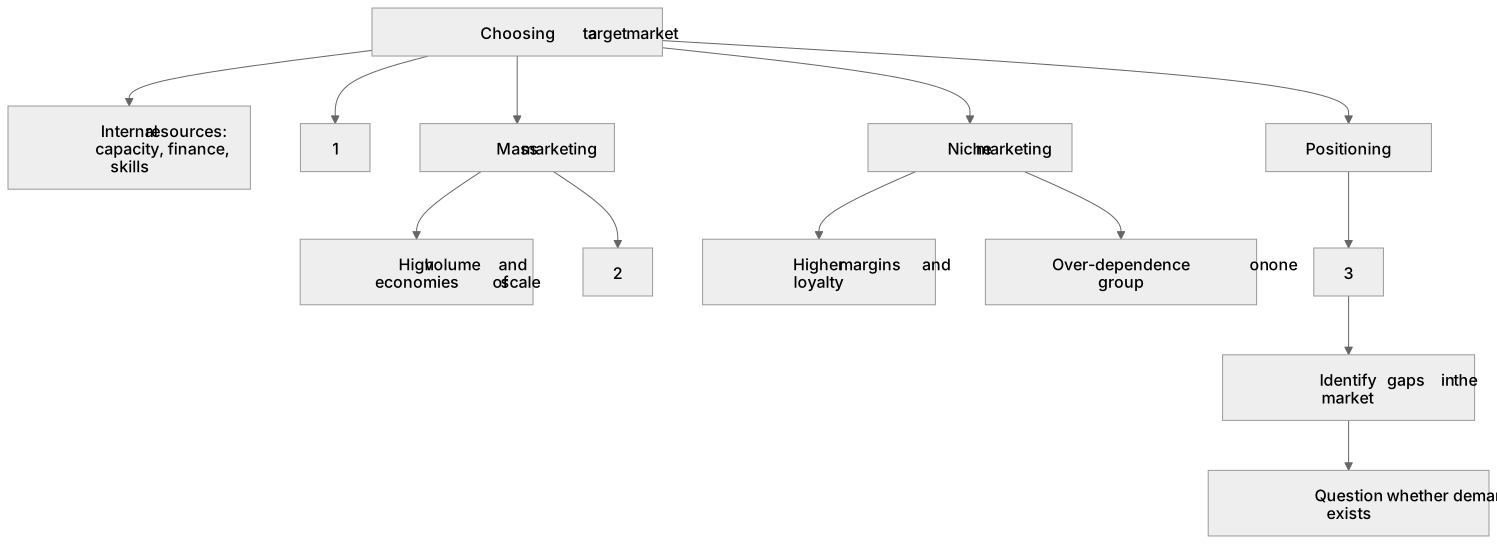
Targeting is selecting a consumer group to aim products at; positioning is creating a distinct brand identity in their minds. The decision balances internal resources (capacity, finance, skills) with external factors (market size, growth, competition). A firm can adopt a mass marketing approach, targeting a large market for high volume and economies of scale, but facing intense competition. Alternatively, niche marketing targets a small, specific segment. This can yield higher margins and loyalty but risks over-dependence on one group. Positioning is visualised using a market map, which plots rivals on two key attributes (e.g., price and quality). This helps identify gaps in the market, though a gap may exist simply because there is no demand for that particular combination of features.
What earns the marks
- Justifying the choice of target market by weighing the firm's own resources and capacity against the attractiveness (e.g., size, growth) of the segment.
- Setting out the trade-off of a niche strategy explicitly: higher margins and loyalty versus dependence on one group and the risk of a larger entrant.
- Reading or drawing a market map on two attributes buyers value, identifying a gap and then questioning whether demand exists to fill it.
- Linking the chosen position back to the rest of the marketing mix, so a premium position is supported by a high price and selective distribution.
Common mistakes and how to put them right
Treating every gap on a market map as an opportunity, when an empty space often means that combination has already been tried and failed.
Describing a niche strategy as simply 'selling less', missing that the higher margin per unit and customer loyalty are the reasons firms choose it.
Recommending a move to the mass market without checking whether the firm has the operational capacity or the finance to supply it.
Exam tips
- Case studies often provide a market map. The marks come from using its axes and the positions of rivals in your argument, rather than just describing the picture.
- Questions on targeting and positioning often end in 'recommend' or 'justify'. Commit to one choice and then evaluate it by considering the risks or what would have to be true for it to succeed.
Try the lesson
The start of the Making marketing decisions: segmentation, targeting, positioning: Influences on choosing a target market and positioning (to include: Targeting may include niche and mass marketing. Positioning should include market mapping.) lesson, made from teaching notes for this specification point.
Have a go first
Which term describes a business that sells to a small, clearly defined group of customers?
Listen
Targeting is selecting a consumer group to aim products at; positioning is creating a distinct brand identity in their minds. The decision balances internal resources (capacity, finance, skills) with external factors (market size, growth, competition). A firm can adopt a mass marketing approach, targeting a large market for high volume and economies of scale, but facing intense competition. Alternatively, niche marketing targets a small, specific segment. This can yield higher margins and loyalty but risks over-dependence on one group. Positioning is visualised using a market map, which plots rivals on two key attributes (e.g., price and quality). This helps identify gaps in the market, though a gap may exist simply because there is no demand for that particular combination of features. A strong answer earns marks for these points. Justifying the choice of target market by weighing the firm's own resources and capacity against the attractiveness (e.g., size, growth) of the segment. Setting out the trade-off of a niche strategy explicitly: higher margins and loyalty versus dependence on one group and the risk of a larger entrant. Reading or drawing a market map on two attributes buyers value, identifying a gap and then questioning whether demand exists to fill it. Linking the chosen position back to the rest of the marketing mix, so a premium position is supported by a high price and selective distribution. Exam tip: Case studies often provide a market map. The marks come from using its axes and the positions of rivals in your argument, rather than just describing the picture.
See it
Key words
Say what each word means before you turn the card.
niche marketing
Try answering aloud or in your head before turning the card.
mass marketing
Try answering aloud or in your head before turning the card.
market mapping
Try answering aloud or in your head before turning the card.
positioning
Try answering aloud or in your head before turning the card.
See every definition
- niche marketing
- Targeting a small, specific segment, which can yield higher margins and loyalty but risks over-dependence on one group.
- mass marketing
- Targeting a large market for high volume and economies of scale, but facing intense competition.
- market mapping
- Plotting rivals on two key attributes to visualise positioning and help identify gaps in the market.
- positioning
- Creating a distinct brand identity in the minds of a chosen consumer group.
Label the diagram
Some boxes have lost their names. Pick the right name for each number.
1Box 1
2Box 2
3Box 3
There is more to this lesson
The full lesson goes on to check your understanding and help you earn the marks. Create a free account to carry on, with your progress saved.
A week of Premium from your first lesson · Then the free plan continues · No card, no charge
Test your understanding of Making marketing decisions: segmentation, targeting, positioning: Influences on choosing a target market and positioning (to include: Targeting may include niche and mass marketing. Positioning should include market mapping.)
Active recall beats re-reading. Take an instant quiz now to test what you’ve learned and lock it into long-term memory.
A week of Premium from your first lesson · Then the free plan continues · No card, no charge