AQA · A-Level · Business
Course version: 7132 · Version from Sept 2023
Increasing efficiency and productivity: How to use technology to improve…
Full specification wording
Making operational decisions to improve performance: increasing efficiency and productivity: How to use technology to improve operational efficiency
This covers far more than robots on a production line: stock control that reads a till and reorders automatically, design software that removes a prototyping stage, warehouse systems that cut…
- Point 5 of 5
- 4 key terms
Study notes
From the teaching notes for this specification point.
The idea
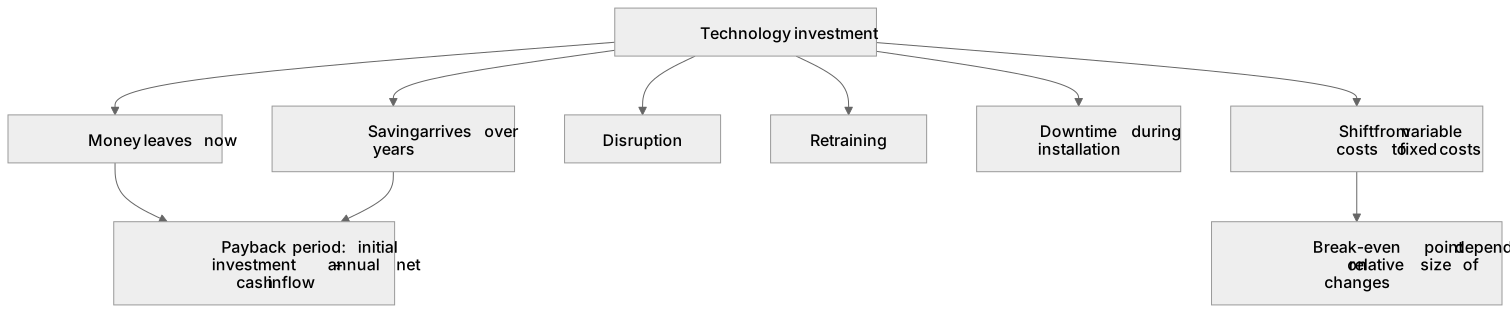
This covers far more than robots on a production line: stock control that reads a till and reorders automatically, design software that removes a prototyping stage, warehouse systems that cut picking time, and forecasting that stops a retailer marking down goods it should never have bought. The gain is usually consistency and speed as well as a lower cost per unit, since a machine does not tire or take holiday, and the data it throws off improves the next decision. The difficulty is that the money leaves now while the saving arrives over years, so the sensible test is payback period, the initial investment divided by the annual net cash inflow, set against the disruption, retraining and downtime the installation itself causes.
What earns the marks
- Naming a specific system and the specific operational problem it fixes at this firm, such as electronic point of sale data cutting stockouts, rather than technology improving efficiency in general.
- Quantifying the case where the data allows it, using payback period or average rate of return, which is average annual profit as a percentage of the initial investment.
- Dealing honestly with the workforce consequence, including retraining, redeployment, redundancy and the resistance that Kotter and Schlesinger would predict from staff who fear for their jobs.
Common mistakes and how to put them right
Listing technologies as a shopping list with no link to the process that is failing in the case study.
Treating the investment as costless once installed, ignoring maintenance, software licences, downtime during changeover and obsolescence within a few years.
Assuming every customer wants an automated service, when a firm competing on personal attention can destroy its own differentiation by removing people.
Exam tips
- These questions often supply an investment cost and an annual saving, which is an invitation to calculate payback and to say whether it beats the criterion the firm has stated.
- Evaluation marks come from the conditions you attach, such as whether demand is stable enough for the equipment to run at the utilisation the payback figure assumed.
- Where the stem mentions a competitor already using the system, frame the argument as competitiveness rather than pure cost saving.
Try the lesson
The start of the Making operational decisions to improve performance: increasing efficiency and productivity: How to use technology to improve operational efficiency lesson, made from teaching notes for this specification point.
Have a go first
Which use of technology most directly improves operational efficiency by raising output per unit of input?
Listen
This covers far more than robots on a production line: stock control that reads a till and reorders automatically, design software that removes a prototyping stage, warehouse systems that cut picking time, and forecasting that stops a retailer marking down goods it should never have bought. The gain is usually consistency and speed as well as a lower cost per unit, since a machine does not tire or take holiday, and the data it throws off improves the next decision. The difficulty is that the money leaves now while the saving arrives over years, so the sensible test is payback period, the initial investment divided by the annual net cash inflow, set against the disruption, retraining and downtime the installation itself causes. A strong answer earns marks for these points. Naming a specific system and the specific operational problem it fixes at this firm, such as electronic point of sale data cutting stockouts, rather than technology improving efficiency in general. Quantifying the case where the data allows it, using payback period or average rate of return, which is average annual profit as a percentage of the initial investment. Explaining the effect on the cost structure and break-even point. Investment in technology typically shifts costs from variable (e.g., wages) to fixed (e.g., depreciation). This raises fixed costs but can also lower variable costs per unit, increasing contribution. The overall effect on the break-even point (Fixed Costs ÷ Contribution per unit) depends on the relative size of these changes. Dealing honestly with the workforce consequence, including retraining, redeployment, redundancy and the resistance that Kotter and Schlesinger would predict from staff who fear for their jobs. Exam tip: These questions often supply an investment cost and an annual saving, which is an invitation to calculate payback and to say whether it beats the criterion the firm has stated.
See it
Key words
Say what each word means before you turn the card.
payback period
Try answering aloud or in your head before turning the card.
shift towards fixed costs
Try answering aloud or in your head before turning the card.
workforce retraining
Try answering aloud or in your head before turning the card.
average rate of return
Try answering aloud or in your head before turning the card.
See every definition
- payback period
- The initial investment divided by the annual net cash inflow, used as the sensible test of a technology investment.
- shift towards fixed costs
- Investment in technology typically shifts costs from variable, such as wages, to fixed, such as depreciation.
- workforce retraining
- A workforce consequence of installing technology, alongside redeployment, redundancy and the resistance staff who fear for their jobs may show.
- average rate of return
- Average annual profit as a percentage of the initial investment, used to quantify the case where the data allows it.
Label the diagram
Some boxes have lost their names. Pick the right name for each number.
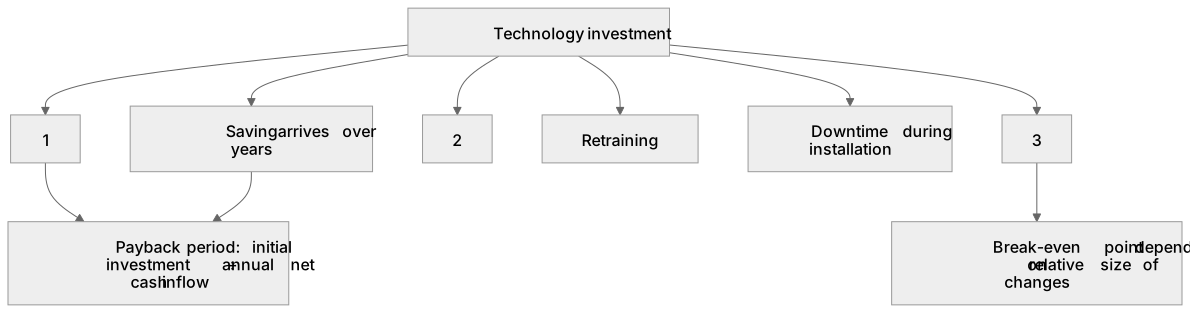
1Box 1
2Box 2
3Box 3
There is more to this lesson
The full lesson goes on to check your understanding and help you earn the marks. Create a free account to carry on, with your progress saved.
A week of Premium from your first lesson · Then the free plan continues · No card, no charge
Test your understanding of Making operational decisions to improve performance: increasing efficiency and productivity: How to use technology to improve operational efficiency
Active recall beats re-reading. Take an instant quiz now to test what you’ve learned and lock it into long-term memory.
A week of Premium from your first lesson · Then the free plan continues · No card, no charge