AQA · A-Level · Business
Course version: 7132 · Version from Sept 2023
Managing inventory and supply chains: How to manage supply to match demand…
Full specification wording
Making operational decisions to improve performance: managing inventory and supply chains: How to manage supply to match demand and the value of doing so (to include: Ways of matching supply to demand include: outsourcing, use of temporary and part time employees, producing to order.)
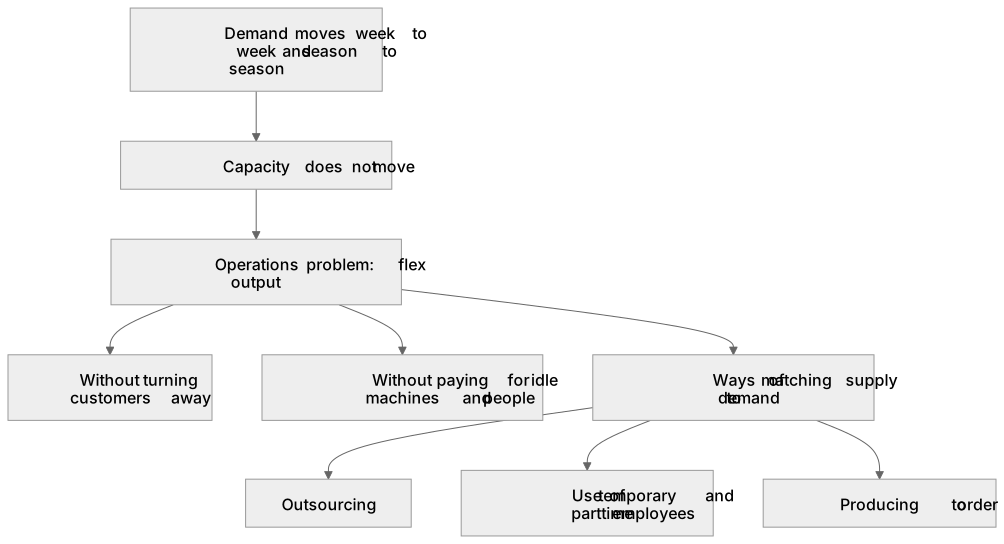
Demand for most products moves around, week to week and season to season, and capacity does not, so the operations problem is how to flex output without either turning customers away or paying for…
- Point 1 of 5
- 4 key terms
Study notes
From the teaching notes for this specification point.
The idea
Demand for most products moves around, week to week and season to season, and capacity does not, so the operations problem is how to flex output without either turning customers away or paying for machines and people that stand idle. Capacity utilisation, which is actual output divided by maximum possible output and then multiplied by one hundred to give a percentage, tells you which problem the firm has: at around sixty per cent it is spreading fixed costs over too little output and unit cost is climbing, while at a hundred per cent it has no slack for maintenance, sickness or a rush order and delivery reliability starts to slip. Each of the board named methods buys flexibility at a price, and naming that price is where the marks are.
What earns the marks
- Naming the method the business in the case actually uses, such as taking on temporary staff for a Christmas peak or subcontracting a production run, and then working through what it does to capacity utilisation.
- Calculating capacity utilisation as actual output divided by maximum possible output multiplied by one hundred, and presenting it as a percentage rather than leaving it as a decimal.
- Explaining the cost consequence in both directions, because under-utilisation raises fixed cost per unit while running flat out removes the slack needed for maintenance, absence cover and rush orders.
- Weighing a named drawback against the gain, for example that producing to order almost eliminates finished goods inventory but lengthens the wait the customer has to accept.
- Judging which method suits this firm by distinguishing a predictable seasonal peak, which temporary labour handles well, from a permanent rise in demand, which justifies investment in capacity.
Common mistakes and how to put them right
Treating full capacity as the goal, when a business running at full capacity cannot take an extra order, cannot service its machines and usually sees quality and delivery reliability fall.
Listing the three methods from the specification without applying any of them to the firm in the extract, which is the paragraph that scores in the lowest level.
Assuming temporary and part time employees cost the same per unit of output as permanent staff, ignoring recruitment, induction and the lower productivity of a worker in their first week.
Claiming producing to order removes all inventory, when the firm still has to hold raw materials and components to be able to start the job at all.
Exam tips
- Capacity utilisation is a favourite short calculate question and it is usually followed by an analyse question on how the firm should raise it, so have both the arithmetic and the consequences ready.
- In an assess or evaluate question the deciding factor is normally whether the change in demand is temporary or permanent, so say which you think it is for this firm and what would change your mind.
- Use the order and output figures printed in the extract; an answer that never touches the case data rarely reaches the top level even when the theory is correct.
Try the lesson
The start of the Making operational decisions to improve performance: managing inventory and supply chains: How to manage supply to match demand and the value of doing so (to include: Ways of matching supply to demand include: outsourcing, use of temporary and part time employees, producing to order.) lesson, made from teaching notes for this specification point.
Have a go first
Which method of matching supply to demand involves a business asking another business to make some of its products?
Listen
Demand for most products moves around, week to week and season to season, and capacity does not, so the operations problem is how to flex output without either turning customers away or paying for machines and people that stand idle. Capacity utilisation, which is actual output divided by maximum possible output and then multiplied by one hundred to give a percentage, tells you which problem the firm has: at around sixty per cent it is spreading fixed costs over too little output and unit cost is climbing, while at a hundred per cent it has no slack for maintenance, sickness or a rush order and delivery reliability starts to slip. Each of the board named methods buys flexibility at a price, and naming that price is where the marks are. A strong answer earns marks for these points. Naming the method the business in the case actually uses, such as taking on temporary staff for a Christmas peak or subcontracting a production run, and then working through what it does to capacity utilisation. Calculating capacity utilisation as actual output divided by maximum possible output multiplied by one hundred, and presenting it as a percentage rather than leaving it as a decimal. Explaining the cost consequence in both directions, because under-utilisation raises fixed cost per unit while running flat out removes the slack needed for maintenance, absence cover and rush orders. Weighing a named drawback against the gain, for example that producing to order almost eliminates finished goods inventory but lengthens the wait the customer has to accept. Exam tip: Capacity utilisation is a favourite short calculate question and it is usually followed by an analyse question on how the firm should raise it, so have both the arithmetic and the consequences ready.
See it
Key words
Say what each word means before you turn the card.
capacity utilisation
Try answering aloud or in your head before turning the card.
outsourcing
Try answering aloud or in your head before turning the card.
temporary and part time employees
Try answering aloud or in your head before turning the card.
producing to order
Try answering aloud or in your head before turning the card.
See every definition
- capacity utilisation
- Actual output divided by maximum possible output and then multiplied by one hundred to give a percentage, telling you which problem the firm has.
- outsourcing
- A way of matching supply to demand, buying flexibility at a price.
- temporary and part time employees
- A way of matching supply to demand, buying flexibility at a price.
- producing to order
- A way of matching supply to demand that almost eliminates finished goods inventory but lengthens the wait the customer has to accept.
Label the diagram
Some boxes have lost their names. Pick the right name for each number.
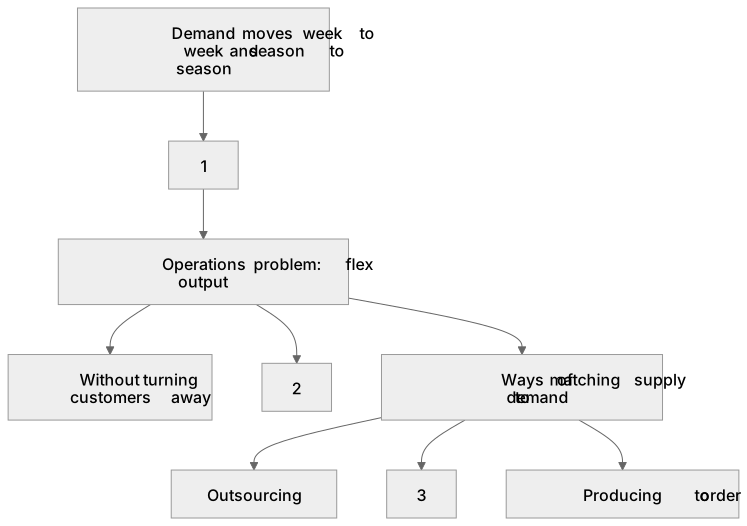
1Box 1
2Box 2
3Box 3
There is more to this lesson
The full lesson goes on to check your understanding and help you earn the marks. Create a free account to carry on, with your progress saved.
A week of Premium from your first lesson · Then the free plan continues · No card, no charge
Test your understanding of Making operational decisions to improve performance: managing inventory and supply chains: How to manage supply to match demand and the value of doing so (to include: Ways of matching supply to demand include: outsourcing, use of temporary and part time employees, producing to order.)
Active recall beats re-reading. Take an instant quiz now to test what you’ve learned and lock it into long-term memory.
A week of Premium from your first lesson · Then the free plan continues · No card, no charge