AQA · A-Level · Business
Course version: 7132 · Version from Sept 2023
The value of a flexible organisation (to include: Flexible organisations…
Full specification wording
Managing change: The value of a flexible organisation (to include: Flexible organisations include: restructuring, delayering, flexible employment contracts, organic structures v mechanistic, knowledge and information management.)
A flexible organisation adapts its structure, operations, and workforce to meet changing market demands.
- Point 3 of 6
- 4 key terms
Study notes
From the teaching notes for this specification point.
The idea
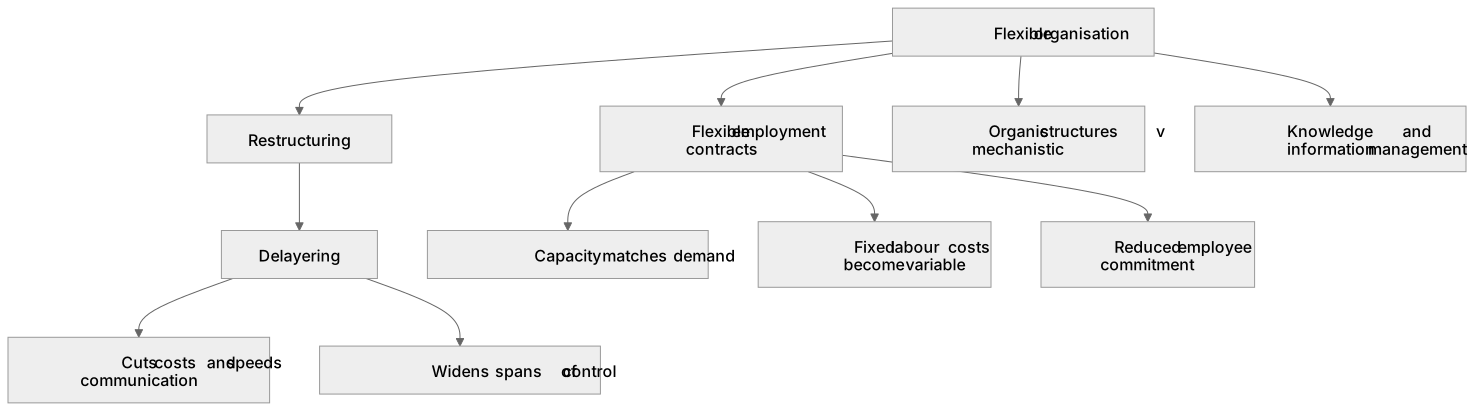
A flexible organisation adapts its structure, operations, and workforce to meet changing market demands. This involves restructuring, such as delayering to remove management tiers, which cuts costs and speeds communication but widens spans of control. Flexible workforce arrangements, including part-time/temporary contracts and outsourcing, allow capacity to match demand, turning fixed labour costs into variable ones but potentially reducing employee commitment. The choice of structure is key: organic structures with decentralised power suit dynamic markets, whereas mechanistic structures with clear hierarchies suit stable environments. Effective knowledge and information management underpins this, using systems to capture and share information so the business can learn and react quickly.
What earns the marks
- Linking a specific form of flexibility to the problem in the case, e.g., delayering to solve a cost/speed issue or flexible contracts for seasonal demand.
- Explaining the consequences of a structural change, such as delayering leading to wider spans of control and potential manager overload.
- Using data from a case study (e.g., labour turnover, unit costs) to evaluate whether a flexible model is proving successful.
- Explaining how a specific knowledge management system, like a customer relationship management (CRM) database, enables a firm to adapt its marketing mix more quickly.
Common mistakes and how to put them right
Confusing delayering (removing a management tier) with redundancy among operational staff.
Put it right: The former changes the hierarchy; the latter reduces production capacity.
Presenting flexible contracts as a purely cost-saving measure, ignoring potential downsides like reduced employee commitment, higher turnover, and inconsistent service quality.
Stating that organic structures are inherently superior, without recognising that mechanistic structures are often more efficient for businesses in stable markets with standardised production.
Exam tips
- When presented with an organisation chart and data (e.g., labour turnover), use both to build your argument. The chart shows the structure (spans of control, layers), while the data reveals the human and financial consequences.
- For 'recommend' questions, justify your choice of one flexibility method over others for the specific business in the case. This comparative analysis demonstrates higher-level evaluation skills.
Try the lesson
The start of the Managing change: The value of a flexible organisation (to include: Flexible organisations include: restructuring, delayering, flexible employment contracts, organic structures v mechanistic, knowledge and information management.) lesson, made from teaching notes for this specification point.
Have a go first
What is meant by delayering in a flexible organisation?
Listen
A flexible organisation adapts its structure, operations, and workforce to meet changing market demands. This involves restructuring, such as delayering to remove management tiers, which cuts costs and speeds communication but widens spans of control. Flexible workforce arrangements, including part-time/temporary contracts and outsourcing, allow capacity to match demand, turning fixed labour costs into variable ones but potentially reducing employee commitment. The choice of structure is key: organic structures with decentralised power suit dynamic markets, whereas mechanistic structures with clear hierarchies suit stable environments. Effective knowledge and information management underpins this, using systems to capture and share information so the business can learn and react quickly. A strong answer earns marks for these points. Linking a specific form of flexibility to the problem in the case, e.g., delayering to solve a cost/speed issue or flexible contracts for seasonal demand. Explaining the consequences of a structural change, such as delayering leading to wider spans of control and potential manager overload. Using data from a case study (e.g., labour turnover, unit costs) to evaluate whether a flexible model is proving successful. Explaining how a specific knowledge management system, like a customer relationship management (CRM) database, enables a firm to adapt its marketing mix more quickly. Exam tip: When presented with an organisation chart and data (e.g., labour turnover), use both to build your argument. The chart shows the structure (spans of control, layers), while the data reveals the human and financial consequences.
See it
Key words
Say what each word means before you turn the card.
Delayering
Try answering aloud or in your head before turning the card.
Flexible employment contracts
Try answering aloud or in your head before turning the card.
Organic structures
Try answering aloud or in your head before turning the card.
Mechanistic structures
Try answering aloud or in your head before turning the card.
See every definition
- Delayering
- Removing a management tier, which cuts costs and speeds communication but widens spans of control.
- Flexible employment contracts
- Part-time or temporary contracts and outsourcing that allow capacity to match demand, turning fixed labour costs into variable ones but potentially reducing employee commitment.
- Organic structures
- Structures with decentralised power that suit dynamic markets.
- Mechanistic structures
- Structures with clear hierarchies that suit stable environments.
Label the diagram
Some boxes have lost their names. Pick the right name for each number.
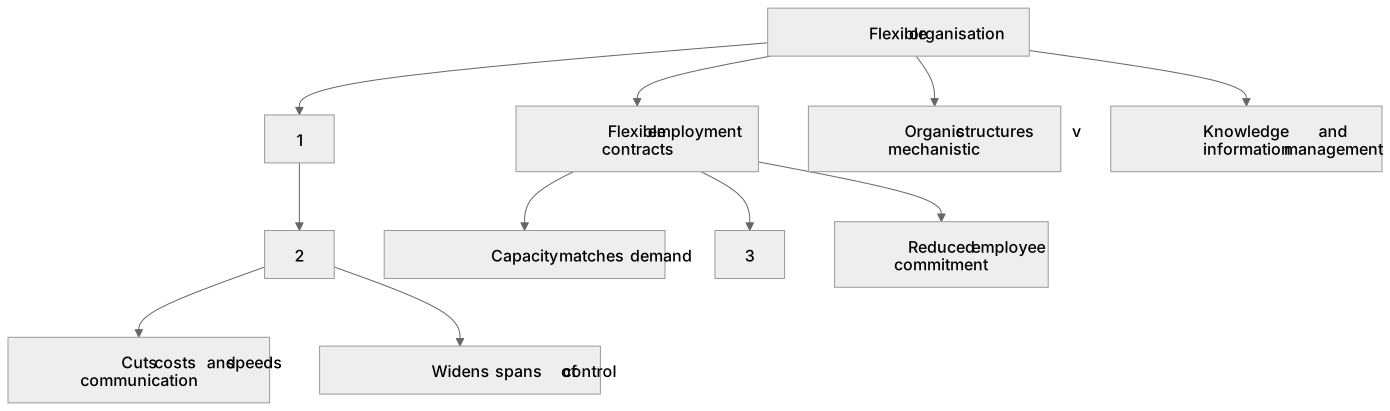
1Box 1
2Box 2
3Box 3
There is more to this lesson
The full lesson goes on to check your understanding and help you earn the marks. Create a free account to carry on, with your progress saved.
A week of Premium from your first lesson · Then the free plan continues · No card, no charge
Test your understanding of Managing change: The value of a flexible organisation (to include: Flexible organisations include: restructuring, delayering, flexible employment contracts, organic structures v mechanistic, knowledge and information management.)
Active recall beats re-reading. Take an instant quiz now to test what you’ve learned and lock it into long-term memory.
A week of Premium from your first lesson · Then the free plan continues · No card, no charge