AQA · A-Level · Business
Course version: 7132 · Version from Sept 2023
How to implement strategy effectively (to include: Implementing strategy…
Full specification wording
Managing strategic implementation: How to implement strategy effectively (to include: Implementing strategy effectively to include: the value of leadership in strategic implementation, the value of communications in strategic implementation.)
This is the unglamorous half where most strategies die: turning a decision into budgets, deadlines, job changes and a sequence of tasks that somebody owns by name.
- Point 1 of 3
- 4 key terms
Study notes
From the teaching notes for this specification point.
The idea
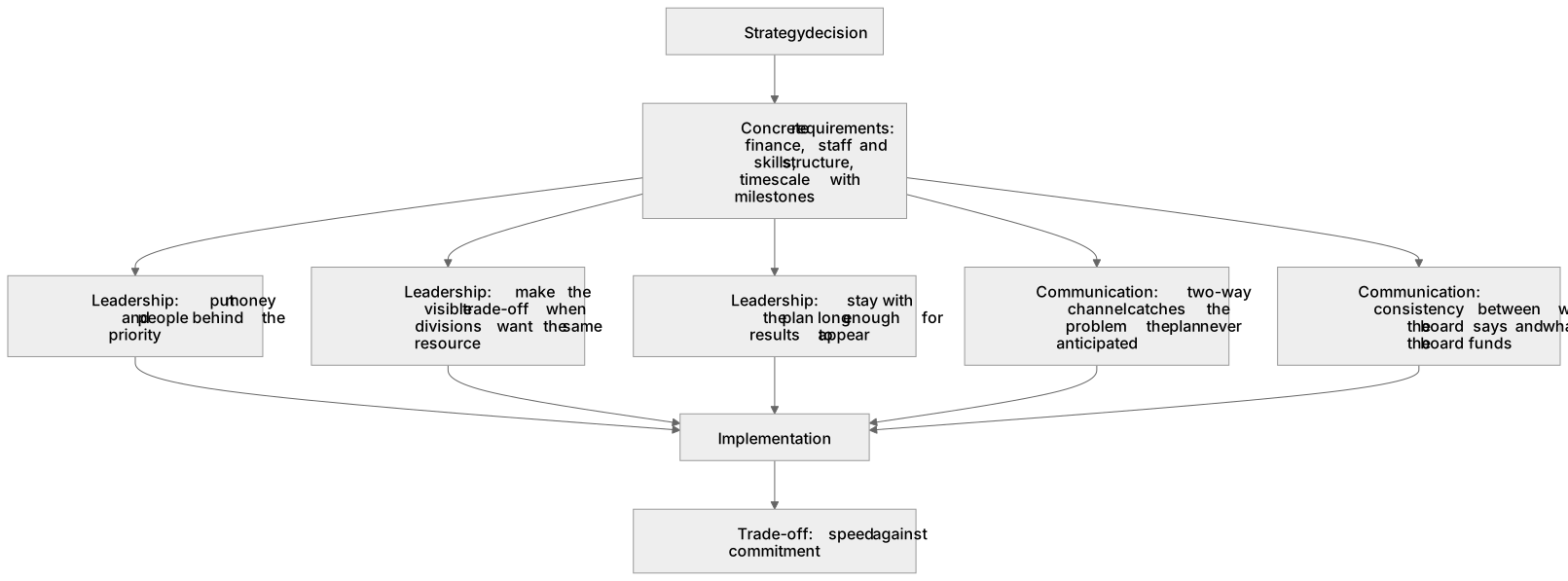
This is the unglamorous half where most strategies die: turning a decision into budgets, deadlines, job changes and a sequence of tasks that somebody owns by name. Leadership matters here less as charisma than as three concrete acts, putting money and people behind the priority instead of spreading both thinly, making the visible trade-off when two divisions want the same resource, and staying with the plan long enough for results to appear. Communication matters because staff act on the reason, not the memo: a two way channel catches the problem the plan never anticipated, and consistency between what the board says and what the board funds is what employees actually read. The trade-off to carry into evaluation is speed against commitment, since driving it from the top is quick and breeds compliance, while consultation is slow and sticks.
What earns the marks
- Turning the strategy in the case into concrete requirements: the finance needed, the staff and skills, the changes to structure, and a timescale with milestones.
- Explaining the leadership act specifically, such as the chief executive reallocating the capital budget away from the legacy division, rather than describing good leadership in the abstract.
- Showing what weak communication would cost in this particular business, for example a sales force still selling the old range while the factory has retooled for the new one.
- Judging implementation against a measurable target from the case, such as the promised cost saving, the launch date, or the return on capital employed the board committed to.
Common mistakes and how to put them right
Rewriting the strategic choice instead of answering how it is delivered, so the answer never reaches resources, sequence or responsibility.
Treating communication as telling staff what has been decided, when the marks are in feedback, timing, and consistency between the message and what is rewarded.
Assuming a charismatic leader guarantees success while ignoring the finance and the capacity, which is usually where the plan actually fails.
Exam tips
- The case study paper gives appendices, often a cash flow forecast or a staffing table, so use them to show the plan is deliverable rather than merely desirable.
- Evaluate questions reward a condition, so state what would have to be true, funding secured, key staff retained, suppliers able to scale, for the implementation to succeed.
Try the lesson
The start of the Managing strategic implementation: How to implement strategy effectively (to include: Implementing strategy effectively to include: the value of leadership in strategic implementation, the value of communications in strategic implementation.) lesson, made from teaching notes for this specification point.
Have a go first
What is the main purpose of leadership when a business implements a new strategy?
Listen
This is the unglamorous half where most strategies die: turning a decision into budgets, deadlines, job changes and a sequence of tasks that somebody owns by name. Leadership matters here less as charisma than as three concrete acts, putting money and people behind the priority instead of spreading both thinly, making the visible trade-off when two divisions want the same resource, and staying with the plan long enough for results to appear. Communication matters because staff act on the reason, not the memo: a two way channel catches the problem the plan never anticipated, and consistency between what the board says and what the board funds is what employees actually read. The trade-off to carry into evaluation is speed against commitment, since driving it from the top is quick and breeds compliance, while consultation is slow and sticks. A strong answer earns marks for these points. Turning the strategy in the case into concrete requirements: the finance needed, the staff and skills, the changes to structure, and a timescale with milestones. Explaining the leadership act specifically, such as the chief executive reallocating the capital budget away from the legacy division, rather than describing good leadership in the abstract. Showing what weak communication would cost in this particular business, for example a sales force still selling the old range while the factory has retooled for the new one. Judging implementation against a measurable target from the case, such as the promised cost saving, the launch date, or the return on capital employed the board committed to. Exam tip: The case study paper gives appendices, often a cash flow forecast or a staffing table, so use them to show the plan is deliverable rather than merely desirable.
See it
Key words
Say what each word means before you turn the card.
leadership commitment
Try answering aloud or in your head before turning the card.
two way communication
Try answering aloud or in your head before turning the card.
speed versus buy-in
Try answering aloud or in your head before turning the card.
milestones and review
Try answering aloud or in your head before turning the card.
See every definition
- leadership commitment
- Putting money and people behind the priority instead of spreading both thinly, making the visible trade-off when two divisions want the same resource, and staying with the plan long enough for results to appear.
- two way communication
- A channel that catches the problem the plan never anticipated, since staff act on the reason rather than the memo.
- speed versus buy-in
- The trade-off where driving it from the top is quick and breeds compliance, while consultation is slow and sticks.
- milestones and review
- A timescale with milestones forming part of the concrete requirements the strategy is turned into.
Label the diagram
Some boxes have lost their names. Pick the right name for each number.
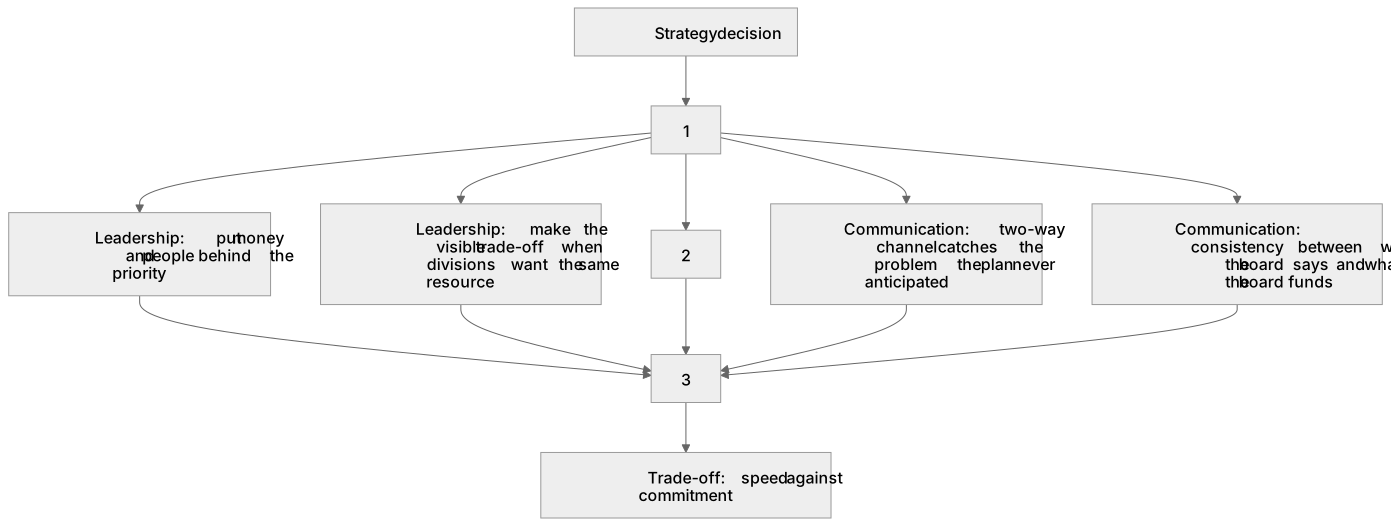
1Box 1
2Box 2
3Box 3
There is more to this lesson
The full lesson goes on to check your understanding and help you earn the marks. Create a free account to carry on, with your progress saved.
A week of Premium from your first lesson · Then the free plan continues · No card, no charge
Test your understanding of Managing strategic implementation: How to implement strategy effectively (to include: Implementing strategy effectively to include: the value of leadership in strategic implementation, the value of communications in strategic implementation.)
Active recall beats re-reading. Take an instant quiz now to test what you’ve learned and lock it into long-term memory.
A week of Premium from your first lesson · Then the free plan continues · No card, no charge