AQA · A-Level · Business
Course version: 7132 · Version from Sept 2023
Students should consider the following throughout this section of the…
Full specification wording
Marketing management: Students should consider the following throughout this section of the specification:
This row lists the lenses AQA expects you to apply throughout marketing management.
- 4 key terms
Study notes
From the teaching notes for this specification point.
The idea
This row lists the lenses AQA expects you to apply throughout marketing management. They are a planning checklist, not a topic to revise alone. The lenses are: the importance of marketing to a business; the impact of technology on marketing, which can cut costs and widen reach but also demands investment and can expose a firm to new rivals; ethical and environmental influences, which may be positive (a premium for sustainable sourcing) or negative (higher costs, reputational risk); the state of the market and the strength of rivals; and whether finance, operations and human resources can deliver what marketing promises. Treat them as sources of application and judgement. In an extended answer, one lens is usually enough if it is developed on the named business, because a paragraph that runs a single chain to a consequence is stronger than five lenses named in a list.
What earns the marks
- Choosing one lens that genuinely bites on the case, such as a market in decline or a rival with deeper pockets, and building the argument around it.
- Carrying the reasoning through to a business consequence, for example on margin, market share or cash flow, rather than stopping at an observation.
- Explaining why marketing matters to the business in the case, for example by linking it to brand loyalty, repeat purchase or the ability to charge a premium.
- Using case evidence and figures as the basis for the judgement rather than general knowledge about markets.
- Showing that technology and ethics can cut both ways, for example online selling lowering distribution cost while raising the cost of returns and data protection.
Common mistakes and how to put them right
Answering marketing questions in a vacuum, as though price and promotion were decided without reference to rivals, costs or capacity.
Put it right: Anchor each decision to the case's market conditions and to another function's constraint.
Naming all five themes in an introduction and then abandoning them, which pads the answer without adding analysis.
Put it right: Develop one or two lenses in depth instead of listing all five.
Assuming technology and ethics are always an advantage, when technology can cut costs but also demands investment, and ethical sourcing can raise costs while appealing to some consumers.
Put it right: State the direction of the effect and the condition under which it holds.
Writing about marketing theory in general when the question names a firm and a decision.
Put it right: Apply each point to the named business and its decision, using the case evidence.
Exam tips
- Marketing content is examined on Paper 1 and the synoptic Paper 3; Paper 2 assesses 3.7 to 3.10, so check which paper you are sitting.
- Before writing, ask what has changed in this market recently, because the extracts almost always plant one such change for you to use.
- For assess and evaluate, put the constraint from another function in the counter argument paragraph; it is the quickest way to a genuine judgement.
- Keep the definition to a clause and spend the words on application, since marks for defining marketing terms are few.
Try the lesson
The start of the Marketing management: Students should consider the following throughout this section of the specification: lesson, made from teaching notes for this specification point.
Have a go first
Which of the following best describes the purpose of marketing management within a business?
Listen
This row lists the lenses AQA expects you to apply throughout marketing management. They are a planning checklist, not a topic to revise alone. The lenses are: the importance of marketing to a business; the impact of technology on marketing, which can cut costs and widen reach but also demands investment and can expose a firm to new rivals; ethical and environmental influences, which may be positive (a premium for sustainable sourcing) or negative (higher costs, reputational risk); the state of the market and the strength of rivals; and whether finance, operations and human resources can deliver what marketing promises. Treat them as sources of application and judgement. In an extended answer, one lens is usually enough if it is developed on the named business, because a paragraph that runs a single chain to a consequence is stronger than five lenses named in a list. A strong answer earns marks for these points. Choosing one lens that genuinely bites on the case, such as a market in decline or a rival with deeper pockets, and building the argument around it. Carrying the reasoning through to a business consequence, for example on margin, market share or cash flow, rather than stopping at an observation. Checking a marketing proposal against another function, which shows the interdependence the specification asks for throughout. Explaining why marketing matters to the business in the case, for example by linking it to brand loyalty, repeat purchase or the ability to charge a premium. A common slip: Answering marketing questions in a vacuum, as though price and promotion were decided without reference to rivals, costs or capacity. Instead, Anchor each decision to the case's market conditions and to another function's constraint. Exam tip: Marketing content is examined on Paper 1 and the synoptic Paper 3; Paper 2 assesses 3.7 to 3.10, so check which paper you are sitting.
See it

Key words
Say what each word means before you turn the card.
Importance of marketing to a business
Try answering aloud or in your head before turning the card.
Functional interdependence
Try answering aloud or in your head before turning the card.
Application to a named business
Try answering aloud or in your head before turning the card.
Recurring marketing themes
Try answering aloud or in your head before turning the card.
See every definition
- Importance of marketing to a business
- A lens linking marketing to brand loyalty, repeat purchase or the ability to charge a premium.
- Functional interdependence
- Checking a marketing proposal against another function, such as whether finance, operations and human resources can deliver what marketing promises.
- Application to a named business
- Developing one lens on the named business, carrying a single chain of reasoning through to a business consequence.
- Recurring marketing themes
- A planning checklist of lenses AQA expects you to apply throughout marketing management, not a topic to revise alone.
Label the diagram
Some boxes have lost their names. Pick the right name for each number.
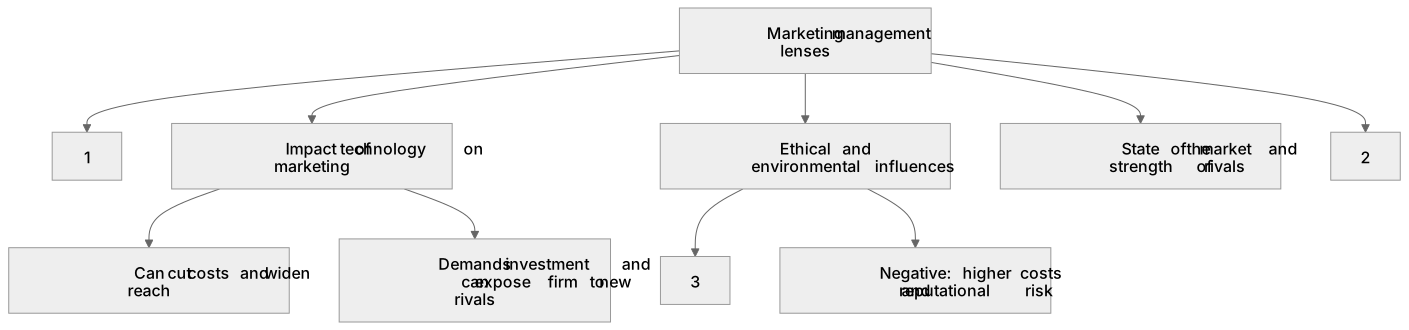
1Box 1
2Box 2
3Box 3
There is more to this lesson
The full lesson goes on to check your understanding and help you earn the marks. Create a free account to carry on, with your progress saved.
A week of Premium from your first lesson · Then the free plan continues · No card, no charge
Test your understanding of Marketing management: Students should consider the following throughout this section of the specification:
Active recall beats re-reading. Take an instant quiz now to test what you’ve learned and lock it into long-term memory.
A week of Premium from your first lesson · Then the free plan continues · No card, no charge