AQA · A-Level · Business
Course version: 7132 · Version from Sept 2023
The value of SWOT analysis
Full specification wording
Mission, corporate objectives, functional objectives and strategy: The value of SWOT analysis
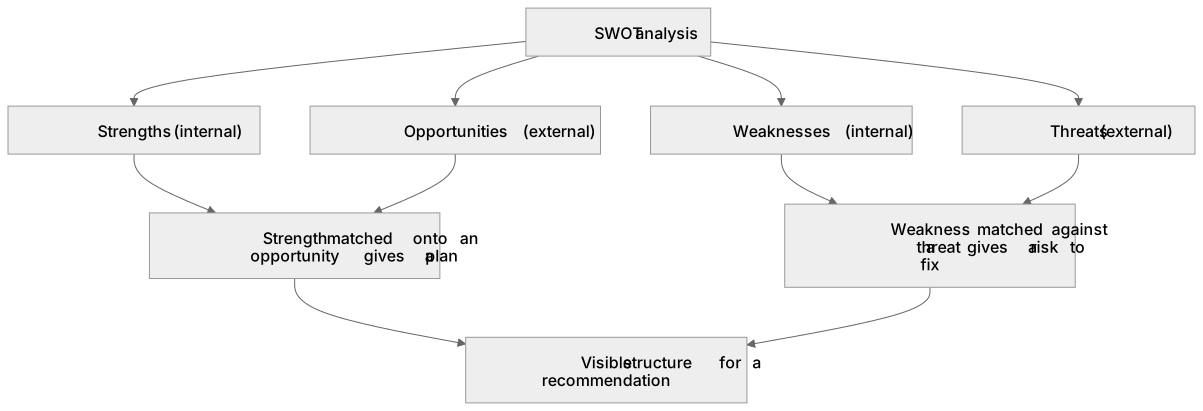
Sorting what a firm is good and bad at internally against what the outside world is offering and threatening only pays if the four boxes are then matched: a strength onto an opportunity to give a…
- Point 7 of 7
- 3 key terms
Study notes
From the teaching notes for this specification point.
The idea
Sorting what a firm is good and bad at internally against what the outside world is offering and threatening only pays if the four boxes are then matched: a strength onto an opportunity to give a plan, a weakness against a threat to give a risk to fix. Its merits are speed, low cost, forcing managers to look outward, and giving a visible structure for a recommendation. What it cannot see is weight and probability, so one fatal threat and ten trivial opportunities look identical in a list; it demands no evidence; and the same fact can sit in two boxes, since a strong premium brand is a strength that also blocks a move into budget ranges. Being a snapshot, it should be paired with ratio analysis and with Porter's five forces before anyone acts on it.
What earns the marks
- Placing items in the right box for the right reason, keeping strengths and weaknesses internal and controllable, and opportunities and threats external.
- Matching across the boxes, so the answer produces a course of action from a strength meeting an opportunity rather than four lists.
- Weighing the entries, saying which threat is most likely and most damaging, because a list with no weighting cannot support a decision.
- Arguing the limits, that it is static, subjective, only as good as the information behind it, and silent on whether the firm can afford to act.
Common mistakes and how to put them right
Putting a rival's new product under weaknesses, or the firm's own falling margin under threats, which destroys the internal and external split the tool exists for.
Producing four lists and stopping, with no decision drawn from them, which is exactly what a question about value is testing.
Padding the boxes with items not in the case, so the analysis describes businesses in general.
Exam tips
- A question about value wants both sides, so plan two merits and two limitations and reach a verdict on this business rather than on the tool in the abstract.
- Where there are financial appendices, evidence the internal half with a ratio, for example a current ratio below one, so the weakness is proved rather than asserted.
Try the lesson
The start of the Mission, corporate objectives, functional objectives and strategy: The value of SWOT analysis lesson, made from teaching notes for this specification point.
Have a go first
What does the letter S stand for in the SWOT analysis model?
Listen
Sorting what a firm is good and bad at internally against what the outside world is offering and threatening only pays if the four boxes are then matched: a strength onto an opportunity to give a plan, a weakness against a threat to give a risk to fix. Its merits are speed, low cost, forcing managers to look outward, and giving a visible structure for a recommendation. What it cannot see is weight and probability, so one fatal threat and ten trivial opportunities look identical in a list; it demands no evidence; and the same fact can sit in two boxes, since a strong premium brand is a strength that also blocks a move into budget ranges. Being a snapshot, it should be paired with ratio analysis and with Porter's five forces before anyone acts on it. A strong answer earns marks for these points. Placing items in the right box for the right reason, keeping strengths and weaknesses internal and controllable, and opportunities and threats external. Matching across the boxes, so the answer produces a course of action from a strength meeting an opportunity rather than four lists. Weighing the entries, saying which threat is most likely and most damaging, because a list with no weighting cannot support a decision. Arguing the limits, that it is static, subjective, only as good as the information behind it, and silent on whether the firm can afford to act. Exam tip: A question about value wants both sides, so plan two merits and two limitations and reach a verdict on this business rather than on the tool in the abstract.
See it
Key words
Say what each word means before you turn the card.
matching strategy
Try answering aloud or in your head before turning the card.
weighting and evidence
Try answering aloud or in your head before turning the card.
limits of models
Try answering aloud or in your head before turning the card.
See every definition
- matching strategy
- Pairing a strength with an opportunity to give a plan, or a weakness with a threat to give a risk to fix, rather than leaving four separate lists.
- weighting and evidence
- What SWOT cannot see, since one fatal threat and ten trivial opportunities look identical in a list and no evidence is demanded.
- limits of models
- Being a snapshot, it is static, subjective, only as good as the information behind it, and silent on whether the firm can afford to act.
Label the diagram
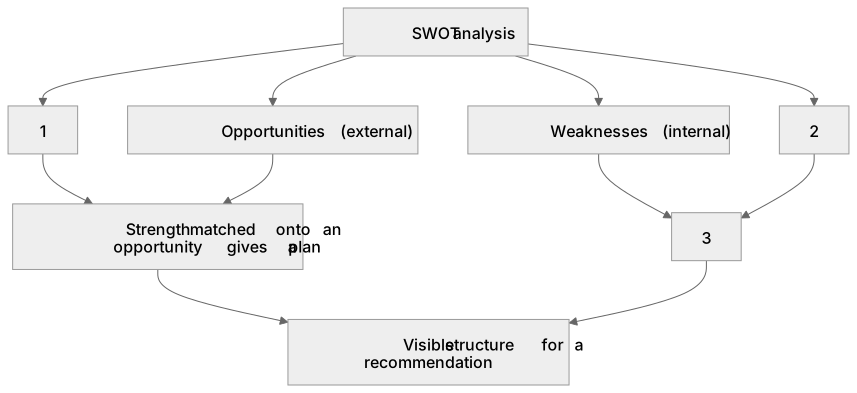
Some boxes have lost their names. Pick the right name for each number.
1Box 1
2Box 2
3Box 3
There is more to this lesson
The full lesson goes on to check your understanding and help you earn the marks. Create a free account to carry on, with your progress saved.
A week of Premium from your first lesson · Then the free plan continues · No card, no charge
Test your understanding of Mission, corporate objectives, functional objectives and strategy: The value of SWOT analysis
Active recall beats re-reading. Take an instant quiz now to test what you’ve learned and lock it into long-term memory.
A week of Premium from your first lesson · Then the free plan continues · No card, no charge