AQA · A-Level · Business
Course version: 7132 · Version from Sept 2023
Methods of achieving human resource objectives (to include: Methods should…
Full specification wording
Setting human resource objectives: Methods of achieving human resource objectives (to include: Methods should include soft and hard human resource management (HRM) approaches.)
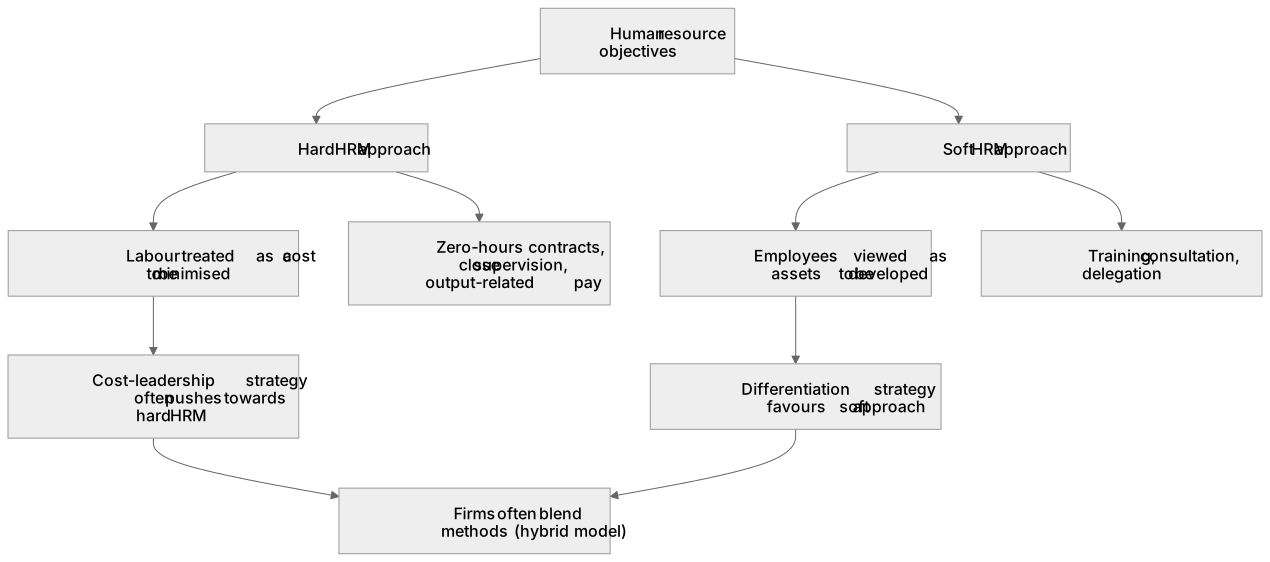
Hard HRM treats labour as a cost to be minimised, using methods like zero-hours contracts, close supervision, and output-related pay, reflecting Taylor's scientific management.
- Point 2 of 2
- 2 key terms
Study notes
From the teaching notes for this specification point.
The idea
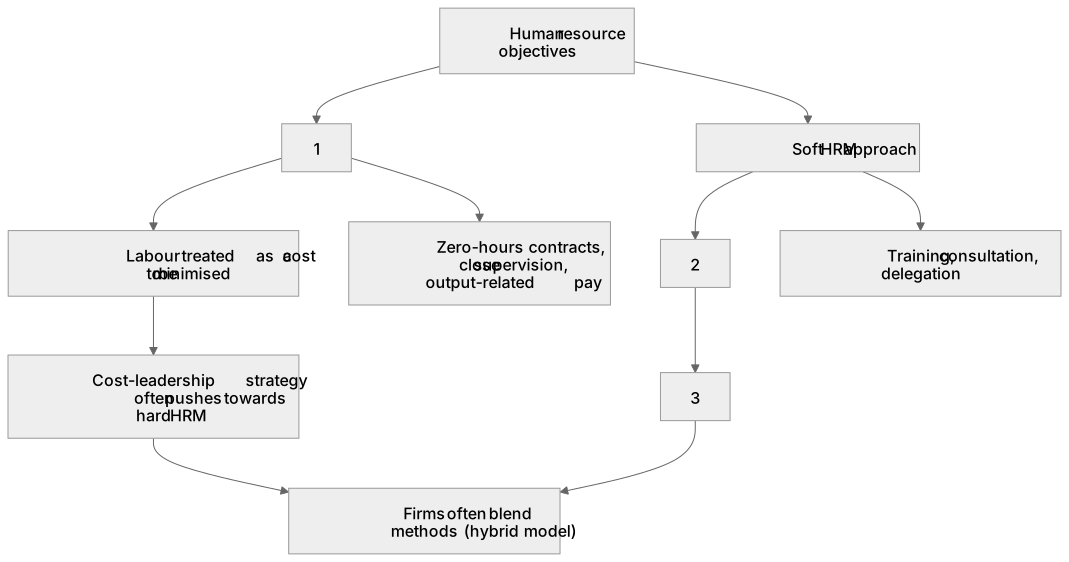
Hard HRM treats labour as a cost to be minimised, using methods like zero-hours contracts, close supervision, and output-related pay, reflecting Taylor's scientific management. In contrast, soft HRM views employees as assets to be developed, investing in training, consultation, and delegation, aligning with theorists like Herzberg and Mayo. The choice is strategic, not simply moral. A cost-leadership strategy often pushes a firm towards hard HRM, while a differentiation strategy, reliant on expertise, favours a soft approach. However, firms often blend methods. For instance, a low-cost business might offer above-average pay (a soft element) to reduce costly staff turnover, applying a soft tactic for a hard financial reason. Many firms use a hybrid model, and exam answers should assess the appropriateness of this mix for achieving specific objectives.
What earns the marks
- Defining the approach through what the firm actually does, such as using agency staff at peak and cutting hours in a downturn, rather than repeating the words asset and cost.
- Linking the method to competitive strategy, so cost leadership in Porter's terms pushes towards hard methods and differentiation towards soft ones.
- Supporting a soft method with a theorist used properly, for example Herzberg's argument that responsibility and achievement motivate while pay only removes dissatisfaction.
- Quantifying the trade-off where the case allows it, showing what the recruitment and induction cost of replacing leavers does to the saving made on wages.
- Reaching a judgement about fit, since the approach that works in a call centre may not work in a design studio.
- Explaining how a hybrid mix can serve a single objective, for example paying above the market to cut turnover while still using flexible contracts at peak.
Common mistakes and how to put them right
Presenting the hard approach as simply bad, when a seasonal business with unpredictable demand may have no realistic alternative to flexible contracts.
Put it right: Judge the approach against the firm's demand pattern and objectives rather than against a moral standard.
Treating the two as a switch rather than a spectrum, so the answer misses that many firms use soft methods for core staff and hard ones at the margin.
Put it right: Describe the mix and explain why different groups of staff are treated differently.
Naming Maslow or Herzberg and then never using the theory.
Put it right: Apply the theory to the case, for example using Herzberg to explain why added responsibility may motivate more than a small pay rise.
Assuming training automatically raises productivity, when trained staff are also the easiest for a rival to poach.
Put it right: Weigh the productivity gain against the risk of losing trained staff and the cost of replacing them.
Exam tips
- Questions here usually give a firm under cost pressure and ask you to assess a change of approach, so decide early which competitive strategy the business follows and argue from that.
- Analyse marks come from a chain: the method, its effect on staff, the effect on productivity or leaving rates, then the effect on the objective named in the question.
- Leave room for the counter argument, because an evaluate answer that gives only one side is unlikely to reach the top levels however well it is written.
Try the lesson
The start of the Setting human resource objectives: Methods of achieving human resource objectives (to include: Methods should include soft and hard human resource management (HRM) approaches.) lesson, made from teaching notes for this specification point.
Have a go first
Which of the following is a method of achieving human resource objectives that is associated with a soft HRM approach?
Listen
Hard HRM treats labour as a cost to be minimised, using methods like zero-hours contracts, close supervision, and output-related pay, reflecting Taylor's scientific management. In contrast, soft HRM views employees as assets to be developed, investing in training, consultation, and delegation, aligning with theorists like Herzberg and Mayo. The choice is strategic, not simply moral. A cost-leadership strategy often pushes a firm towards hard HRM, while a differentiation strategy, reliant on expertise, favours a soft approach. However, firms often blend methods. For instance, a low-cost business might offer above-average pay (a soft element) to reduce costly staff turnover, applying a soft tactic for a hard financial reason. Many firms use a hybrid model, and exam answers should assess the appropriateness of this mix for achieving specific objectives. A strong answer earns marks for these points. Defining the approach through what the firm actually does, such as using agency staff at peak and cutting hours in a downturn, rather than repeating the words asset and cost. Linking the method to competitive strategy, so cost leadership in Porter's terms pushes towards hard methods and differentiation towards soft ones. Supporting a soft method with a theorist used properly, for example Herzberg's argument that responsibility and achievement motivate while pay only removes dissatisfaction. Quantifying the trade-off where the case allows it, showing what the recruitment and induction cost of replacing leavers does to the saving made on wages. A common slip: Presenting the hard approach as simply bad, when a seasonal business with unpredictable demand may have no realistic alternative to flexible contracts. Instead, Judge the approach against the firm's demand pattern and objectives rather than against a moral standard. Exam tip: Questions here usually give a firm under cost pressure and ask you to assess a change of approach, so decide early which competitive strategy the business follows and argue from that.
See it
Key words
Say what each word means before you turn the card.
hard human resource management
Try answering aloud or in your head before turning the card.
soft human resource management
Try answering aloud or in your head before turning the card.
See every definition
- hard human resource management
- Treats labour as a cost to be minimised, using methods like zero-hours contracts, close supervision, and output-related pay.
- soft human resource management
- Views employees as assets to be developed, investing in training, consultation, and delegation.
Label the diagram
Some boxes have lost their names. Pick the right name for each number.
1Box 1
2Box 2
3Box 3
There is more to this lesson
The full lesson goes on to check your understanding and help you earn the marks. Create a free account to carry on, with your progress saved.
A week of Premium from your first lesson · Then the free plan continues · No card, no charge
Test your understanding of Setting human resource objectives: Methods of achieving human resource objectives (to include: Methods should include soft and hard human resource management (HRM) approaches.)
Active recall beats re-reading. Take an instant quiz now to test what you’ve learned and lock it into long-term memory.
A week of Premium from your first lesson · Then the free plan continues · No card, no charge