AQA · A-Level · Business
Course version: 7132 · Version from Sept 2023
The value of setting marketing objectives (to include: Marketing…
Full specification wording
Setting marketing objectives: The value of setting marketing objectives (to include: Marketing objectives include: sales volume and sales value, market size, market and sales growth, market share, brand loyalty.)
Targets turn a corporate aim into something the marketing department can be held to, direct effort, justify a budget and give a yardstick for control, and each named target measures something…
- 4 key terms
Study notes
From the teaching notes for this specification point.
The idea
Targets turn a corporate aim into something the marketing department can be held to, direct effort, justify a budget and give a yardstick for control, and each named target measures something different. Volume counts units while value counts revenue, so a firm can sell more and earn less if it has discounted to do it. Market size sets the ceiling, growth shows whether the tide is rising, and share, the firm's sales divided by total market sales, times one hundred, strips the tide out and shows performance against rivals, which is why share can rise while sales fall. Brand loyalty shows up as repeat purchase and retention rates, and it protects future revenue. The trade-off is that a target distorts behaviour, since a share target met by deep discounting destroys margin, and objectives written for stable conditions need reviewing when the market turns.
What earns the marks
- Making the targets measurable in this firm's terms, with a figure and a deadline, rather than describing them as increasing sales.
- Separating volume from value, and using the difference to explain how a discounting strategy can flatter one and damage the other.
- Calculating or interpreting market share correctly as the firm's sales against the whole market, and distinguishing it from sales growth.
- Showing how the objective guides the marketing mix and the budget, which is the value the question is really asking about.
- Evaluating the risk that a single target distorts behaviour, and saying which objective fits this firm's position and market conditions best.
Common mistakes and how to put them right
Treating sales growth and market share growth as the same, when a firm can grow sales and still lose share in a faster growing market.
Quoting a target with no number or timescale, so it cannot be used for control and earns little credit.
Assuming brand loyalty is simply a good thing without connecting it to repeat purchase, lower promotion spend or a price premium.
Listing the objectives from the specification without saying which one this business should choose and why.
Exam tips
- Expect a calculation, most often market share or percentage growth, followed by a question asking what the result means for the objectives that were set.
- Check whether a share figure is measured by volume or by value, because a premium brand can hold a small volume share and a large value share.
- For assess or justify, argue from the firm's stage and market, since a new entrant chasing share and a mature brand defending loyalty need different targets.
- Mention review and revision briefly in the conclusion, as objectives set before a market shock are a standard evaluation point.
Try the lesson
The start of the Setting marketing objectives: The value of setting marketing objectives (to include: Marketing objectives include: sales volume and sales value, market size, market and sales growth, market share, brand loyalty.) lesson, made from teaching notes for this specification point.
Have a go first
Which of the following is a marketing objective that measures the number of units a business sells?
Listen
Targets turn a corporate aim into something the marketing department can be held to, direct effort, justify a budget and give a yardstick for control, and each named target measures something different. Volume counts units while value counts revenue, so a firm can sell more and earn less if it has discounted to do it. Market size sets the ceiling, growth shows whether the tide is rising, and share, the firm's sales divided by total market sales, times one hundred, strips the tide out and shows performance against rivals, which is why share can rise while sales fall. Brand loyalty shows up as repeat purchase and retention rates, and it protects future revenue. The trade-off is that a target distorts behaviour, since a share target met by deep discounting destroys margin, and objectives written for stable conditions need reviewing when the market turns. A strong answer earns marks for these points. Making the targets measurable in this firm's terms, with a figure and a deadline, rather than describing them as increasing sales. Separating volume from value, and using the difference to explain how a discounting strategy can flatter one and damage the other. Calculating or interpreting market share correctly as the firm's sales against the whole market, and distinguishing it from sales growth. Showing how the objective guides the marketing mix and the budget, which is the value the question is really asking about. Exam tip: Expect a calculation, most often market share or percentage growth, followed by a question asking what the result means for the objectives that were set.
See it

Key words
Say what each word means before you turn the card.
Sales volume
Try answering aloud or in your head before turning the card.
Sales value
Try answering aloud or in your head before turning the card.
Market share
Try answering aloud or in your head before turning the card.
Brand loyalty
Try answering aloud or in your head before turning the card.
See every definition
- Sales volume
- A marketing objective that counts units, so a firm can sell more and earn less if it has discounted to do it.
- Sales value
- A marketing objective that counts revenue, which a discounting strategy can damage even while volume rises.
- Market share
- The firm's sales divided by total market sales, times one hundred, which strips the tide out and shows performance against rivals.
- Brand loyalty
- Shows up as repeat purchase and retention rates, and it protects future revenue.
Label the diagram
Some boxes have lost their names. Pick the right name for each number.
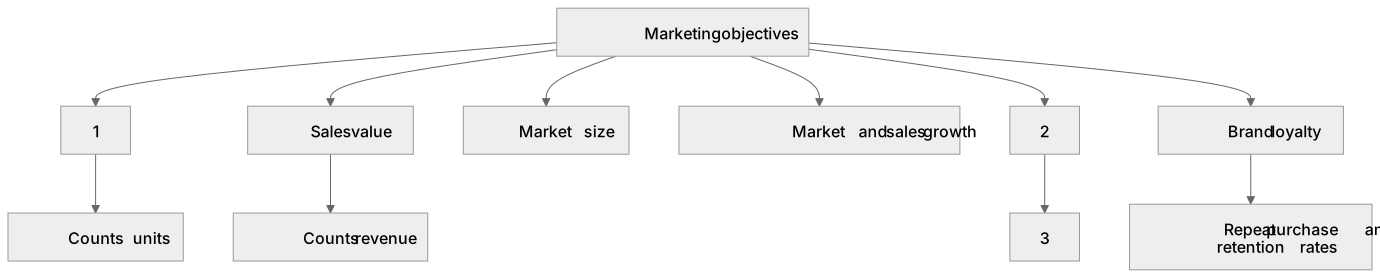
1Box 1
2Box 2
3Box 3
There is more to this lesson
The full lesson goes on to check your understanding and help you earn the marks. Create a free account to carry on, with your progress saved.
A week of Premium from your first lesson · Then the free plan continues · No card, no charge
Test your understanding of Setting marketing objectives: The value of setting marketing objectives (to include: Marketing objectives include: sales volume and sales value, market size, market and sales growth, market share, brand loyalty.)
Active recall beats re-reading. Take an instant quiz now to test what you’ve learned and lock it into long-term memory.
A week of Premium from your first lesson · Then the free plan continues · No card, no charge