AQA · A-Level · Business
Course version: 7132 · Version from Sept 2023
The difficulties in forecasting future trends
Full specification wording
Strategic decision making (A-level only): the difficulties in forecasting future trends
Every strategic number in this subject rests on a prediction: the sales volume behind a break even chart, the net cash flows discounted in an appraisal, the demand behind a capacity decision.
- Point 4 of 6
- 4 key terms
Study notes
From the teaching notes for this specification point.
The idea
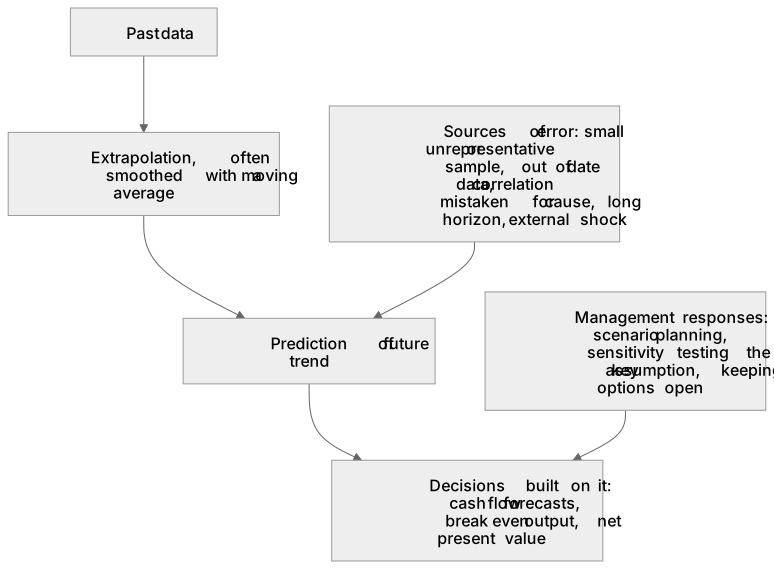
Every strategic number in this subject rests on a prediction: the sales volume behind a break even chart, the net cash flows discounted in an appraisal, the demand behind a capacity decision. Predictions are usually built by extrapolating past data, often smoothed with a moving average, and they go wrong for reasons you can name in an answer, that the sample was small or unrepresentative, that a correlation was treated as a cause, that the horizon is long enough for tastes, technology, interest rates or exchange rates to move, and that a single shock can break the series. The management responses are scenario planning, sensitivity testing the key assumption, and keeping options open. In evaluation, say how much confidence the figure deserves and what the business should do if it proves wrong.
What earns the marks
- Explaining that extrapolation assumes the past pattern continues, which is precisely the assumption an external shock destroys.
- Naming specific sources of error, such as a small or biased sample, out of date data, correlation mistaken for causation, or a horizon long enough for the market to change.
- Linking the error to the decisions built on it, including cash flow forecasts, break even output and the net present value that discounts predicted cash flows.
- Noting that error grows with the time horizon, so a decision appraised over several years is far more exposed than next quarter's sales plan.
- Offering a management response: scenario planning, sensitivity analysis on the key variable, or staged investment that keeps the option to stop.
- Judging usefulness rather than accuracy, since a rough projection that is revised often still beats deciding with nothing.
Common mistakes and how to put them right
Concluding that because predictions can be wrong the business should not make them.
Put it right: The marks are for managing the limits, not for abandoning the tool.
Confusing a projection with a target.
Put it right: A sales projection is what the firm expects; a sales objective is what it commits to achieving.
Quoting a market research sample size without saying whether those people represent the customers this business actually sells to.
Treating qualitative influences such as changing tastes or a new entrant as if they could be read off a trend line.
Exam tips
- This is rarely a whole question by itself; it is the evaluation lever for capacity, investment and cash flow answers, so bring it in whenever a decision rests on projected demand.
- When past sales data is printed, comment on the shape of the trend and on the one figure that sits oddly, because the examiner put it there on purpose.
- Saying what would make you change your recommendation is the clearest way to show judgement under uncertainty.
Try the lesson
The start of the Strategic decision making (A-level only): the difficulties in forecasting future trends lesson, made from teaching notes for this specification point.
Have a go first
Which of the following is a reason why forecasting future trends is difficult for a business?
Listen
Every strategic number in this subject rests on a prediction: the sales volume behind a break even chart, the net cash flows discounted in an appraisal, the demand behind a capacity decision. Predictions are usually built by extrapolating past data, often smoothed with a moving average, and they go wrong for reasons you can name in an answer, that the sample was small or unrepresentative, that a correlation was treated as a cause, that the horizon is long enough for tastes, technology, interest rates or exchange rates to move, and that a single shock can break the series. The management responses are scenario planning, sensitivity testing the key assumption, and keeping options open. In evaluation, say how much confidence the figure deserves and what the business should do if it proves wrong. A strong answer earns marks for these points. Explaining that extrapolation assumes the past pattern continues, which is precisely the assumption an external shock destroys. Naming specific sources of error, such as a small or biased sample, out of date data, correlation mistaken for causation, or a horizon long enough for the market to change. Linking the error to the decisions built on it, including cash flow forecasts, break even output and the net present value that discounts predicted cash flows. Noting that error grows with the time horizon, so a decision appraised over several years is far more exposed than next quarter's sales plan. Exam tip: This is rarely a whole question by itself; it is the evaluation lever for capacity, investment and cash flow answers, so bring it in whenever a decision rests on projected demand.
See it
Key words
Say what each word means before you turn the card.
Extrapolation
Try answering aloud or in your head before turning the card.
Sources of error
Try answering aloud or in your head before turning the card.
Time horizon
Try answering aloud or in your head before turning the card.
Scenario planning
Try answering aloud or in your head before turning the card.
See every definition
- Extrapolation
- A prediction built by assuming the past pattern continues, which is precisely the assumption an external shock destroys.
- Sources of error
- Reasons a projection goes wrong, such as a small or biased sample, out of date data, correlation mistaken for causation, or a horizon long enough for the market to change.
- Time horizon
- The length of time a decision is appraised over, with error growing as it lengthens, so a decision over several years is far more exposed than next quarter's sales plan.
- Scenario planning
- A management response to forecasting difficulty, alongside sensitivity analysis on the key variable and staged investment that keeps the option to stop.
Label the diagram
Some boxes have lost their names. Pick the right name for each number.
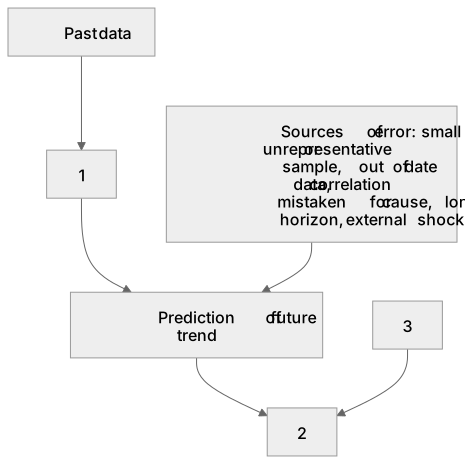
1Box 1
2Box 2
3Box 3
There is more to this lesson
The full lesson goes on to check your understanding and help you earn the marks. Create a free account to carry on, with your progress saved.
A week of Premium from your first lesson · Then the free plan continues · No card, no charge
Test your understanding of Strategic decision making (A-level only): the difficulties in forecasting future trends
Active recall beats re-reading. Take an instant quiz now to test what you’ve learned and lock it into long-term memory.
A week of Premium from your first lesson · Then the free plan continues · No card, no charge