AQA · A-Level · Business
Course version: 7132 · Version from Sept 2023
The impact on stakeholders of strategic decisions and their response to…
Full specification wording
Strategic decision making (A-level only): the impact on stakeholders of strategic decisions and their response to such decisions.
Any large decision creates winners and losers, and how the losers react is part of whether it works.
- Point 6 of 6
- 3 key terms
Study notes
From the teaching notes for this specification point.
The idea
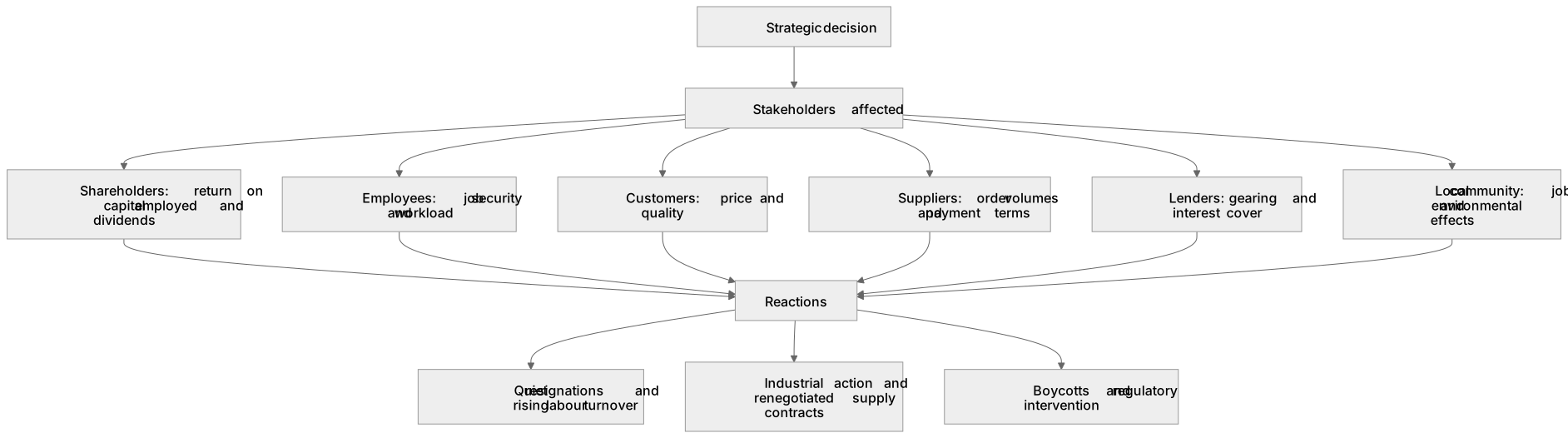
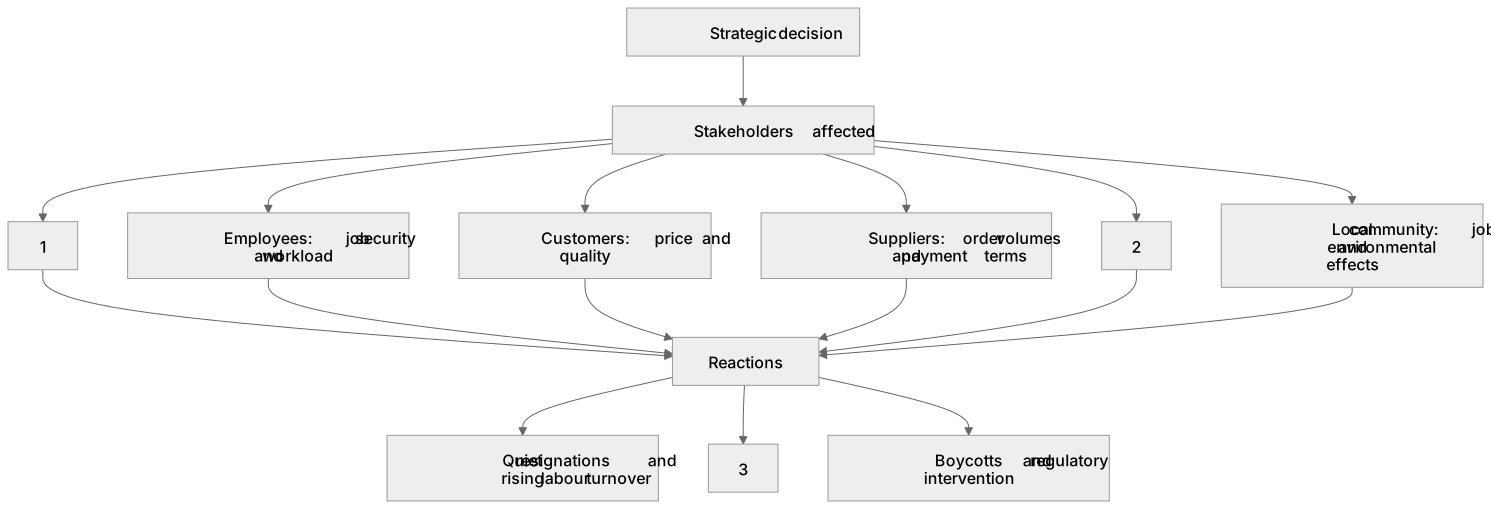
Any large decision creates winners and losers, and how the losers react is part of whether it works. Use Mendelow's matrix: manage high-power, high-interest groups closely; keep low-power, high-interest groups informed; give low-power, low-interest groups minimal effort. Shareholders judge by return on capital employed and dividends, employees by job security and workload, customers by price and quality, suppliers by order volumes and payment terms, lenders by gearing and interest cover, and the local community by jobs and environmental effects. Reactions run from quiet resignations and rising labour turnover, through industrial action and renegotiated supply contracts, to boycotts and regulatory intervention. The matrix is blind to how fast power shifts, since one social media campaign can move a powerless group into the group that decides the outcome.
What earns the marks
- Identifying the specific groups named in the case study rather than reciting a generic list of stakeholders.
- Saying what each group gains or loses in its own terms: jobs and workload for employees, price and availability for customers, order volume and payment terms for suppliers.
- Using power and interest mapping to explain why one group is managed closely while another is merely informed.
- Predicting a realistic reaction and its cost to the business, such as resistance raising labour turnover and recruitment costs, or a supplier switching to a rival.
- Using Kotter and Schlesinger to say how resistance could be handled, from education and participation through to negotiation, and pricing each approach in time or money.
- Judging whose reaction actually threatens the objective, because a firm can survive grumbling customers but not a key supplier walking away.
Common mistakes and how to put them right
Listing every stakeholder group when the decision affects only two or three of them, which dilutes the answer and earns no application marks.
Assuming employees always resist change, when staff on a bonus scheme or with a stake in the outcome may push hard for it.
Confusing shareholders with stakeholders, or claiming a private limited company has no owners to answer to.
Stopping at who is affected without saying what they will do about it, which is the half of the statement that carries the analysis.
Exam tips
- These questions are usually assess or evaluate, so rank the groups by how much their reaction matters to the objective before judging.
- Bring a number out of the extracts, such as the share of output taken by one customer, to show why that group has power.
- Where the question is about managing a reaction, name the approach and state what it costs in time or money instead of listing every option.
Try the lesson
The start of the Strategic decision making (A-level only): the impact on stakeholders of strategic decisions and their response to such decisions. lesson, made from teaching notes for this specification point.
Have a go first
A large car manufacturer announces a strategic decision to close its factory in the North of England and move all production overseas to reduce labour costs. Which of the following describes the most likely impact on, and response from, the local community stakeholder group?
Listen
Any large decision creates winners and losers, and how the losers react is part of whether it works. Use Mendelow's matrix: manage high-power, high-interest groups closely; keep low-power, high-interest groups informed; give low-power, low-interest groups minimal effort. Shareholders judge by return on capital employed and dividends, employees by job security and workload, customers by price and quality, suppliers by order volumes and payment terms, lenders by gearing and interest cover, and the local community by jobs and environmental effects. Reactions run from quiet resignations and rising labour turnover, through industrial action and renegotiated supply contracts, to boycotts and regulatory intervention. The matrix is blind to how fast power shifts, since one social media campaign can move a powerless group into the group that decides the outcome. A strong answer earns marks for these points. Identifying the specific groups named in the case study rather than reciting a generic list of stakeholders. Saying what each group gains or loses in its own terms: jobs and workload for employees, price and availability for customers, order volume and payment terms for suppliers. Using power and interest mapping to explain why one group is managed closely while another is merely informed. Predicting a realistic reaction and its cost to the business, such as resistance raising labour turnover and recruitment costs, or a supplier switching to a rival. Exam tip: These questions are usually assess or evaluate, so rank the groups by how much their reaction matters to the objective before judging.
See it
Key words
Say what each word means before you turn the card.
Stakeholder power and interest
Try answering aloud or in your head before turning the card.
Resistance and its cost to the business
Try answering aloud or in your head before turning the card.
Managing reactions to change
Try answering aloud or in your head before turning the card.
See every definition
- Stakeholder power and interest
- Mapping groups by power and interest to decide which are managed closely, kept informed or given minimal effort.
- Resistance and its cost to the business
- Reactions run from quiet resignations and rising labour turnover, through industrial action and renegotiated supply contracts, to boycotts and regulatory intervention.
- Managing reactions to change
- Handling resistance from education and participation through to negotiation, pricing each approach in time or money.
Label the diagram
Some boxes have lost their names. Pick the right name for each number.
1Box 1
2Box 2
3Box 3
There is more to this lesson
The full lesson goes on to check your understanding and help you earn the marks. Create a free account to carry on, with your progress saved.
A week of Premium from your first lesson · Then the free plan continues · No card, no charge
Test your understanding of Strategic decision making (A-level only): the impact on stakeholders of strategic decisions and their response to such decisions.
Active recall beats re-reading. Take an instant quiz now to test what you’ve learned and lock it into long-term memory.
A week of Premium from your first lesson · Then the free plan continues · No card, no charge