AQA · A-Level · Business
Course version: 7132 · Version from Sept 2023
Choosing how to compete: The value of different strategic positioning…
Full specification wording
Strategic positioning: choosing how to compete: The value of different strategic positioning strategies
Each stance earns money in a different way, and comparing those ways is what an answer is for.
- Point 3 of 5
- 3 key terms
Study notes
From the teaching notes for this specification point.
The idea
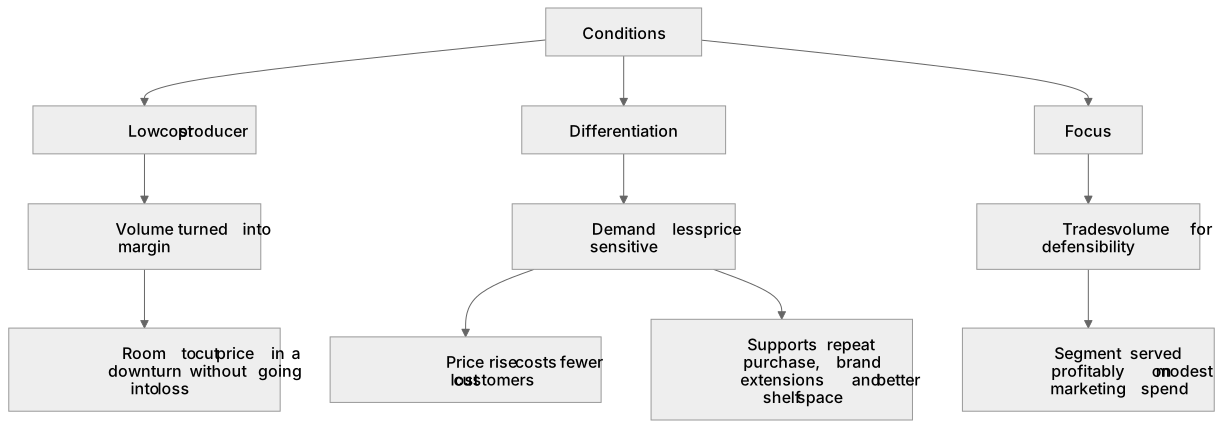
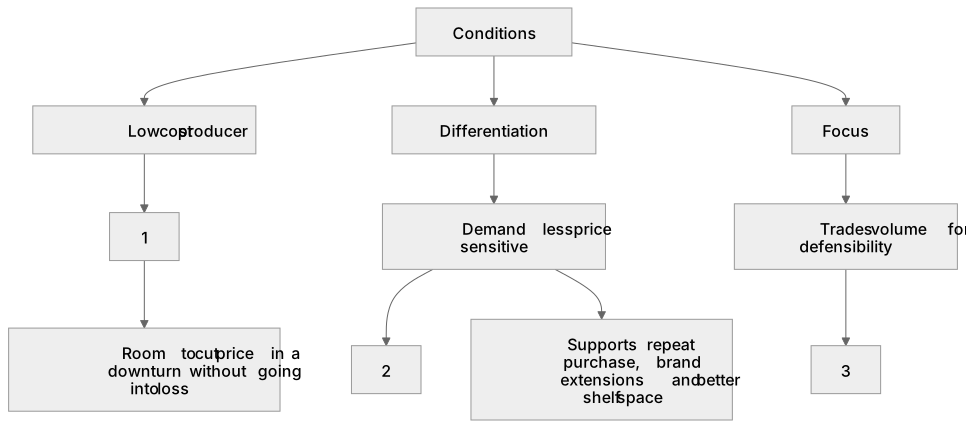
Each stance earns money in a different way, and comparing those ways is what an answer is for. Being the low cost producer turns volume into margin and leaves room to cut price in a downturn without going into loss, which is how a discounter survives a price war that damages everybody else. Differentiation makes demand less price sensitive, so a price rise costs fewer lost customers, and it supports repeat purchase, brand extensions and better shelf space. A focus approach trades volume for defensibility, because a segment too small to interest a national rival can still be served profitably on modest marketing spend. The comparison turns on conditions: low cost needs demand high enough to keep capacity utilisation up, a premium needs customers with money and a reason to care, and a niche can vanish when tastes move or a large firm decides to enter it.
What earns the marks
- Tying each stance to a financial consequence, such as a wider gross margin, a lower break even output, or a higher average selling price, rather than to a vague strength.
- Using price elasticity to explain why a differentiated brand loses proportionately fewer sales after a price rise than a commodity producer does.
- Judging the stance against conditions in the case, for example rising input costs, falling real incomes, or a rival that has just cut price.
- Recognising that worth is a question of time, since an approach that is profitable now can be matched within a year.
Common mistakes and how to put them right
Writing advantages and disadvantages of each strategy as a list, with no comparison and no context, which reads as revision notes rather than argument.
Assuming a premium approach is always the more profitable one, when high unit costs and low volume can leave the margin thinner than a discounter's.
Forgetting the customer, since a niche only pays if the segment can afford the price and is large enough to cover fixed costs.
Exam tips
- This is essay territory on the longer papers, so build two sided paragraphs that judge each approach against the same criterion.
- Use the figures supplied, because margin, market share and capacity utilisation usually settle which approach is working.
- Finish by saying under what circumstances the judgement would change, since that is where the top band sits.
Try the lesson
The start of the Strategic positioning: choosing how to compete: The value of different strategic positioning strategies lesson, made from teaching notes for this specification point.
Have a go first
Which strategic positioning strategy involves a business competing by offering lower prices than its rivals?
Listen
Each stance earns money in a different way, and comparing those ways is what an answer is for. Being the low cost producer turns volume into margin and leaves room to cut price in a downturn without going into loss, which is how a discounter survives a price war that damages everybody else. Differentiation makes demand less price sensitive, so a price rise costs fewer lost customers, and it supports repeat purchase, brand extensions and better shelf space. A focus approach trades volume for defensibility, because a segment too small to interest a national rival can still be served profitably on modest marketing spend. The comparison turns on conditions: low cost needs demand high enough to keep capacity utilisation up, a premium needs customers with money and a reason to care, and a niche can vanish when tastes move or a large firm decides to enter it. A strong answer earns marks for these points. Tying each stance to a financial consequence, such as a wider gross margin, a lower break even output, or a higher average selling price, rather than to a vague strength. Using price elasticity to explain why a differentiated brand loses proportionately fewer sales after a price rise than a commodity producer does. Judging the stance against conditions in the case, for example rising input costs, falling real incomes, or a rival that has just cut price. Recognising that worth is a question of time, since an approach that is profitable now can be matched within a year. Exam tip: This is essay territory on the longer papers, so build two sided paragraphs that judge each approach against the same criterion.
See it
Key words
Say what each word means before you turn the card.
margin and volume
Try answering aloud or in your head before turning the card.
price sensitivity
Try answering aloud or in your head before turning the card.
niche defensibility
Try answering aloud or in your head before turning the card.
See every definition
- margin and volume
- Being the low cost producer turns volume into margin and leaves room to cut price in a downturn without going into loss.
- price sensitivity
- Differentiation makes demand less price sensitive, so a price rise costs fewer lost customers.
- niche defensibility
- A focus approach trades volume for defensibility, because a segment too small to interest a national rival can still be served profitably on modest marketing spend.
Label the diagram
Some boxes have lost their names. Pick the right name for each number.
1Box 1
2Box 2
3Box 3
There is more to this lesson
The full lesson goes on to check your understanding and help you earn the marks. Create a free account to carry on, with your progress saved.
A week of Premium from your first lesson · Then the free plan continues · No card, no charge
Test your understanding of Strategic positioning: choosing how to compete: The value of different strategic positioning strategies
Active recall beats re-reading. Take an instant quiz now to test what you’ve learned and lock it into long-term memory.
A week of Premium from your first lesson · Then the free plan continues · No card, no charge