AQA · A-Level · Business
Course version: 7132 · Version from Sept 2023
The importance of the context of business in relation to decision making
Full specification wording
Subject content: the importance of the context of business in relation to decision making
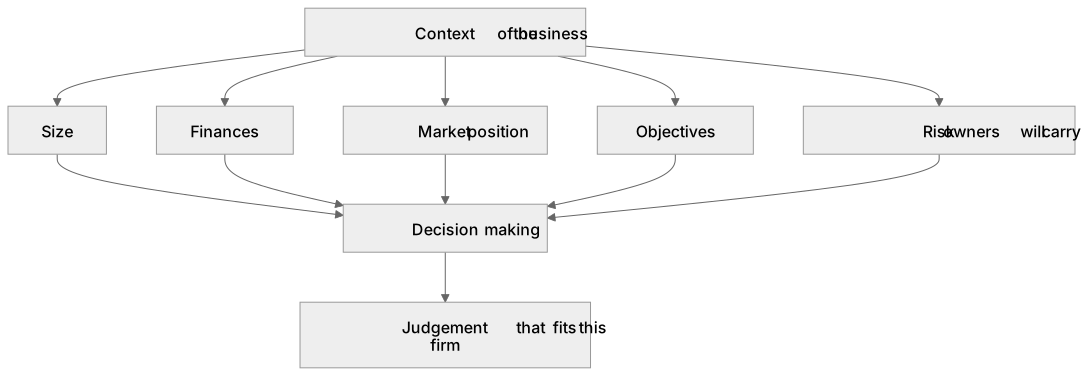
Context is the set of circumstances that decides whether a choice is right: size, finances, market position, objectives and how much risk the owners will carry.
- Point 2 of 9
- 4 key terms
Study notes
From the teaching notes for this specification point.
The idea
Context is the set of circumstances that decides whether a choice is right: size, finances, market position, objectives and how much risk the owners will carry. Two firms can run the same investment appraisal, get the same payback period of three years and be correct to reach opposite conclusions, because one holds cash and a patient family owner while the other has borrowings to service and a bank covenant to meet. A well-supported judgement therefore explains why the recommendation fits this firm and names the condition under which it would change. The trade-off usually comes down to short term security against long term position, and which of the two this firm can afford to lose.
What earns the marks
- Building a chain of reasoning that ends in a clause about this firm, such as because it is a start up with no retained profit, rather than a general statement about businesses.
- Naming the condition that would reverse the recommendation, for example a rise in interest rates or the loss of the contract that supplies most of the revenue.
- Weighing short term and long term effects separately and saying which matters more given the firm's current position.
- Using the firm's own objective as the yardstick for success, not a general assumption that profit is the goal.
Common mistakes and how to put them right
Giving a balanced answer that lists advantages and disadvantages in the abstract and never decides, which caps the response below the top level for judgement.
Repeating the same sentence about the firm in every paragraph so it becomes decoration rather than reasoning.
Applying a rule of thumb such as high gearing is bad without checking whether this firm's cash flows are stable enough to service the debt.
Exam tips
- The longest answers are marked on judgement supported by context, so plan the verdict in one sentence first and build the paragraphs towards it.
- When a question says assess or evaluate, the final paragraph must decide and give the reason it decided that way for this firm, not summarise both sides again.
- Short answer questions still carry application marks, so even a four mark explain question should reach for the firm's own figures.
Try the lesson
The start of the Subject content: the importance of the context of business in relation to decision making lesson, made from teaching notes for this specification point.
Have a go first
Why is the context of a business important when making a decision?
Listen
Context is the set of circumstances that decides whether a choice is right: size, finances, market position, objectives and how much risk the owners will carry. Two firms can run the same investment appraisal, get the same payback period of three years and be correct to reach opposite conclusions, because one holds cash and a patient family owner while the other has borrowings to service and a bank covenant to meet. A well-supported judgement therefore explains why the recommendation fits this firm and names the condition under which it would change. The trade-off usually comes down to short term security against long term position, and which of the two this firm can afford to lose. A strong answer earns marks for these points. Building a chain of reasoning that ends in a clause about this firm, such as because it is a start up with no retained profit, rather than a general statement about businesses. Naming the condition that would reverse the recommendation, for example a rise in interest rates or the loss of the contract that supplies most of the revenue. Weighing short term and long term effects separately and saying which matters more given the firm's current position. Using the firm's own objective as the yardstick for success, not a general assumption that profit is the goal. Exam tip: The longest answers are marked on judgement supported by context, so plan the verdict in one sentence first and build the paragraphs towards it.
See it
Key words
Say what each word means before you turn the card.
decision context
Try answering aloud or in your head before turning the card.
risk appetite
Try answering aloud or in your head before turning the card.
objectives as yardstick
Try answering aloud or in your head before turning the card.
supported judgement
Try answering aloud or in your head before turning the card.
See every definition
- decision context
- The set of circumstances that decides whether a choice is right, including size, finances, market position, objectives and how much risk the owners will carry.
- risk appetite
- How much risk the owners will carry, which is part of the set of circumstances that decides whether a choice is right.
- objectives as yardstick
- Using the firm's own objective as the yardstick for success, not a general assumption that profit is the goal.
- supported judgement
- A judgement that explains why the recommendation fits this firm and names the condition under which it would change.
Label the diagram
Some boxes have lost their names. Pick the right name for each number.
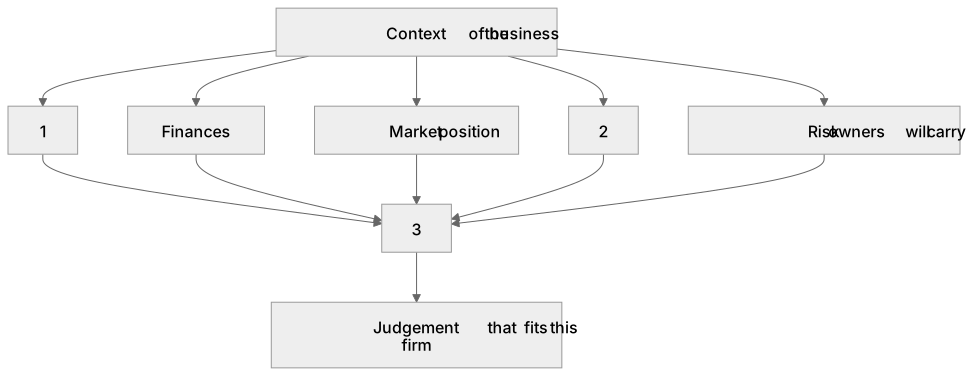
1Box 1
2Box 2
3Box 3
There is more to this lesson
The full lesson goes on to check your understanding and help you earn the marks. Create a free account to carry on, with your progress saved.
A week of Premium from your first lesson · Then the free plan continues · No card, no charge
Test your understanding of Subject content: the importance of the context of business in relation to decision making
Active recall beats re-reading. Take an instant quiz now to test what you’ve learned and lock it into long-term memory.
A week of Premium from your first lesson · Then the free plan continues · No card, no charge