AQA · A-Level · Business
Course version: 7132 · Version from Sept 2023
The value of decision making based on data (scientific decision making)…
Full specification wording
Understanding management decision making: The value of decision making based on data (scientific decision making) and on intuition (to include: Scientific decision making should include understanding and interpreting decision trees and calculating expected value and net gains. Decision making to include an understanding of: risks, rewards, uncertainty, opportunity cost, the use and value of decision trees in decision making.)
Scientific decision making replaces a hunch with a number, and the decision tree is the tool you are expected to work.
- Point 1 of 2
- 4 key terms
Study notes
From the teaching notes for this specification point.
The idea
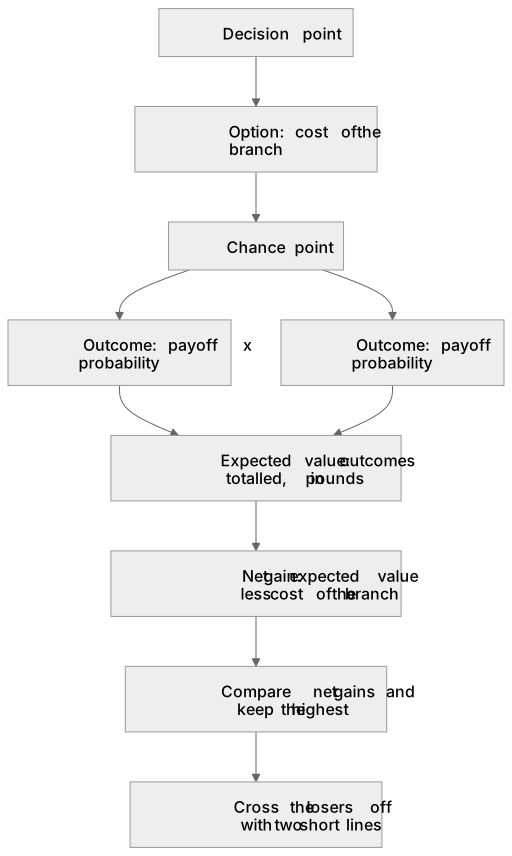
Scientific decision making replaces a hunch with a number, and the decision tree is the tool you are expected to work. Squares are decision points and circles are chance points; at each circle the expected value is every outcome multiplied by its probability and then totalled, in pounds, and the net gain is that expected value less the cost of the branch leading to it. Compare net gains, keep the highest and cross the losers off with two short lines. The arithmetic is the easy half. Probabilities are estimates, usually drawn from past data that a changed market has already made stale. Payoffs are money only, so brand damage and staff goodwill sit outside the model entirely. The method is risk neutral, which is fatal advice for a small firm that could not survive the worst branch however good the average looks.
What earns the marks
- Calculating expected value by multiplying each payoff by its probability and totalling them, with the working shown and the units given in pounds.
- Taking off the cost of the option to reach net gain, then choosing between options on net gain rather than on expected value alone.
- Criticising the inputs, since a tree is only as trustworthy as the probabilities and payoffs a manager fed into it.
- Recognising what a tree cannot price, including reputation, staff morale, ethics and the risk that one bad outcome would finish the firm.
Common mistakes and how to put them right
Comparing expected values and forgetting to deduct the cost of each option, which reverses the recommendation surprisingly often.
Letting the probabilities on a chance node total something other than a whole, or multiplying by a percentage without converting it first.
Dismissing intuition altogether, when a genuinely new market offers no historical data and leaves a manager nothing else to judge on.
Exam tips
- Calculate questions on trees carry method marks, so set out the expected value at each chance node and label the units before comparing anything.
- The follow up is nearly always a question on how much confidence to place in the result, so keep the limitations ready to deploy.
- Opportunity cost is examined here too: say what the rejected branch would have delivered, because that is the true cost of the choice made.
Try the lesson
The start of the Understanding management decision making: The value of decision making based on data (scientific decision making) and on intuition (to include: Scientific decision making should include understanding and interpreting decision trees and calculating expected value and net gains. Decision making to include an understanding of: risks, rewards, uncertainty, opportunity cost, the use and value of decision trees in decision making.) lesson, made from teaching notes for this specification point.
Have a go first
What is meant by scientific decision making?
Listen
Scientific decision making replaces a hunch with a number, and the decision tree is the tool you are expected to work. Squares are decision points and circles are chance points; at each circle the expected value is every outcome multiplied by its probability and then totalled, in pounds, and the net gain is that expected value less the cost of the branch leading to it. Compare net gains, keep the highest and cross the losers off with two short lines. The arithmetic is the easy half. Probabilities are estimates, usually drawn from past data that a changed market has already made stale. Payoffs are money only, so brand damage and staff goodwill sit outside the model entirely. The method is risk neutral, which is fatal advice for a small firm that could not survive the worst branch however good the average looks. A strong answer earns marks for these points. Calculating expected value by multiplying each payoff by its probability and totalling them, with the working shown and the units given in pounds. Taking off the cost of the option to reach net gain, then choosing between options on net gain rather than on expected value alone. Criticising the inputs, since a tree is only as trustworthy as the probabilities and payoffs a manager fed into it. Recognising what a tree cannot price, including reputation, staff morale, ethics and the risk that one bad outcome would finish the firm. Exam tip: Calculate questions on trees carry method marks, so set out the expected value at each chance node and label the units before comparing anything.
See it
Key words
Say what each word means before you turn the card.
decision trees
Try answering aloud or in your head before turning the card.
expected value and net gain
Try answering aloud or in your head before turning the card.
risk and uncertainty
Try answering aloud or in your head before turning the card.
opportunity cost
Try answering aloud or in your head before turning the card.
See every definition
- decision trees
- A tool for scientific decision making, with squares as decision points and circles as chance points, used to understand and interpret options.
- expected value and net gain
- At each circle every outcome is multiplied by its probability and totalled in pounds, and the net gain is that expected value less the cost of the branch leading to it.
- risk and uncertainty
- Probabilities are estimates, usually drawn from past data that a changed market has already made stale, and the method is risk neutral.
- opportunity cost
- The true cost of the choice made is what the rejected branch would have delivered.
There is more to this lesson
The full lesson goes on to check your understanding and help you earn the marks. Create a free account to carry on, with your progress saved.
A week of Premium from your first lesson · Then the free plan continues · No card, no charge
Test your understanding of Understanding management decision making: The value of decision making based on data (scientific decision making) and on intuition (to include: Scientific decision making should include understanding and interpreting decision trees and calculating expected value and net gains. Decision making to include an understanding of: risks, rewards, uncertainty, opportunity cost, the use and value of decision trees in decision making.)
Active recall beats re-reading. Take an instant quiz now to test what you’ve learned and lock it into long-term memory.
A week of Premium from your first lesson · Then the free plan continues · No card, no charge