AQA · A-Level · Business
Course version: 7132 · Version from Sept 2023
The distinction between management and leadership
Full specification wording
Understanding management, leadership and decision making: The distinction between management and leadership
Managers keep an existing system running, planning, budgeting, organising people and checking progress against targets, while leaders decide where the system ought to be going and persuade people…
- Point 1 of 3
- 4 key terms
Study notes
From the teaching notes for this specification point.
The idea
Managers keep an existing system running, planning, budgeting, organising people and checking progress against targets, while leaders decide where the system ought to be going and persuade people to follow them there. Kotter framed it as coping with complexity against coping with change, and the pairing matters because a business needs both at once. A firm with excellent managers and nobody leading hits every budget while its market walks away; a charismatic founder with no management control wins orders the firm cannot deliver and runs out of cash. In a small business one person does both jobs, badly on some days. In a listed company the board is expected to lead and middle managers to manage, which is exactly why a change programme stalls when the vision never reaches the supervisors who have to run it.
What earns the marks
- Drawing the distinction by function, direction setting and commitment against planning and control, rather than claiming leaders are senior and managers are junior.
- Applying it to the named individual in the case and judging which of the two roles that person is actually performing.
- Arguing that the two are complementary, so the problem in the stem is usually a shortage of one of them rather than a surplus of the other.
- Linking a leadership failure to a measurable symptom such as rising labour turnover, missed deadlines or a change programme that has stopped moving.
Common mistakes and how to put them right
Treating leader and manager as job titles, so anyone with a large office is called a leader whatever they spend the day doing.
Claiming leadership always beats management, when a firm in a cost crisis needs tight control more than it needs a new vision.
Describing the theory at length and never saying what the person in the case study should do differently on Monday.
Exam tips
- Short answers ask you to explain one difference, so carry one crisp contrast rather than a list of adjectives.
- Pair this with change management, because Kotter and Lewin both assume somebody is leading rather than only administering.
- In an essay, decide early whether the case needs more leadership or more management, and hold that line through to the conclusion.
Try the lesson
The start of the Understanding management, leadership and decision making: The distinction between management and leadership lesson, made from teaching notes for this specification point.
Have a go first
Which term describes the process of setting a direction for a team and inspiring its members to follow it?
Listen
Managers keep an existing system running, planning, budgeting, organising people and checking progress against targets, while leaders decide where the system ought to be going and persuade people to follow them there. Kotter framed it as coping with complexity against coping with change, and the pairing matters because a business needs both at once. A firm with excellent managers and nobody leading hits every budget while its market walks away; a charismatic founder with no management control wins orders the firm cannot deliver and runs out of cash. In a small business one person does both jobs, badly on some days. In a listed company the board is expected to lead and middle managers to manage, which is exactly why a change programme stalls when the vision never reaches the supervisors who have to run it. A strong answer earns marks for these points. Drawing the distinction by function, direction setting and commitment against planning and control, rather than claiming leaders are senior and managers are junior. Applying it to the named individual in the case and judging which of the two roles that person is actually performing. Arguing that the two are complementary, so the problem in the stem is usually a shortage of one of them rather than a surplus of the other. Linking a leadership failure to a measurable symptom such as rising labour turnover, missed deadlines or a change programme that has stopped moving. Exam tip: Short answers ask you to explain one difference, so carry one crisp contrast rather than a list of adjectives.
See it

Key words
Say what each word means before you turn the card.
management functions
Try answering aloud or in your head before turning the card.
leadership and vision
Try answering aloud or in your head before turning the card.
direction and control
Try answering aloud or in your head before turning the card.
organisational change
Try answering aloud or in your head before turning the card.
See every definition
- management functions
- Planning, budgeting, organising people and checking progress against targets, keeping an existing system running.
- leadership and vision
- Deciding where the system ought to be going and persuading people to follow them there.
- direction and control
- Setting the direction against planning and control, rather than claiming leaders are senior and managers are junior.
- organisational change
- Coping with change, as framed by Kotter against coping with complexity, needing somebody to lead rather than only administer.
Label the diagram
Some boxes have lost their names. Pick the right name for each number.
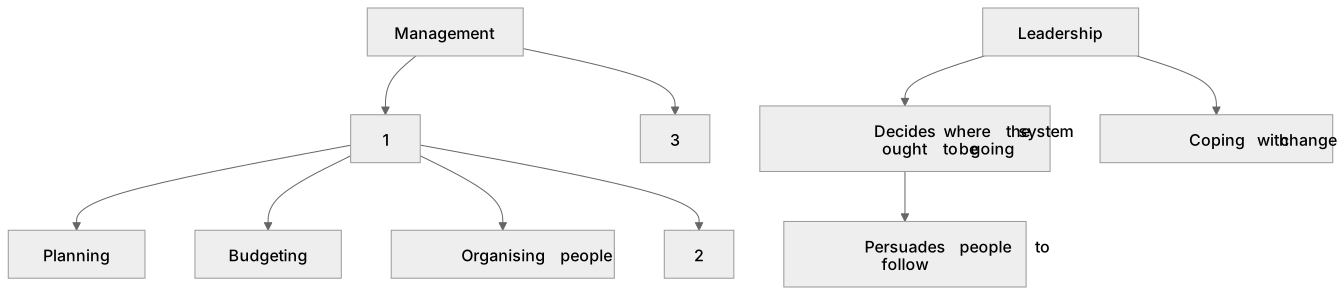
1Box 1
2Box 2
3Box 3
There is more to this lesson
The full lesson goes on to check your understanding and help you earn the marks. Create a free account to carry on, with your progress saved.
A week of Premium from your first lesson · Then the free plan continues · No card, no charge
Test your understanding of Understanding management, leadership and decision making: The distinction between management and leadership
Active recall beats re-reading. Take an instant quiz now to test what you’ve learned and lock it into long-term memory.
A week of Premium from your first lesson · Then the free plan continues · No card, no charge