AQA · A-Level · Business
Course version: 7132 · Version from Sept 2023
The need to consider stakeholder needs when making decisions (to include:…
Full specification wording
Understanding the role and importance of stakeholders: The need to consider stakeholder needs when making decisions (to include: Stakeholder mapping: stakeholder power and interest)
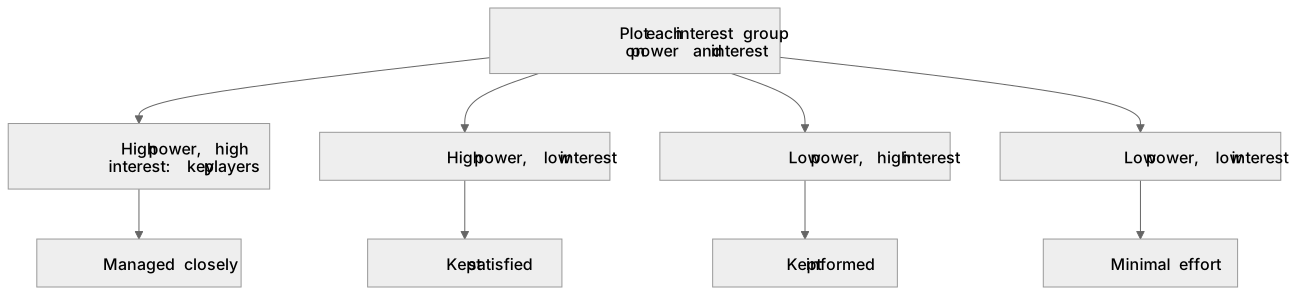
Mendelow's matrix is the tool behind this row: it plots every interest group on two axes, the power it holds over the business and the interest it takes in this particular decision, and the box a…
- Point 1 of 3
- 4 key terms
Study notes
From the teaching notes for this specification point.
The idea
Mendelow's matrix is the tool behind this row: it plots every interest group on two axes, the power it holds over the business and the interest it takes in this particular decision, and the box a group lands in prescribes the treatment. Key players with both are managed closely, powerful but uninterested groups are kept satisfied, interested but weak groups are kept informed, and the rest take minimal effort. Managers use it before a decision such as closing a depot, to work out whose objection could actually stop the plan. The trade-off is time and money, because full consultation slows the decision and leaks it to rivals, while skipping it invites strike action, a supplier refusing credit or a bank withdrawing a facility. The grid is blind to how fast power shifts, since one viral post can lift customers overnight, and it says nothing about whether ignoring the weak is right.
What earns the marks
- Naming Mendelow, placing a group from the case in a specific box and then saying what that placing means for the decision, which is the application the marker is looking for.
- Judging power by what a group can withhold, such as labour, components, credit, planning permission or repeat custom, rather than by how vocal it is.
- Using evidence from the extracts to justify the placing, for example one supplier providing most of the components, so the map is argued rather than asserted.
- Reaching a supported judgement on which single group must be managed closely for this decision, and saying why the others can be handled more cheaply.
- Recognising that the map is drawn for one decision at one moment, so a change in the market or a campaign can move a group into another box.
Common mistakes and how to put them right
Listing every group in the case with a sentence each, which fills the page but never ranks them, so the question's judgement marks stay unavailable.
Treating power and interest as the same thing, so a noisy pressure group with no purchasing power or legal leverage is placed among the key players.
Drawing the grid for the business in general rather than for the decision in the stem, which makes the same map serve a redundancy plan and a product launch.
Assuming shareholders are automatically the key players, when a dispersed shareholder base often has high power and low interest until a dividend is cut.
Exam tips
- This is usually attached to one named decision in the case, so anchor every box to that decision and quote a figure from the extract for the group you rank first.
- When the command is assess or evaluate, use the final paragraph to say which group the directors should prioritise and what would change that ranking.
- There is no calculation here, so the marks sit in application and judgement; a textbook description of the four boxes on its own reaches only the first level.
- If asked to recommend, commit to one group and one method of handling it, because a recommendation that hedges across all four boxes scores as description.
Try the lesson
The start of the Understanding the role and importance of stakeholders: The need to consider stakeholder needs when making decisions (to include: Stakeholder mapping: stakeholder power and interest) lesson, made from teaching notes for this specification point.
Have a go first
In stakeholder mapping, which two factors are used to position stakeholders?
Listen
Mendelow's matrix is the tool behind this row: it plots every interest group on two axes, the power it holds over the business and the interest it takes in this particular decision, and the box a group lands in prescribes the treatment. Key players with both are managed closely, powerful but uninterested groups are kept satisfied, interested but weak groups are kept informed, and the rest take minimal effort. Managers use it before a decision such as closing a depot, to work out whose objection could actually stop the plan. The trade-off is time and money, because full consultation slows the decision and leaks it to rivals, while skipping it invites strike action, a supplier refusing credit or a bank withdrawing a facility. The grid is blind to how fast power shifts, since one viral post can lift customers overnight, and it says nothing about whether ignoring the weak is right. A strong answer earns marks for these points. Naming Mendelow, placing a group from the case in a specific box and then saying what that placing means for the decision, which is the application the marker is looking for. Judging power by what a group can withhold, such as labour, components, credit, planning permission or repeat custom, rather than by how vocal it is. Using evidence from the extracts to justify the placing, for example one supplier providing most of the components, so the map is argued rather than asserted. Reaching a supported judgement on which single group must be managed closely for this decision, and saying why the others can be handled more cheaply. Exam tip: This is usually attached to one named decision in the case, so anchor every box to that decision and quote a figure from the extract for the group you rank first.
See it
Key words
Say what each word means before you turn the card.
Stakeholder power and interest
Try answering aloud or in your head before turning the card.
Mendelow matrix
Try answering aloud or in your head before turning the card.
Consultation cost and speed
Try answering aloud or in your head before turning the card.
Decision specific mapping
Try answering aloud or in your head before turning the card.
See every definition
- Stakeholder power and interest
- The two axes on which every interest group is plotted: the power it holds over the business and the interest it takes in this particular decision.
- Mendelow matrix
- A tool that plots every interest group on power and interest, and the box a group lands in prescribes the treatment.
- Consultation cost and speed
- The trade-off of time and money, because full consultation slows the decision and leaks it to rivals, while skipping it invites strike action, a supplier refusing credit or a bank withdrawing a facility.
- Decision specific mapping
- The map is drawn for one decision at one moment, so a change in the market or a campaign can move a group into another box.
Label the diagram
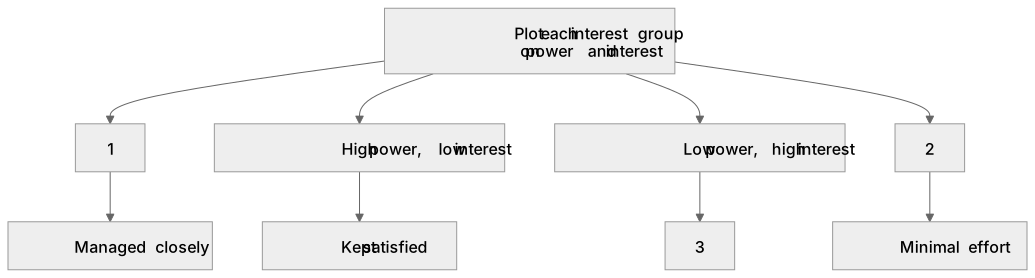
Some boxes have lost their names. Pick the right name for each number.
1Box 1
2Box 2
3Box 3
There is more to this lesson
The full lesson goes on to check your understanding and help you earn the marks. Create a free account to carry on, with your progress saved.
A week of Premium from your first lesson · Then the free plan continues · No card, no charge
Test your understanding of Understanding the role and importance of stakeholders: The need to consider stakeholder needs when making decisions (to include: Stakeholder mapping: stakeholder power and interest)
Active recall beats re-reading. Take an instant quiz now to test what you’ve learned and lock it into long-term memory.
A week of Premium from your first lesson · Then the free plan continues · No card, no charge