AQA · GCSE · Business
Course version: 8132 · Version from Sept 2017
Cash flow
Master the movement of money with this definitive guide to Cash Flow. Discover why profitable businesses can still go bust, how to build and interpret cash flow forecasts, and the examiner-approved ways to solve cash flow crises.
- Point 1 of 7
- 5 min read
- 3 worked examples
- 2 practice questions
- 4 key terms
Study Notes
Overview
Cash flow is the lifeblood of any business, representing the dynamic movement of money in and out over a period of time. For GCSE Business candidates, mastering this topic is non-negotiable. Examiners consistently test your ability to construct forecasts, interpret financial data, and critically evaluate solutions to cash flow problems.
Historically, many fast-growing businesses have failed not because they lacked profit, but because they ran out of cash. This guide will equip you with the precise terminology and analytical skills required to secure top marks. You will learn to differentiate between cash and profit, calculate net cash flows and closing balances accurately, and weigh the short-term versus long-term impacts of various financial interventions.
Listen to the companion podcast below for an examiner's perspective on common pitfalls and top tips:
Cash vs Profit: The Crucial Distinction
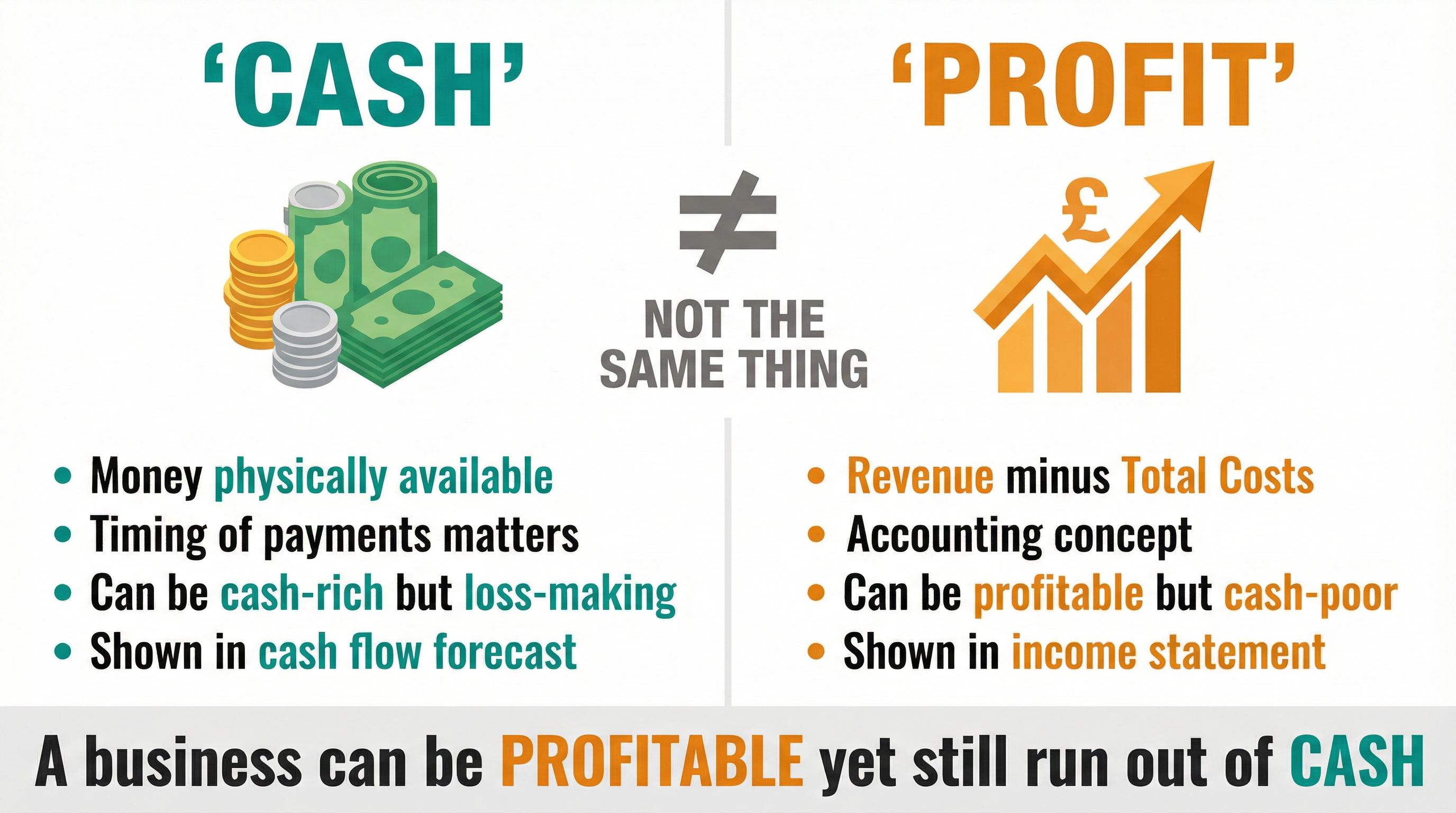
One of the most frequent errors candidates make is conflating cash with profit.
 Open full-size image (opens in a new tab)
Profit is an accounting concept calculated as Total Revenue minus Total Costs. A business can record a profit when a sale is made, even if the customer has not yet paid.
Cash, however, is the physical money available to the business at a specific moment in time. A business might be highly profitable on paper but suffer a severe cash flow crisis if customers delay payment while suppliers demand immediate settlement. This scenario is often referred to as being 'cash poor but profit rich'.
Constructing a Cash Flow Forecast
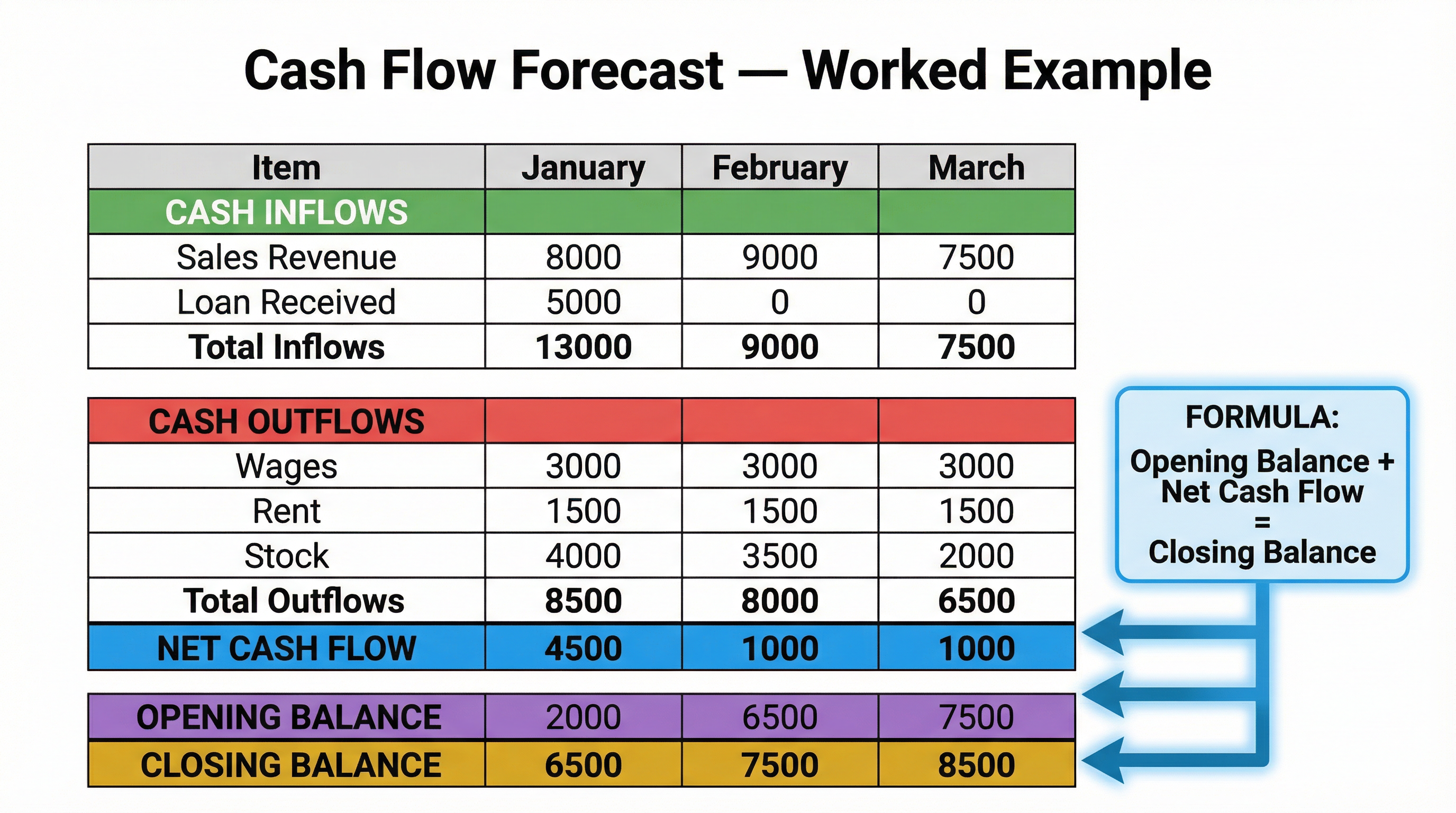
A cash flow forecast is a forward-looking financial document that predicts a business's cash inflows and outflows over a specific period, usually month by month. Examiners frequently require candidates to complete missing figures in a forecast table.
 Open full-size image (opens in a new tab)
Key Components:
- Cash Inflows: Money entering the business (e.g., sales revenue, loans received, investment).
- Cash Outflows: Money leaving the business (e.g., wages, rent, payments to suppliers).
- Net Cash Flow: Calculated as Total Inflows minus Total Outflows.
- Opening Balance: The cash available at the start of the month.
- Closing Balance: Calculated as Opening Balance plus Net Cash Flow. Crucially, the closing balance of one month becomes the opening balance of the next.
Consequences of Cash Flow Problems
When outflows consistently exceed inflows, a business faces a cash flow problem. The consequences can be severe:
- Short-term: Inability to pay wages (damaging staff morale) or suppliers (leading to a loss of credit facilities).
- Long-term: The business may become insolvent, meaning it cannot pay its debts, potentially leading to administration or liquidation, even if it is profitable.
Evaluating Solutions to Cash Flow Problems
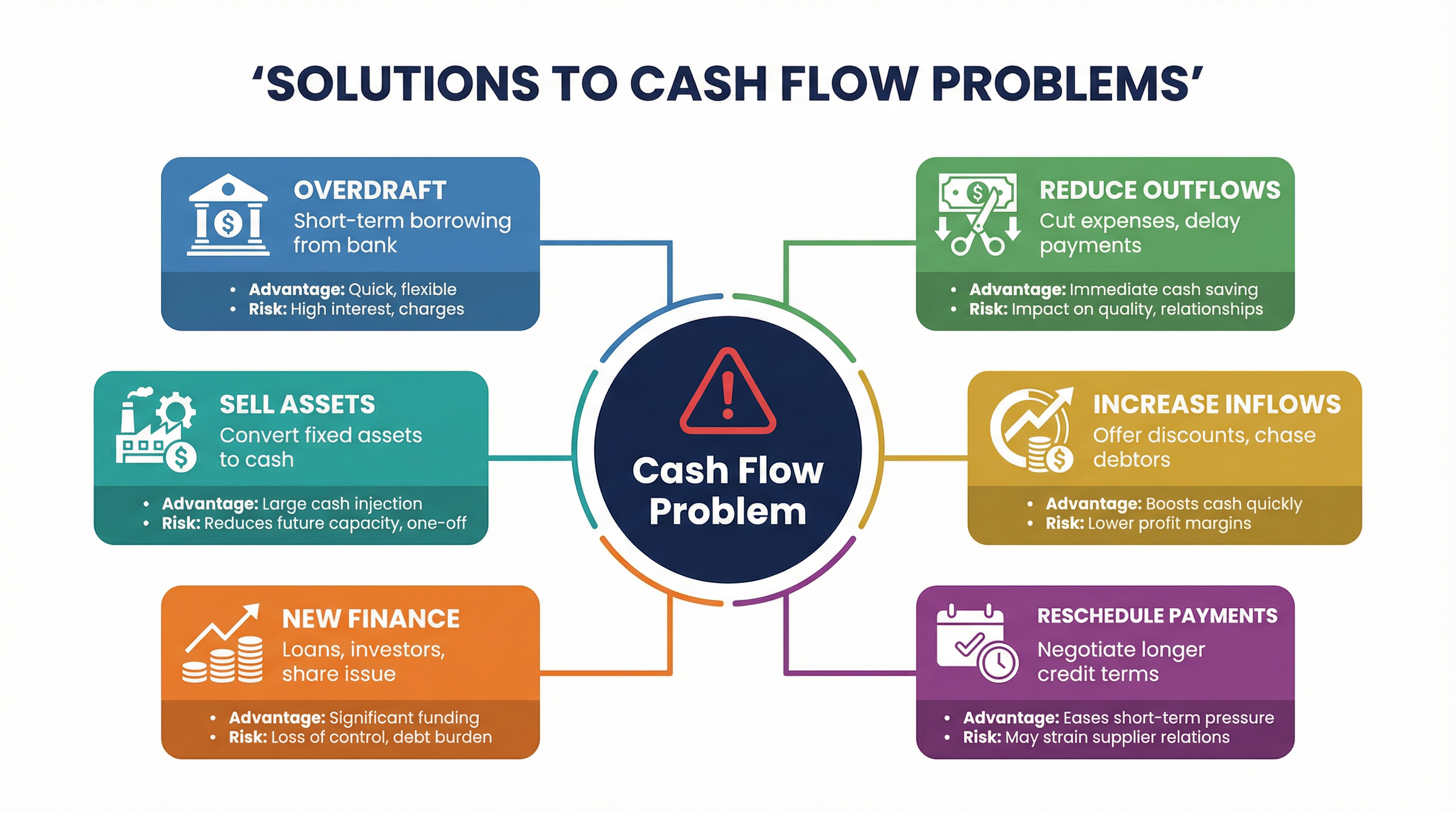
When examiners ask you to evaluate solutions, they expect a balanced analysis of both advantages and disadvantages in context.
 Open full-size image (opens in a new tab)
1. Arrange an Overdraft
What it is: Short-term borrowing from a bank up to an agreed limit.
Advantage: Quick to arrange and highly flexible for temporary shortfalls.
Disadvantage: High interest rates and the bank can demand immediate repayment.
2. Reschedule Payments
What it is: Negotiating longer credit terms with suppliers.
Advantage: Keeps cash in the business for longer without incurring interest.
Disadvantage: May damage supplier relationships or result in the loss of early payment discounts.
3. Reduce Outflows
What it is: Cutting expenses or delaying non-essential purchases.
Advantage: Provides an immediate improvement to the cash position.
Disadvantage: Cutting too deeply may compromise product quality or staff morale.
4. Increase Inflows
What it is: Encouraging faster payment from customers or running promotions.
Advantage: Accelerates cash collection.
Disadvantage: Offering discounts to encourage early payment reduces overall profit margins.
5. Seek New Finance
What it is: Obtaining a bank loan or issuing new shares.
Advantage: Provides a significant, lump-sum cash injection.
Disadvantage: Loans increase debt burden and require interest payments; issuing shares dilutes ownership and control.
6. Sell Assets
What it is: Converting fixed assets (e.g., machinery, property) into cash.
Advantage: Can raise substantial amounts of money quickly.
Disadvantage: Reduces the future productive capacity of the business and is a one-off solution.
Try the lesson
The start of the Cash flow lesson, made from teaching notes for this specification point.
Have a go first
Why is cash important to a business?
Listen
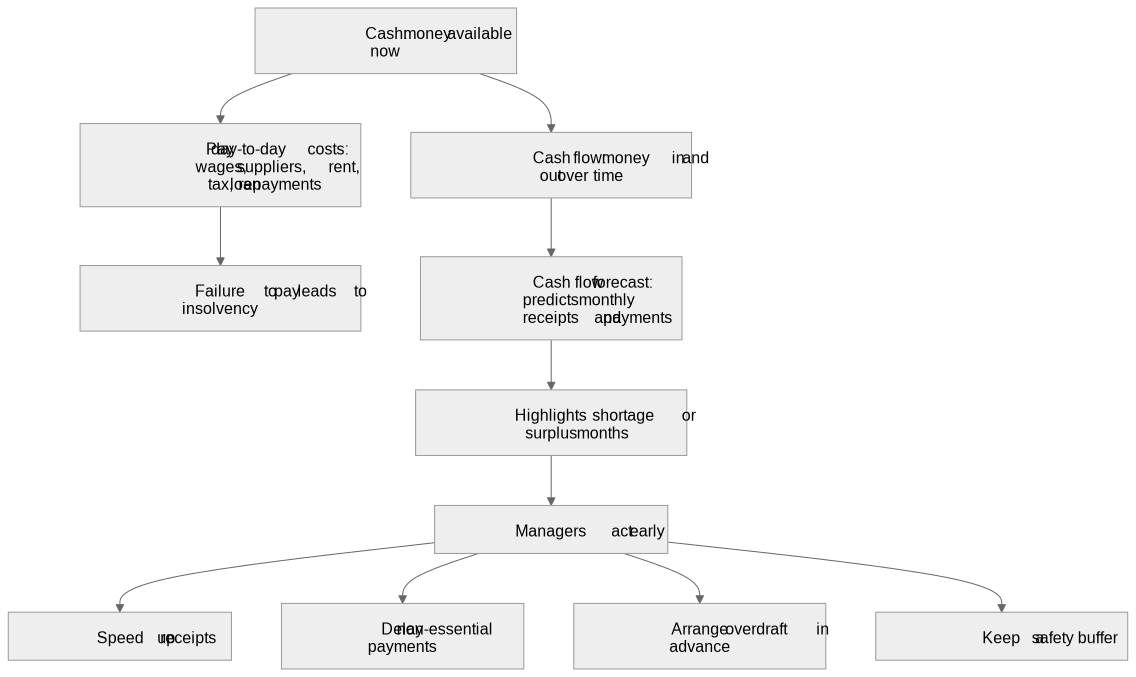
Cash is the money a business can access immediately to pay wages, suppliers, rent, tax and loan repayments. Profit and cash are not the same: a profitable firm can still fail if customers buy on credit and cash arrives later than bills fall due, a situation called insolvency or liquidation. Cash flow is the movement of money in and out over time; a cash flow forecast predicts receipts and payments month by month and highlights periods of shortage or surplus. Importance includes meeting day-to-day obligations, avoiding expensive emergency borrowing, maintaining supplier and employee confidence, funding stock and investment, and surviving seasonal or unexpected downturns. Managing cash involves speeding up receipts, delaying non-essential payments, arranging an overdraft facility in advance and keeping a safety buffer. A strong answer earns marks for these points. Defines cash as money available now and distinguishes it from profit, which is revenue minus costs over a period and may be tied up in debtors or stock. Explains that cash is needed to pay day-to-day costs such as wages, suppliers, rent, utilities, tax and loan interest, and that failure to pay can lead to insolvency. Describes how a cash flow forecast predicts monthly receipts and payments and identifies shortage or surplus months so managers can act early. Analyses consequences of poor cash management: missed payments damage credit rating, suppliers may refuse trade credit, staff may leave and the business may be forced into liquidation. A common slip: Confusing cash with profit. Instead, state that profit is an accounting measure over a period while cash is the immediate money available, and a profitable firm can run out of cash. Exam tip: Use the case study figures to calculate closing balances and identify the month with the largest deficit or surplus.
See it
Key words
Say what each word means before you turn the card.
Cash
Try answering aloud or in your head before turning the card.
Insolvency
Try answering aloud or in your head before turning the card.
Cash flow forecast
Try answering aloud or in your head before turning the card.
Liquidation
Try answering aloud or in your head before turning the card.
See every definition
- Cash
- The money a business can access immediately to pay wages, suppliers, rent, tax and loan repayments.
- Insolvency
- A situation where a profitable firm can still fail if customers buy on credit and cash arrives later than bills fall due.
- Cash flow forecast
- A prediction of receipts and payments month by month that highlights periods of shortage or surplus.
- Liquidation
- A situation, alongside insolvency, arising when customers buy on credit and cash arrives later than bills fall due.
Label the diagram
Some boxes have lost their names. Pick the right name for each number.
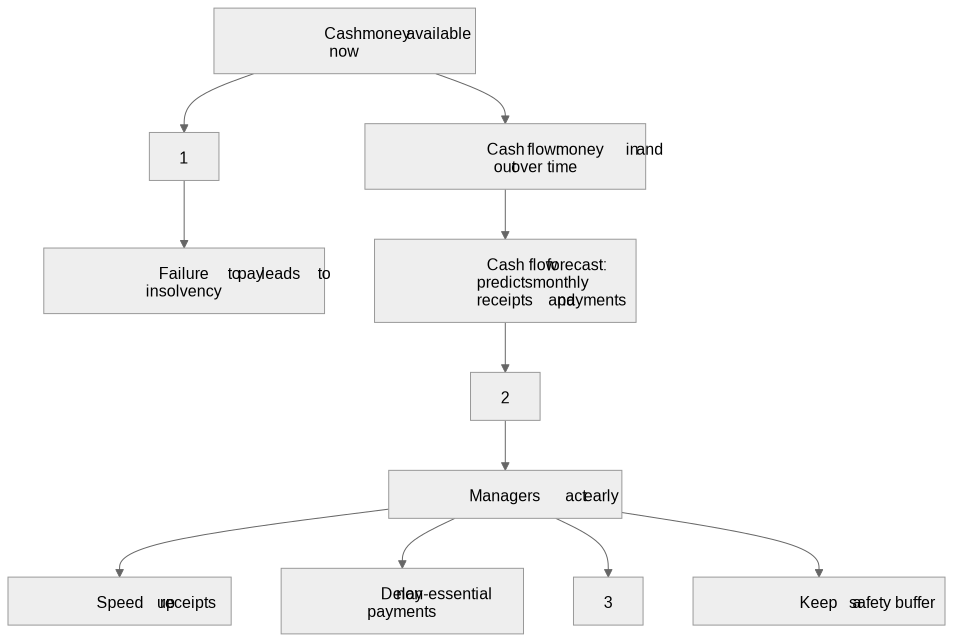
1Box 1
2Box 2
3Box 3
There is more to this lesson
The full lesson goes on to check your understanding and help you earn the marks. Create a free account to carry on, with your progress saved.
A week of Premium from your first lesson · Then the free plan continues · No card, no charge
Worked Examples
3 worked examples — open one to explore the question and available guidance.
Practice Questions
Try the question, then reveal an answer plan or example response
A business is experiencing a negative net cash flow. Explain two methods the business could use to improve its cash flow position. (6 marks)
Hint: Think about one way to increase money coming in, and one way to decrease or delay money going out.
Discuss whether a bank loan or selling assets is the best way for a growing manufacturing business to solve a significant cash flow shortage. (9 marks)
Hint: Evaluate both options in the context of a 'growing manufacturing business'. What does a manufacturer need to grow?
Ready to test yourself interactively?
Active recall beats reading alone. Answer questions on Cash flow with instant AI scoring and mark scheme guidance.
A week of Premium from your first lesson · Then the free plan continues · No card, no charge
Exam technique
How to turn what you know into marks
How to approach the question
Always check the command word. For 'Calculate', show your working. For 'Evaluate', you must provide a balanced argument with a justified conclusion.
How to structure your answer
- Essay questions
- Define key terms -> Advantage in context -> Disadvantage in context -> Justified conclusion.
- Source questions
- Apply your knowledge directly to the specific business mentioned in the case study.
- Explain questions
- Make a clear point, then develop it using connective phrases like 'this means that' or 'as a result'.
Timing
Approximately 1 minute per mark, plus planning time for longer evaluation questions.
Common pitfalls
- Confusing cash flow with profit.
- Making arithmetic errors in forecast tables and not showing working.
- Providing a one-sided evaluation without considering the drawbacks of a proposed solution.
- Failing to carry the closing balance of one month forward as the opening balance of the next.
What the command words want
- Explain
- Provide a reason and develop it logically.
- Evaluate
- Weigh up the pros and cons of a business decision and reach a supported judgement.
- Calculate
- Perform the mathematical operation and explicitly show the steps.
- State/Identify
- Give a brief, factual answer without needing explanation.
Watch or listen (optional)
Test your understanding of Cash flow
Active recall beats re-reading. Take an instant quiz now to test what you’ve learned and lock it into long-term memory.
A week of Premium from your first lesson · Then the free plan continues · No card, no charge