AQA · GCSE · Business
Course version: 8132 · Version from Sept 2017
Motivating employees
Motivation is the internal drive that makes employees want to work hard and perform well. This study guide covers the crucial financial and non-financial methods businesses use to motivate staff, and how a motivated workforce directly impacts business success, productivity, and profitability.
- Point 3 of 5
- 5 min read
- 3 worked examples
- 5 practice questions
- 4 key terms
Study Notes
Overview
Motivation is a fundamental concept in Business Studies. It refers to the willingness of employees to work hard and put effort into their jobs. For any business, a motivated workforce is a critical asset. Examiners consistently test your understanding of how businesses motivate their staff and why it matters to the overall success of the enterprise. You are expected to evaluate different methods of motivation and apply them to specific business contexts. Remember, examiners are not looking for abstract theories like Maslow or Taylor at GCSE level; they want to see practical application of financial and non-financial methods and their direct impact on business performance metrics like productivity, staff turnover, and profitability.
The Importance of Motivation
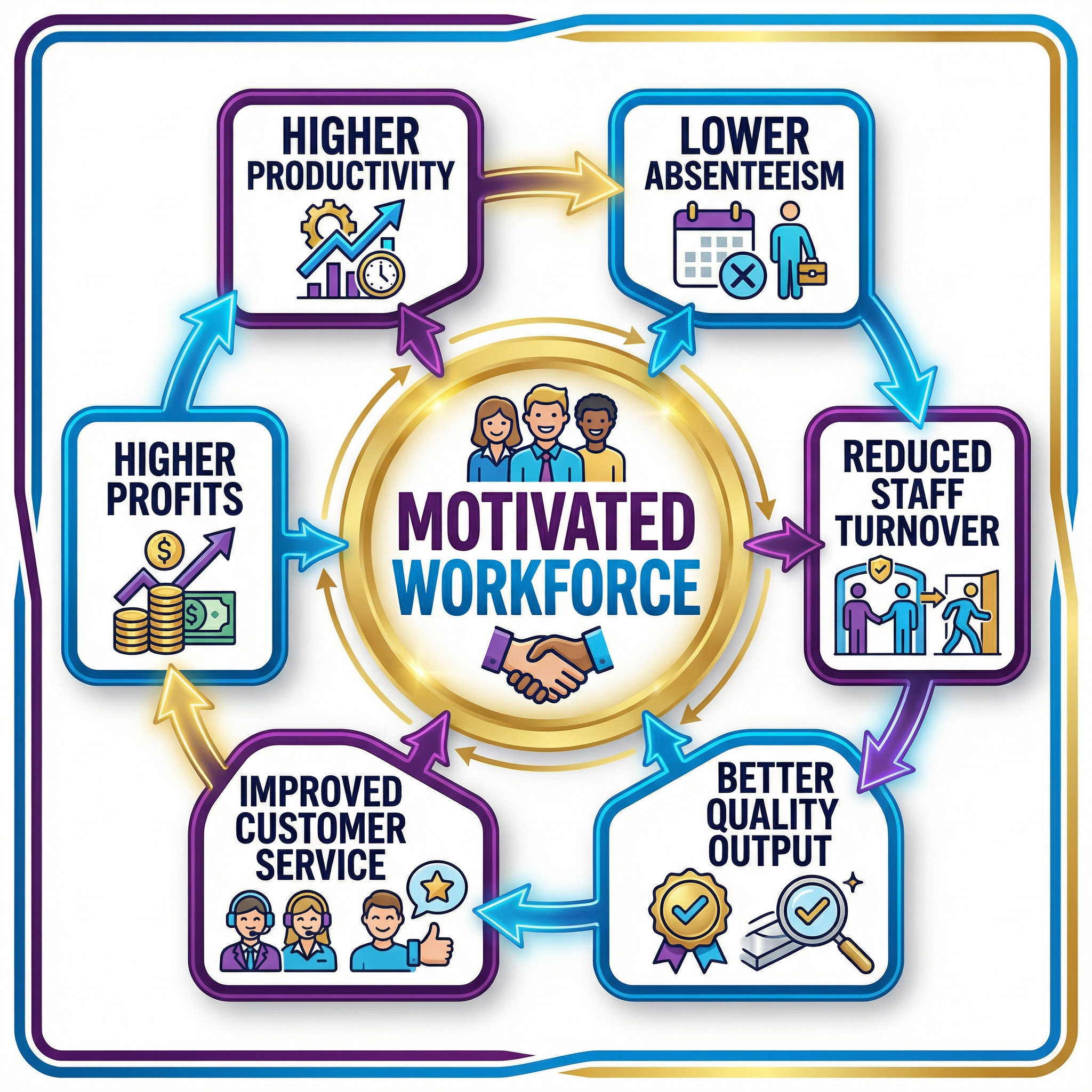
A motivated workforce provides several distinct advantages to a business. Understanding these benefits is crucial for answering 'explain the impact' style questions.
Higher Productivity
Motivated employees produce more output in the same amount of time. They work efficiently and are less likely to waste time. This lowers the unit cost of production, making the business more competitive.
Lower Absenteeism
When employees are motivated and enjoy their work, they are less likely to take unauthorized days off (absenteeism). This ensures smooth operations and reduces the cost of hiring temporary cover.
Reduced Staff Turnover
Staff turnover refers to the rate at which employees leave a business and need to be replaced. Motivated staff are loyal and tend to stay longer. This saves the business significant recruitment and training costs.
Better Quality Output
Employees who care about their work take pride in what they produce. This leads to fewer mistakes, lower wastage rates, and higher quality products or services, which enhances the business's reputation.
 Open full-size image (opens in a new tab)
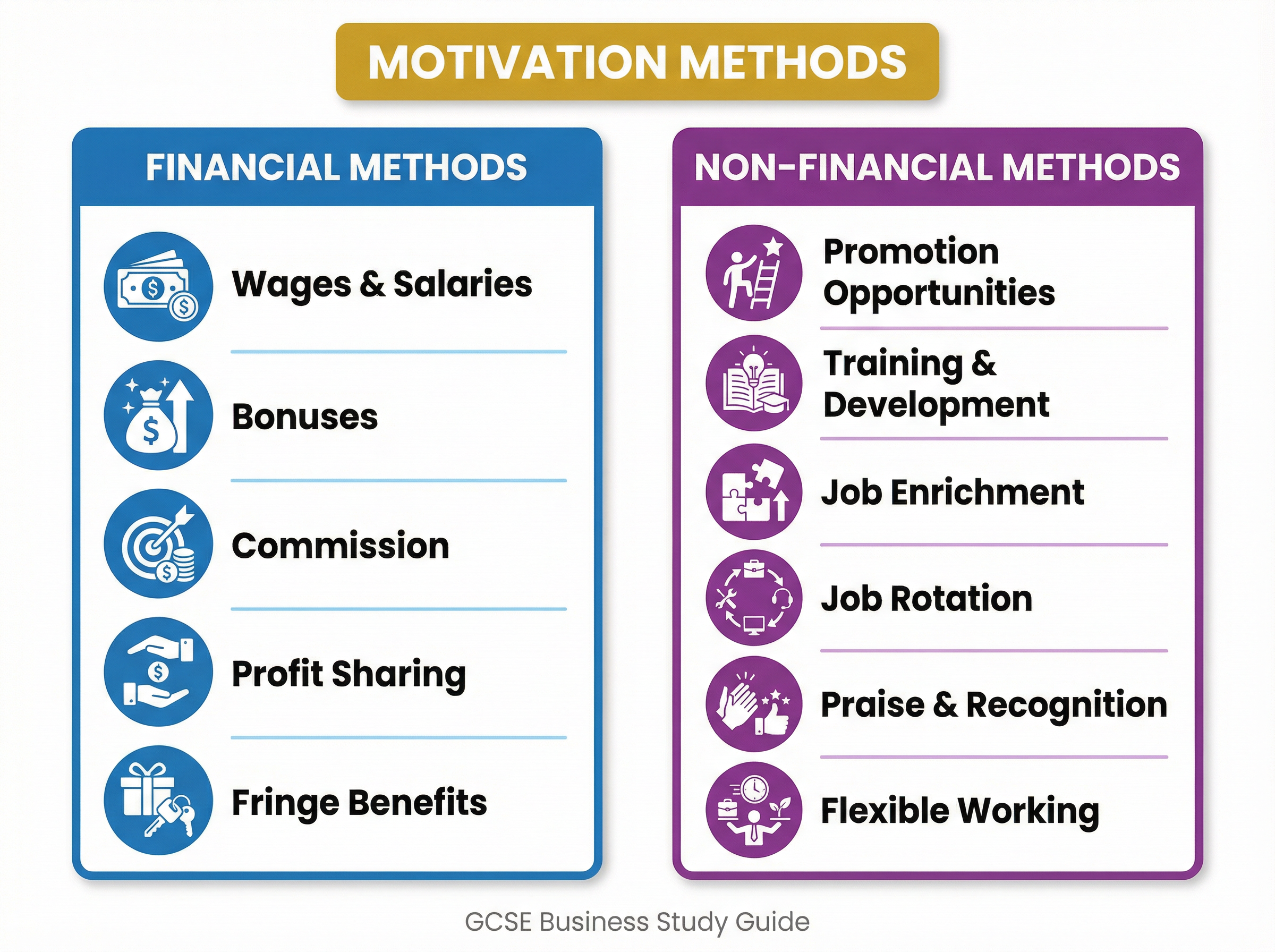
Financial Methods of Motivation
Financial methods involve monetary rewards designed to encourage harder work and better performance.
Wages and Salaries
A wage is typically paid hourly or per unit produced (piece-rate). It is common in retail and manufacturing. A salary is a fixed annual amount paid monthly, regardless of the exact hours worked, common in professional roles. While base pay is necessary, increasing it can provide a short-term motivational boost.
Bonuses
A bonus is a one-off lump sum paid to an employee for achieving a specific target or for excellent performance. It provides a clear, tangible goal for employees to strive towards.
Commission
Commission is a payment made to an employee based on the value of the sales they generate. It is highly motivating for sales staff, as their income is directly tied to their effort and success.
Profit Sharing
This involves distributing a percentage of the business's annual profits among the employees. It aligns the interests of the workers with those of the owners, encouraging everyone to work towards the company's financial success.
Fringe Benefits
Also known as 'perks', these are non-cash rewards that have a financial value. Examples include a company car, private health insurance, free meals, or staff discounts. They help attract and retain high-quality staff.
Non-Financial Methods of Motivation
Non-financial methods focus on psychological needs, job satisfaction, and the working environment. These are often more effective for long-term motivation than money alone.
Promotion Opportunities
Offering a clear career path and the chance to move up the hierarchy motivates employees to work hard to prove their capability. It fulfills the desire for status and achievement.
Training and Development
Providing opportunities for staff to learn new skills makes them feel valued and invested in. It increases their competence and confidence, leading to higher job satisfaction.
Job Enrichment
This involves making a job more challenging and interesting by giving the employee more responsibility, autonomy, and complex tasks. It prevents boredom and allows employees to use their full range of abilities.
Job Rotation
Job rotation involves moving employees between different tasks or departments on a regular basis. This reduces the monotony of repetitive work and helps create a more flexible, multi-skilled workforce.
Praise and Recognition
Simply acknowledging good work through verbal praise, 'Employee of the Month' awards, or public recognition can be incredibly powerful. It costs the business nothing but significantly boosts morale.
Flexible Working
Allowing employees to have control over when and where they work (e.g., remote working, flexitime) improves their work-life balance. This demonstrates trust and can lead to higher loyalty and motivation.
 Open full-size image (opens in a new tab)
Podcast Episode: Motivating Employees
Listen to this 10-minute revision podcast covering the core concepts, exam tips, and a quick-fire recall quiz.
Try the lesson
The start of the Motivating employees lesson, made from teaching notes for this specification point.
Have a go first
Which of the following is a benefit to a business of having a motivated workforce?
Listen
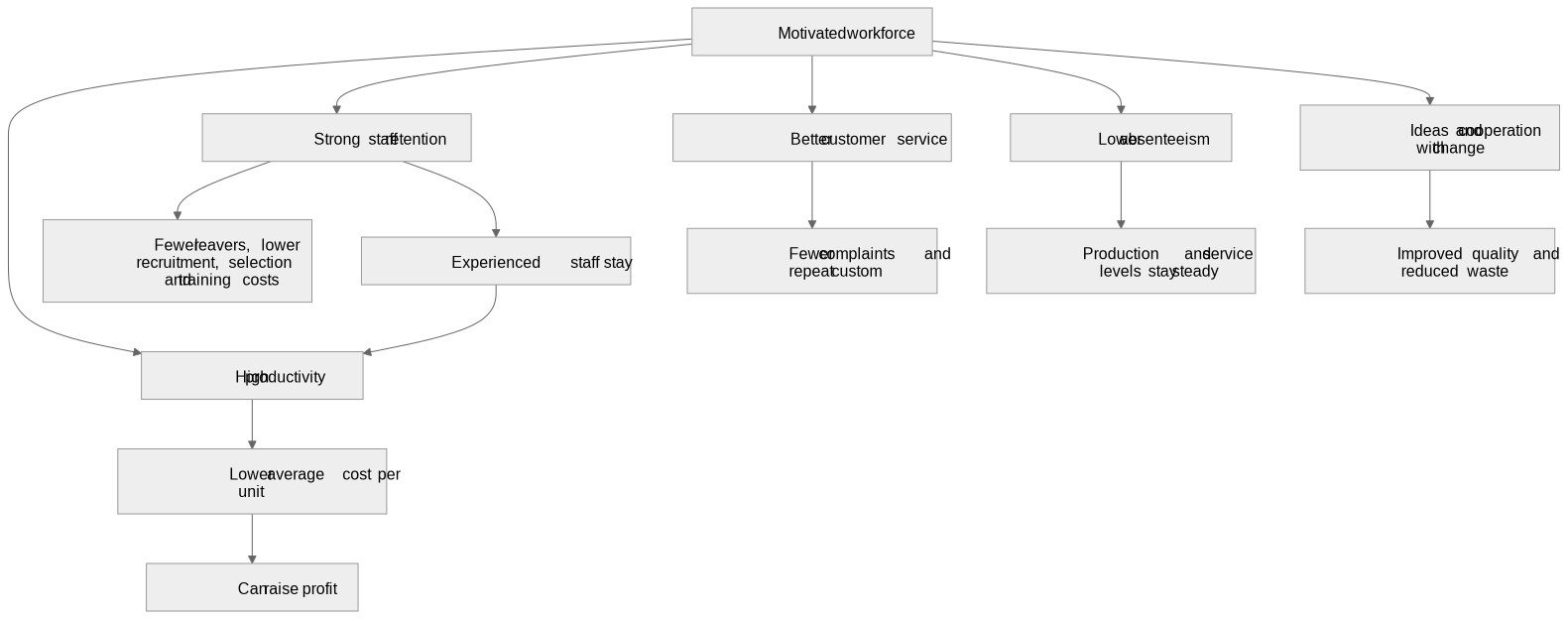
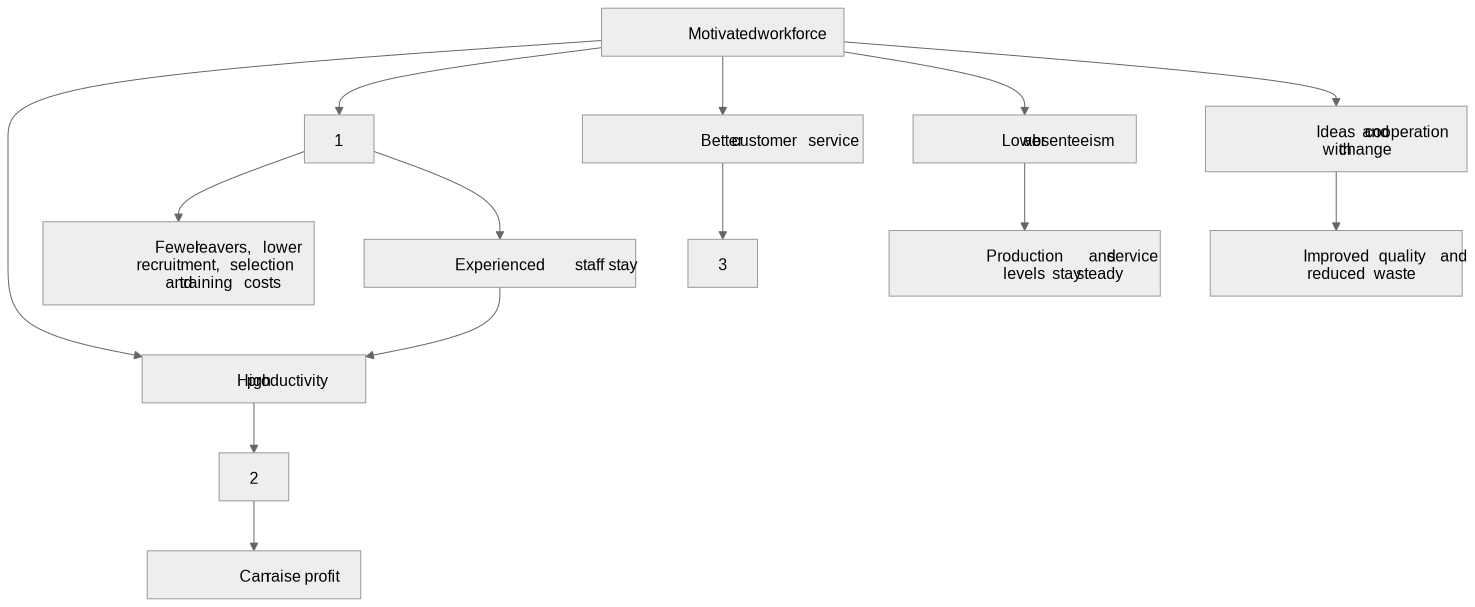
A motivated workforce chooses to work hard, and this brings measurable benefits. High productivity means more output per worker in a given time, which lowers average cost per unit and can raise profit. Strong staff retention means fewer leavers, so recruitment, selection and training costs fall and experienced staff stay. Motivated employees may also give better customer service, reducing complaints and raising repeat custom, and they may suggest improvements that cut waste. Lower absenteeism keeps production steady. These benefits link together: retention preserves skills, skills raise productivity, and productivity supports competitiveness. For example, a factory with low turnover avoids repeatedly training new machinists, so output per hour stays high. Benefits are not automatic; poor management can reverse them. A strong answer earns marks for these points. High productivity means more output per employee in a given period, which reduces average cost per unit and can increase profit. Strong staff retention means fewer employees leave, so the business spends less on recruitment, selection and induction training. Experienced staff who stay may provide better customer service, which can raise customer satisfaction and repeat purchases. Lower absenteeism and a motivated workforce keep production and service levels steady, avoiding disruption and overtime costs. A common slip: Claiming motivation automatically raises profit. Instead, motivation can raise productivity and lower costs, but profit also depends on sales, prices and other costs. Exam tip: Link each benefit to a cause: state the motivation method, then explain how it leads to retention or productivity, then state the effect on the business.
See it
Key words
Say what each word means before you turn the card.
Productivity and unit cost
Try answering aloud or in your head before turning the card.
Staff retention and recruitment costs
Try answering aloud or in your head before turning the card.
Customer service and business reputation
Try answering aloud or in your head before turning the card.
Competitiveness and profitability
Try answering aloud or in your head before turning the card.
See every definition
- Productivity and unit cost
- High productivity means more output per worker in a given time, which lowers average cost per unit and can raise profit.
- Staff retention and recruitment costs
- Strong staff retention means fewer leavers, so recruitment, selection and training costs fall and experienced staff stay.
- Customer service and business reputation
- Motivated employees may give better customer service, reducing complaints and raising repeat custom.
- Competitiveness and profitability
- Lower unit costs and better service can help the business win and keep customers, while lower average cost per unit can raise profit.
Label the diagram
Some boxes have lost their names. Pick the right name for each number.
1Box 1
2Box 2
3Box 3
There is more to this lesson
The full lesson goes on to check your understanding and help you earn the marks. Create a free account to carry on, with your progress saved.
A week of Premium from your first lesson · Then the free plan continues · No card, no charge
Worked Examples
3 worked examples — open one to explore the question and available guidance.
Practice Questions
Try the question, then reveal an answer plan or example response
Explain one reason why a business might use job rotation to motivate its production line workers. (3 marks)
Hint: Think about what working on a production line is usually like, and how moving around changes that.
A software development company pays its programmers a high fixed salary. Analyze how offering flexible working might further motivate these employees. (6 marks)
Hint: Focus on the non-financial benefits of flexible working for professionals who already earn good money.
State two financial methods of motivation other than wages and salaries. (2 marks)
Hint: Think of the 'BCPF' part of the WBC-PFF mnemonic.
Explain how high staff turnover can negatively affect a business. (3 marks)
Hint: What does a business have to do when someone leaves?
Evaluate whether commission is the best way to motivate retail staff in a mobile phone shop. (9 marks)
Hint: Argue both sides. Why is commission good for sales? Why might it cause problems with customer service?
Ready to test yourself interactively?
Active recall beats reading alone. Answer questions on Motivating employees with instant AI scoring and mark scheme guidance.
A week of Premium from your first lesson · Then the free plan continues · No card, no charge
Exam technique
How to turn what you know into marks
How to approach the question
Always identify the command word first. Highlight the context in the case study before writing.
How to structure your answer
- State questions
- Provide simple, one-word or short-phrase answers. Do not waste time explaining.
- Explain questions
- State the point -> Explain how it works -> Explain the impact on the business (BLT: Because, Leading to, Therefore).
- Evaluate questions
- Define key term -> Analyze advantage in context -> Analyze disadvantage in context -> Conclude with a justified decision.
Timing
Approximately 1 minute per mark. Spend 9 minutes on a 9-mark question.
Common pitfalls
- Failing to apply the answer to the specific business context provided in the case study.
- Confusing job enrichment (more responsibility) with job rotation (moving between different tasks).
- Writing about Maslow or Taylor when the specification only requires knowledge of practical methods.
What the command words want
- Analyze
- Examine the impacts or consequences in detail, using connective language.
- Explain
- Make a point and develop it showing cause and effect.
- State/Identify
- Write a simple fact. No explanation needed.
- Evaluate/Recommend
- Look at both sides of an argument (pros and cons) and make a final, justified judgement based on the specific business.
Test your understanding of Motivating employees
Active recall beats re-reading. Take an instant quiz now to test what you’ve learned and lock it into long-term memory.
A week of Premium from your first lesson · Then the free plan continues · No card, no charge