AQA · GCSE · Business
Course version: 8132 · Version from Sept 2017
Setting business aims and objectives
Master the foundation of business strategy by understanding why businesses set aims and objectives. Learn how to distinguish between broad aims and SMART objectives, and discover how business size, sector, and lifecycle stage influence these crucial decisions.
- Point 5 of 10
- 4 min read
- 3 worked examples
- 5 practice questions
- 4 key terms
Study Notes
Overview
Setting aims and objectives is the starting point for any business, whether it's a small local start-up or a multinational PLC. This topic is foundational for GCSE Business; it provides the context for almost every other decision a business makes, from marketing strategies to financial planning. Examiners expect candidates to clearly distinguish between broad, long-term aims and specific, measurable objectives. More importantly, you must be able to apply this knowledge to different business contexts. A common pitfall is giving generic answers without considering the specific size, ownership type, or competitive environment of the business in the case study.
Listen to the Podcast
Key Concepts
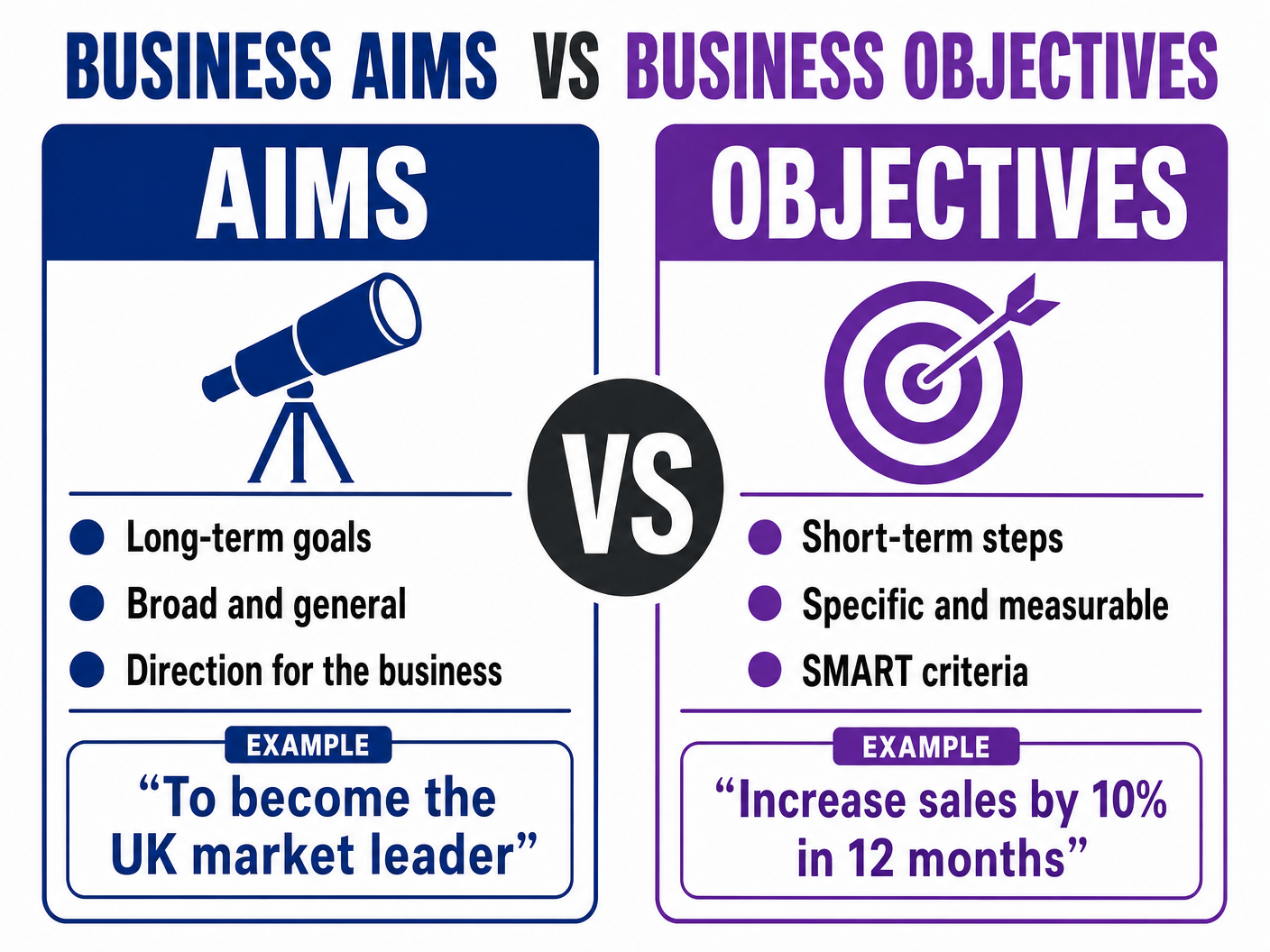
Aims vs Objectives
Many candidates lose marks by confusing these two terms.
- Business Aim: The overarching, long-term goal of the business. It provides direction. For example, 'to be the leading provider of eco-friendly packaging in the UK'.
- Business Objective: A specific, measurable step taken to achieve the aim. Objectives should follow the SMART criteria. For example, 'to increase sales of recycled boxes by 15% within the next 12 months'.
 Open full-size image (opens in a new tab)
SMART Objectives
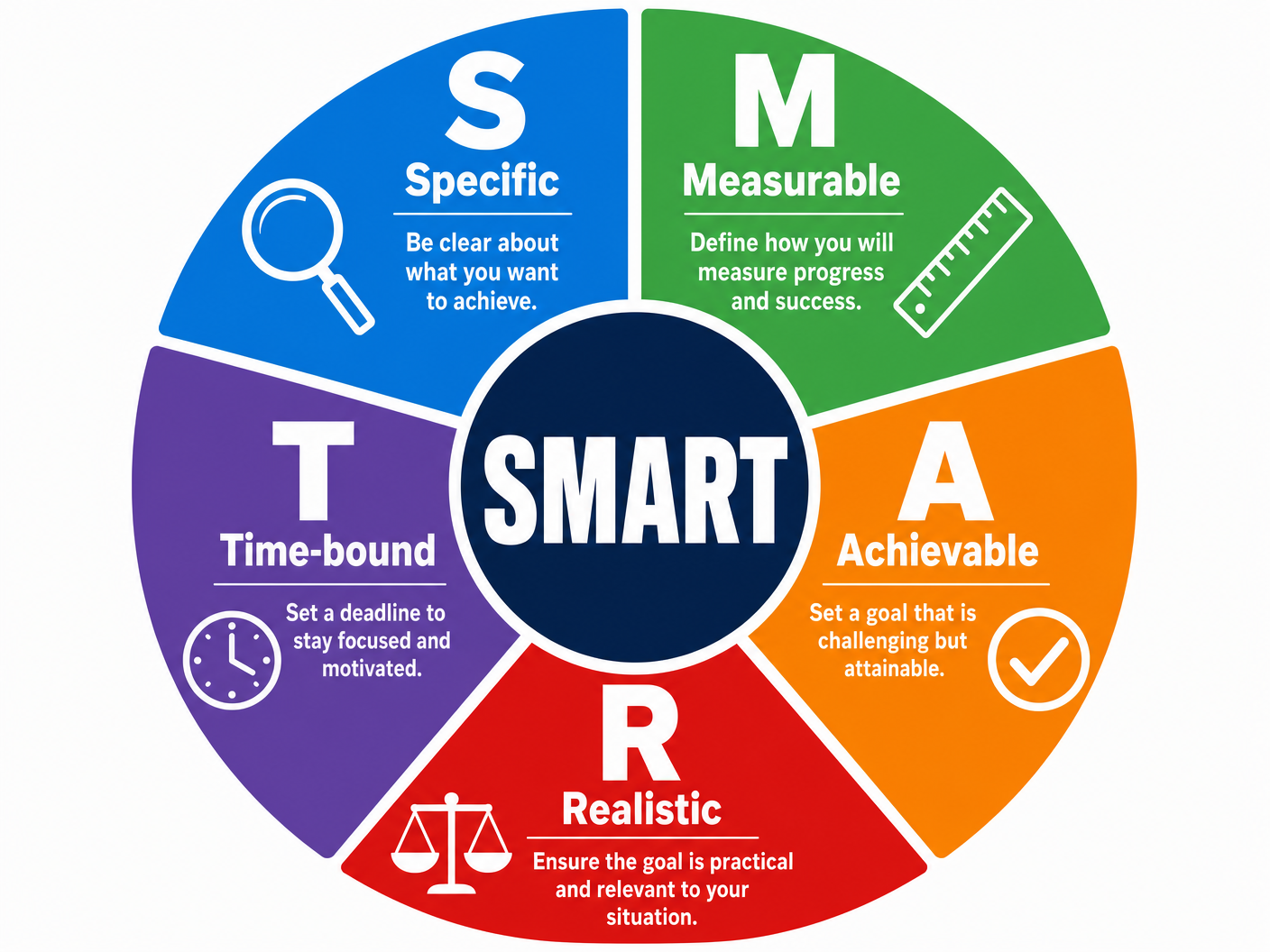
For an objective to be effective, it should be SMART:
- Specific: Clearly defined.
- Measurable: Can be quantified (e.g., in £ or %).
- Achievable: Possible to attain with current resources.
- Realistic: Relevant to the business and its market.
- Time-bound: Has a clear deadline.
 Open full-size image (opens in a new tab)
Main Types of Business Objectives
Candidates must be familiar with seven key objectives:
- Survival: The primary objective for most new start-ups. In the first year of trading, avoiding failure and maintaining positive cash flow is critical.
- Profit Maximisation: Making as much profit as possible. Profit is total revenue minus total costs. This is essential for rewarding owners and funding future growth.
- Growth: Expanding the business. This could be domestic (more stores in the UK) or international. Growth can lead to economies of scale.
- Market Share: The proportion of total sales in a market held by one business. Increasing market share often means taking customers away from competitors.
- Customer Satisfaction: Meeting or exceeding customer expectations. High satisfaction leads to customer loyalty and positive word-of-mouth.
- Social and Ethical Objectives: Operating in a way that benefits society or the environment. This is the primary aim of social enterprises and charities, but is increasingly important for all businesses (Corporate Social Responsibility).
- Shareholder Value: Maximising the return for investors through rising share prices and dividend payments. This is the dominant objective for Public Limited Companies (PLCs).
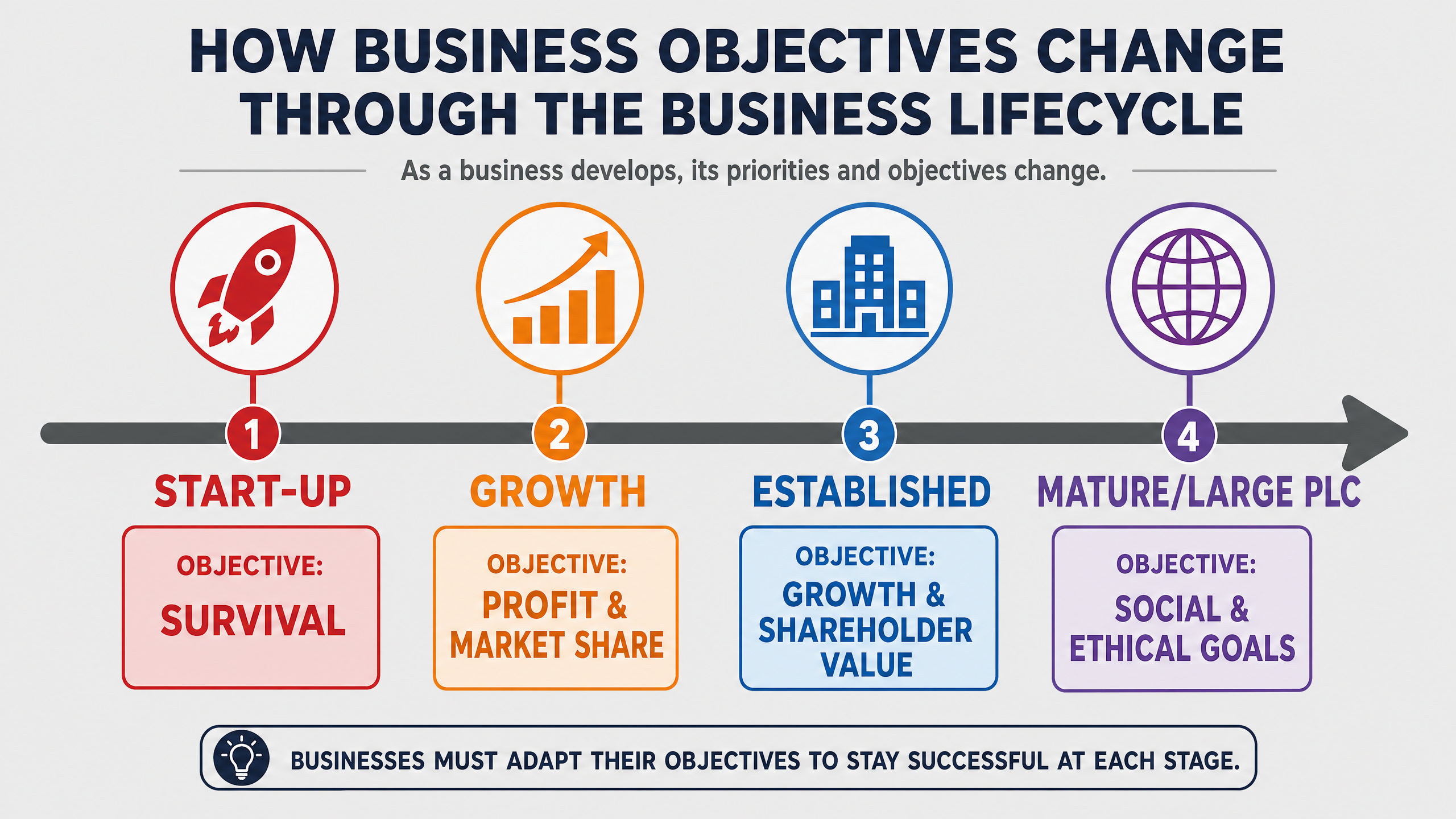
How Objectives Change
Examiners frequently test your understanding of how objectives evolve. Objectives are not static; they change based on:
- Business Lifecycle: A start-up focuses on survival. An established business focuses on profit and growth. A mature PLC might focus on shareholder value and ethical goals.
- Business Type: A sole trader may just want to earn a living wage. A charity aims to maximise its social impact, not profit.
- External Environment: During an economic recession, even a large, established business might revert its objective back to survival.
Try the lesson
The start of the Setting business aims and objectives lesson, made from teaching notes for this specification point.
Have a go first
A business sets an objective to increase its market share from 10% to 15% within two years. If the business reaches 15% market share, what does this show?
Listen
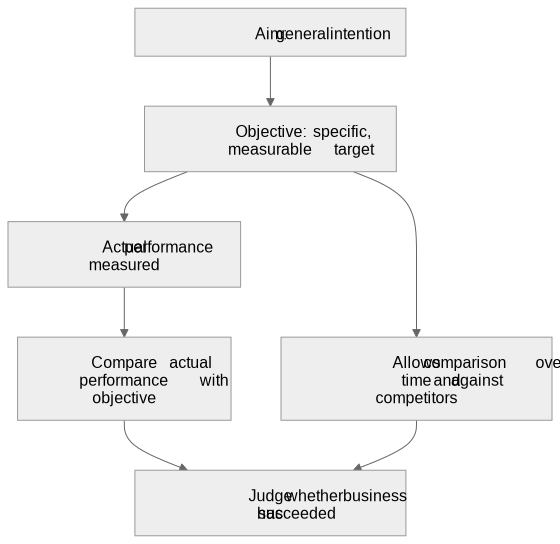
Objectives are the specific, measurable targets a business sets to achieve its aims. They provide a benchmark for judging success: performance is compared with the objective to decide whether the business has succeeded. For example, a business aiming to increase market share might set an objective to raise its market share from 15% to 20% within 12 months. Success is judged by measuring actual market share against that target. Objectives must be specific and measurable so that judgements are evidence-based rather than subjective. They also allow comparison over time and against competitors. Without clear objectives, it is difficult to say whether a business has succeeded because there is no standard for comparison. A strong answer earns marks for these points. Objectives are specific, measurable targets that provide a benchmark for judging success. Success is judged by comparing actual performance with the objective. Objectives must be measurable so that judgements are based on evidence. Objectives allow comparison over time and against competitors. A common slip: Confusing aims with objectives: aims are general intentions, objectives are specific targets. Instead, use objectives for judging success because they are measurable. Exam tip: When asked how objectives help judge success, explain the comparison between actual performance and the target.
See it
Key words
Say what each word means before you turn the card.
Setting objectives
Try answering aloud or in your head before turning the card.
Measuring performance
Try answering aloud or in your head before turning the card.
Judging success
Try answering aloud or in your head before turning the card.
Business aims
Try answering aloud or in your head before turning the card.
See every definition
- Setting objectives
- Objectives are the specific, measurable targets a business sets to achieve its aims.
- Measuring performance
- Actual performance is compared with the objective to decide whether the business has succeeded.
- Judging success
- Success is judged by measuring actual performance against the target, so judgements are evidence-based rather than subjective.
- Business aims
- Aims are general intentions, while objectives are specific targets used for judging success because they are measurable.
Label the diagram
Some boxes have lost their names. Pick the right name for each number.
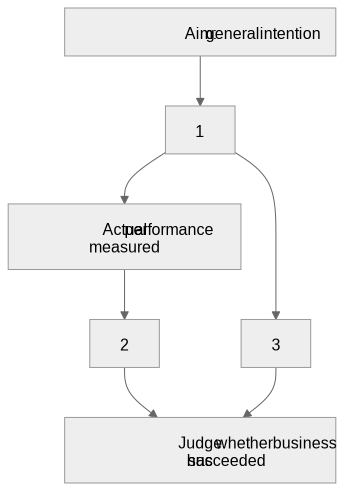
1Box 1
2Box 2
3Box 3
There is more to this lesson
The full lesson goes on to check your understanding and help you earn the marks. Create a free account to carry on, with your progress saved.
A week of Premium from your first lesson · Then the free plan continues · No card, no charge
Worked Examples
3 worked examples — open one to explore the question and available guidance.
Practice Questions
Try the question, then reveal an answer plan or example response
Explain how the objectives of a large multinational PLC might differ from those of a local charity. (6 marks)
Hint: Focus on ownership and purpose. Who owns a PLC and what do they want? What is the purpose of a charity?
State two features of a SMART objective. (2 marks)
Hint: Think of the acronym SMART.
Explain why a business might change its objective from survival to growth. (3 marks)
Hint: What has to happen for a business to no longer worry about survival?
Evaluate the importance of setting social and ethical objectives for a large clothing retailer. (9 marks)
Hint: Consider both the benefits (reputation, sales) and drawbacks (costs, lower profit margins) of ethical sourcing.
Define the term 'market share'. (2 marks)
Hint: It's a percentage of the whole.
Ready to test yourself interactively?
Active recall beats reading alone. Answer questions on Setting business aims and objectives with instant AI scoring and mark scheme guidance.
A week of Premium from your first lesson · Then the free plan continues · No card, no charge
Exam technique
How to turn what you know into marks
How to approach the question
Always highlight the name, size, and type of business in the case study before answering.
How to structure your answer
- Essay questions
- Paragraph 1: Benefit/Argument For (in context). Paragraph 2: Drawback/Argument Against (in context). Conclusion: Judgement with justification.
- Source questions
- N/A for standard Business papers, but always refer to data in the case study.
- Explain questions
- Point -> Context -> Impact. State your point, link it to the specific business, explain the consequence.
Timing
Approximately 1 minute per mark, plus reading time for the case study.
Common pitfalls
- Using 'aim' and 'objective' interchangeably.
- Giving generic answers that could apply to any business, ignoring the case study.
- Assuming profit is the only way to measure success.
What the command words want
- Analyse
- Show the chain of consequences. 'If X happens, then Y will happen, which means Z...'
- Explain
- Give a reason and develop it. Use connective words like 'because', 'leading to', 'therefore'.
- State/Identify
- Give a simple, short answer. No explanation needed.
- Evaluate/Recommend
- Look at both sides (pros and cons), apply to the specific business, and write a final justified decision.
Watch or listen (optional)
Test your understanding of Setting business aims and objectives
Active recall beats re-reading. Take an instant quiz now to test what you’ve learned and lock it into long-term memory.
A week of Premium from your first lesson · Then the free plan continues · No card, no charge