AQA · GCSE · Business
Course version: 8132 · Version from Sept 2017
Students should be able to discuss how demand for products and services…
Full specification wording
The economic climate on businesses: Students should be able to discuss how demand for products and services may change as incomes fluctuate.
Income is the money households receive, and when it rises or falls, spending on products and services shifts.
Checked against the AQA 8132 specification (opens in a new tab) on .
- Point 8 of 8
- 4 key terms
Study notes
From the checked teaching notes for this specification point.
The idea
Income is the money households receive, and when it rises or falls, spending on products and services shifts. For normal goods, demand usually rises as income rises: a family with more disposable income may eat out more often. For inferior goods, demand can fall as income rises because buyers trade up to better alternatives, such as replacing a budget supermarket range with a premium brand. Demand also depends on whether the product is a necessity or a luxury: necessities such as basic food are less income-sensitive, while luxuries such as holidays are more sensitive. Businesses therefore watch income trends, because falling demand can cut revenue and cash flow, while rising demand may require extra capacity.
What earns the marks
- Defines income as the money received by households and links fluctuations to changes in spending on products and services.
- Explains that demand for normal goods generally rises when income rises and falls when income falls, using a named example such as meals out or clothing.
- Explains that demand for inferior goods can fall when income rises as consumers switch to higher-quality substitutes, and can rise when income falls.
- Distinguishes necessities from luxuries, noting that luxury demand is more responsive to income changes than demand for necessities.
- Applies the idea to a business context, for example explaining how a fall in income could reduce revenue, profit and cash flow for a restaurant.
- Uses the term demand correctly as the quantity customers are willing and able to buy at a given price, not simply what customers want.
Common mistakes and how to put them right
Treating all products as normal goods.
Put it right: Recognise inferior goods, where demand can fall as income rises.
Confusing demand with revenue.
Put it right: Demand is the quantity customers are willing and able to buy, while revenue is price multiplied by quantity sold.
Ignoring the necessity or luxury distinction.
Put it right: Luxury demand is more income-sensitive than demand for necessities.
Exam tips
- Use a named product in each explanation so the income link is concrete, for example stating how a rise in income affects demand for budget clothing versus premium clothing.
- Develop each point with a consequence for the business, such as the effect on sales volume, revenue or capacity needs, rather than stopping at the demand change.
- When discussing a fall in income, consider both directions: demand may rise for inferior goods and fall for normal or luxury goods, which shows balanced analysis.
Try the lesson
The start of the The economic climate on businesses: Students should be able to discuss how demand for products and services may change as incomes fluctuate. lesson, made from checked teaching notes for this specification point.
Have a go first
A country experiences a period of economic growth, leading to a significant increase in average consumer incomes. How is this most likely to affect the demand for luxury holidays?
Listen
Income is the money households receive, and when it rises or falls, spending on products and services shifts. For normal goods, demand usually rises as income rises: a family with more disposable income may eat out more often. For inferior goods, demand can fall as income rises because buyers trade up to better alternatives, such as replacing a budget supermarket range with a premium brand. Demand also depends on whether the product is a necessity or a luxury: necessities such as basic food are less income-sensitive, while luxuries such as holidays are more sensitive. Businesses therefore watch income trends, because falling demand can cut revenue and cash flow, while rising demand may require extra capacity. A strong answer earns marks for these points. Defines income as the money received by households and links fluctuations to changes in spending on products and services. Explains that demand for normal goods generally rises when income rises and falls when income falls, using a named example such as meals out or clothing. Explains that demand for inferior goods can fall when income rises as consumers switch to higher-quality substitutes, and can rise when income falls. Distinguishes necessities from luxuries, noting that luxury demand is more responsive to income changes than demand for necessities. A common slip: Treating all products as normal goods: the error is assuming demand always rises with income. Instead, recognise inferior goods, where demand can fall as income rises. Exam tip: Use a named product in each explanation so the income link is concrete, for example stating how a rise in income affects demand for budget clothing versus premium clothing.
See it
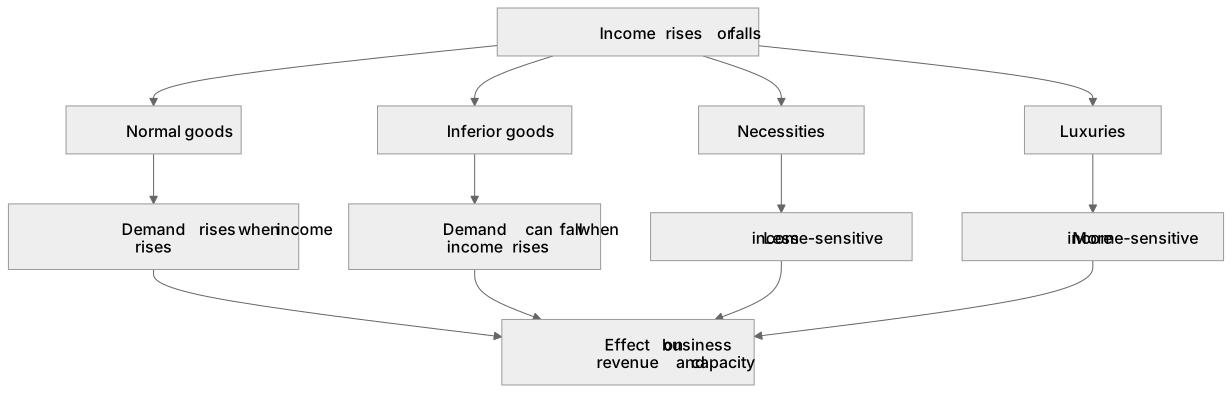
Key words
Say what each word means before you turn the card.
Income
Try answering aloud or in your head before turning the card.
Normal goods
Try answering aloud or in your head before turning the card.
Inferior goods
Try answering aloud or in your head before turning the card.
Necessities and luxuries
Try answering aloud or in your head before turning the card.
See every definition
- Income
- The money households receive, and when it rises or falls, spending on products and services shifts.
- Normal goods
- Products for which demand usually rises as income rises, as a family with more disposable income may eat out more often.
- Inferior goods
- Products for which demand can fall as income rises because buyers trade up to better alternatives.
- Necessities and luxuries
- Necessities such as basic food are less income-sensitive, while luxuries such as holidays are more sensitive.
Label the diagram
Some boxes have lost their names. Pick the right name for each number.
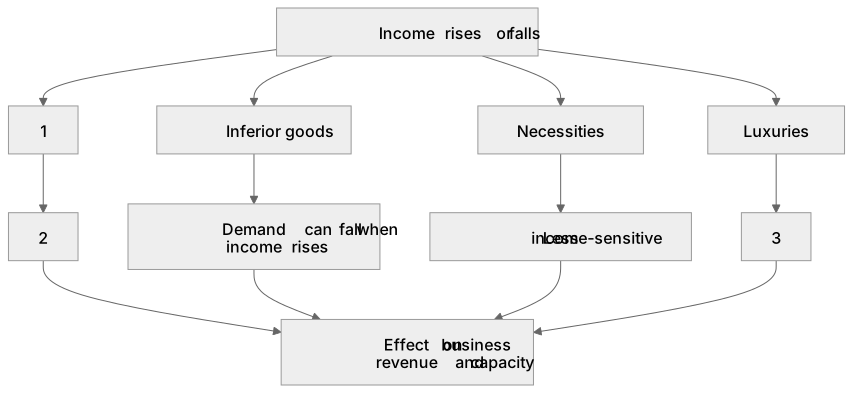
1Box 1
2Box 2
3Box 3
There is more to this lesson
The full lesson goes on to check your understanding and help you earn the marks. Create a free account to carry on, with your progress saved.
A week of Premium from your first lesson · Then the free plan continues · No card, no charge
Test your understanding of The economic climate on businesses: Students should be able to discuss how demand for products and services may change as incomes fluctuate.
Active recall beats re-reading. Take an instant quiz now to test what you’ve learned and lock it into long-term memory.
A week of Premium from your first lesson · Then the free plan continues · No card, no charge