AQA · A-Level · Chemistry
Course version: 7405 · Version from Sept 2016
Nucleophilic substitution: Halogenoalkanes contain polar bonds.
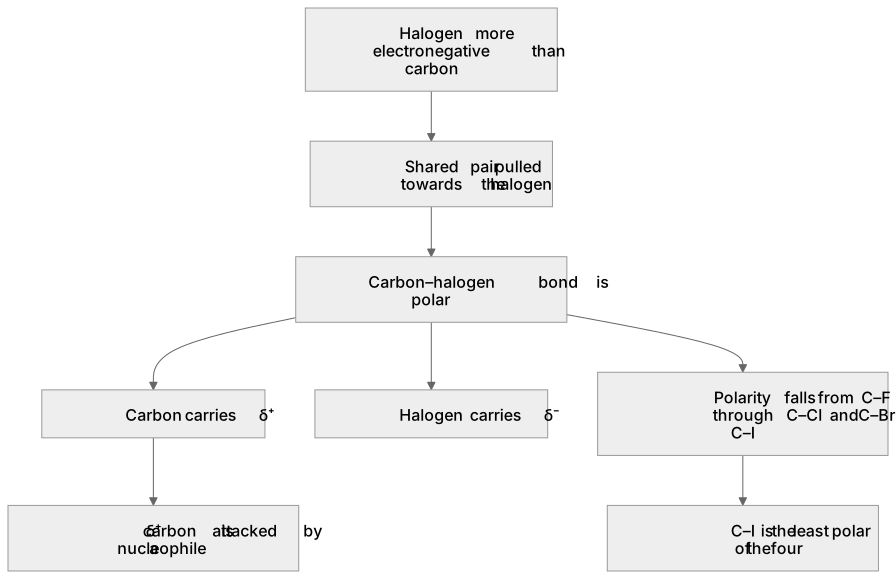
Halogens are more electronegative than carbon, so the shared pair in a carbon–halogen bond is pulled towards the halogen.
Checked against the AQA 7405 specification (opens in a new tab) on .
- Point 1 of 2
- 4 key terms
Study notes
From the checked teaching notes for this specification point.
The idea
Halogens are more electronegative than carbon, so the shared pair in a carbon–halogen bond is pulled towards the halogen. The bond is therefore polar: the carbon carries a small positive charge, δ⁺, and the halogen a small negative charge, δ⁻. That electron-deficient carbon is the site every reaction of a halogenoalkane starts from, because a nucleophile is attracted to positive charge. Polarity falls from C–F through C–Cl and C–Br to C–I as electronegativity falls down the group, so C–I is the least polar bond of the four. Do not turn that into a prediction about rate: iodoalkanes still react fastest because the C–I bond is the weakest, and bond enthalpy, not polarity, controls how quickly the bond breaks.
What earns the marks
- Stating that the halogen is more electronegative than carbon.
- The δ⁺ label on the carbon and the δ⁻ label on the halogen, shown on the bond.
- Identifying the δ⁺ carbon as the atom attacked by a nucleophile.
- The correct order of bond polarity, C–F most polar through to C–I least polar.
Common mistakes and how to put them right
Labelling the carbon δ⁻ and the halogen δ⁺, which reverses the whole mechanism.
Writing full charges C⁺ and Cl⁻ rather than the partial charges δ⁺ and δ⁻.
Claiming C–I is the most polar bond because iodine is the largest atom.
Predicting that the most polar bond reacts fastest, when the rate follows bond enthalpy instead.
Exam tips
- Always draw the δ⁺ and δ⁻ on the bond itself, not floating next to the molecule.
- Say "more electronegative than carbon" explicitly; naming the halogen as electronegative on its own rarely scores.
- Keep polarity and bond enthalpy as two separate arguments so you do not use one where the other is wanted.
Try the lesson
The start of the Nucleophilic substitution: Halogenoalkanes contain polar bonds. lesson, made from checked teaching notes for this specification point.
Have a go first
Which statement explains why the carbon–halogen bond in a halogenoalkane is polar?
Listen
Halogens are more electronegative than carbon, so the shared pair in a carbon–halogen bond is pulled towards the halogen. The bond is therefore polar: the carbon carries a small positive charge, δ⁺, and the halogen a small negative charge, δ⁻. That electron-deficient carbon is the site every reaction of a halogenoalkane starts from, because a nucleophile is attracted to positive charge. Polarity falls from C–F through C–Cl and C–Br to C–I as electronegativity falls down the group, so C–I is the least polar bond of the four. Do not turn that into a prediction about rate: iodoalkanes still react fastest because the C–I bond is the weakest, and bond enthalpy, not polarity, controls how quickly the bond breaks. A strong answer earns marks for these points. stating that the halogen is more electronegative than carbon. the δ⁺ label on the carbon and the δ⁻ label on the halogen, shown on the bond. identifying the δ⁺ carbon as the atom attacked by a nucleophile. the correct order of bond polarity, C–F most polar through to C–I least polar. Exam tip: Always draw the δ⁺ and δ⁻ on the bond itself, not floating next to the molecule.
See it
Key words
Say what each word means before you turn the card.
bond polarity
Try answering aloud or in your head before turning the card.
partial charges
Try answering aloud or in your head before turning the card.
electron-deficient carbon
Try answering aloud or in your head before turning the card.
site of nucleophilic attack
Try answering aloud or in your head before turning the card.
See every definition
- bond polarity
- The shared pair in a carbon–halogen bond is pulled towards the halogen, so the bond is polar.
- partial charges
- The carbon carries a small positive charge, δ⁺, and the halogen a small negative charge, δ⁻.
- electron-deficient carbon
- The carbon carrying a small positive charge, δ⁺, is the site every reaction of a halogenoalkane starts from.
- site of nucleophilic attack
- The electron-deficient carbon is attacked because a nucleophile is attracted to positive charge.
Label the diagram
Some boxes have lost their names. Pick the right name for each number.
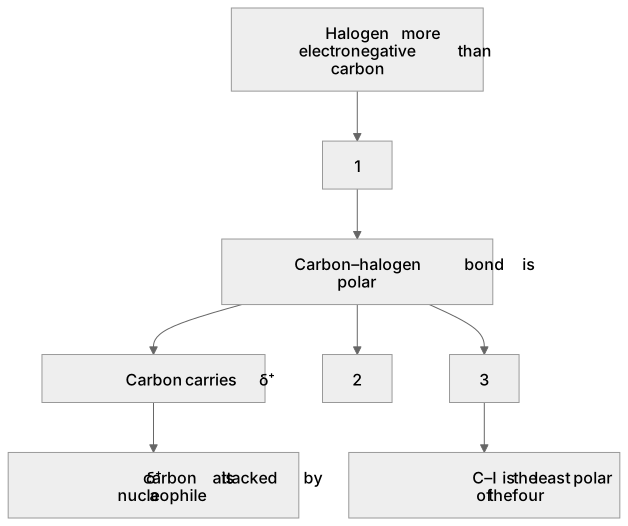
1Box 1
2Box 2
3Box 3
There is more to this lesson
The full lesson goes on to check your understanding and help you earn the marks. Create a free account to carry on, with your progress saved.
A week of Premium from your first lesson · Then the free plan continues · No card, no charge
Test your understanding of Nucleophilic substitution: Halogenoalkanes contain polar bonds.
Active recall beats re-reading. Take an instant quiz now to test what you’ve learned and lock it into long-term memory.
A week of Premium from your first lesson · Then the free plan continues · No card, no charge