AQA · GCSE · Chemistry
Course version: 8462 · Version from Sept 2018
Catalysts: Enzymes act as catalysts in biological systems.
Enzymes are biological catalysts: proteins that speed up reactions in living organisms without being used up.
- Point 2 of 5
Study notes
From the teaching notes for this specification point.
The idea
Enzymes are biological catalysts: proteins that speed up reactions in living organisms without being used up. They work in the same way as inorganic catalysts by providing an alternative pathway with a lower activation energy, but they are specific to particular substrates because their active site has a complementary shape. For example, catalase speeds up the breakdown of hydrogen peroxide into water and oxygen, and amylase breaks down starch into sugars. Enzymes operate under mild conditions of temperature and pH, and their activity is affected if these conditions change because the active site can be denatured. This links the general idea of catalysis to biological systems and shows that the same principles of collision theory and activation energy apply.
What earns the marks
- State that enzymes are biological catalysts, usually proteins.
- Explain that enzymes speed up reactions without being used up.
- Link enzyme action to a lower activation energy pathway, as with other catalysts.
- Describe enzyme specificity using the active site and complementary substrate shape.
- Give a named example such as catalase breaking down hydrogen peroxide or amylase breaking down starch.
Common mistakes and how to put them right
Saying enzymes are used up in the reaction.
Put it right by stating they are catalysts and are regenerated.
Claiming enzymes work for any substrate.
Put it right by explaining that the active site is specific to a complementary substrate.
Stating enzymes are inorganic catalysts.
Put it right by identifying them as biological catalysts, typically proteins.
Exam tips
- Use the term biological catalyst when defining an enzyme.
- Link enzyme action to the same collision theory and activation energy ideas used for inorganic catalysts.
- If asked about conditions, mention that high temperature or extreme pH can denature the enzyme and stop it working.
Try the lesson
The start of the Catalysts: Enzymes act as catalysts in biological systems. lesson, made from teaching notes for this specification point.
Have a go first
What is the role of enzymes in biological systems?
Listen
Enzymes are biological catalysts: proteins that speed up reactions in living organisms without being used up. They work in the same way as inorganic catalysts by providing an alternative pathway with a lower activation energy, but they are specific to particular substrates because their active site has a complementary shape. For example, catalase speeds up the breakdown of hydrogen peroxide into water and oxygen, and amylase breaks down starch into sugars. Enzymes operate under mild conditions of temperature and pH, and their activity is affected if these conditions change because the active site can be denatured. This links the general idea of catalysis to biological systems and shows that the same principles of collision theory and activation energy apply. A strong answer earns marks for these points. State that enzymes are biological catalysts, usually proteins. Explain that enzymes speed up reactions without being used up. Link enzyme action to a lower activation energy pathway, as with other catalysts. Describe enzyme specificity using the active site and complementary substrate shape. A common slip: Saying enzymes are used up in the reaction. Instead, stating they are catalysts and are regenerated. Exam tip: Use the term biological catalyst when defining an enzyme.
See it
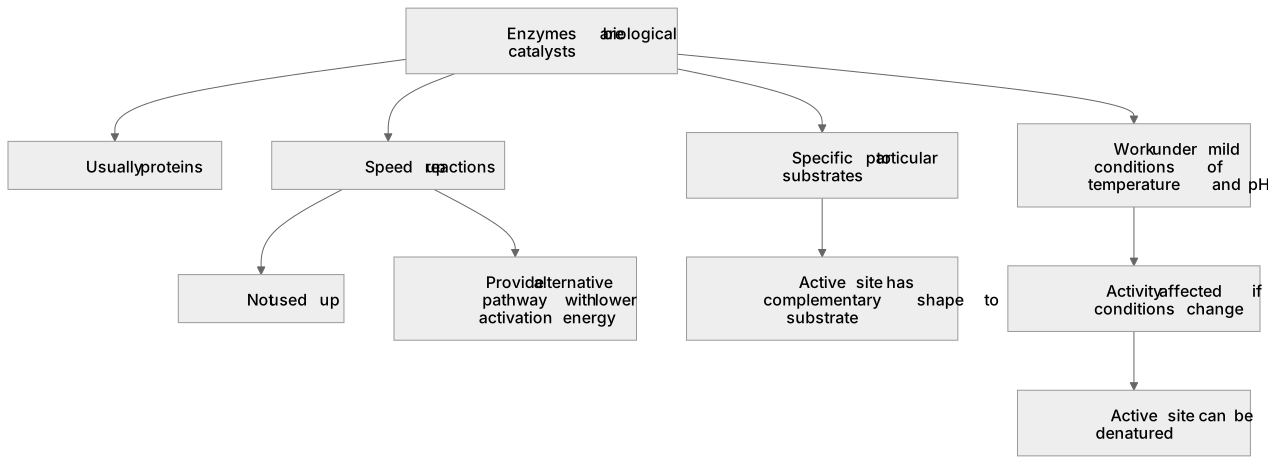
Label the diagram
Some boxes have lost their names. Pick the right name for each number.
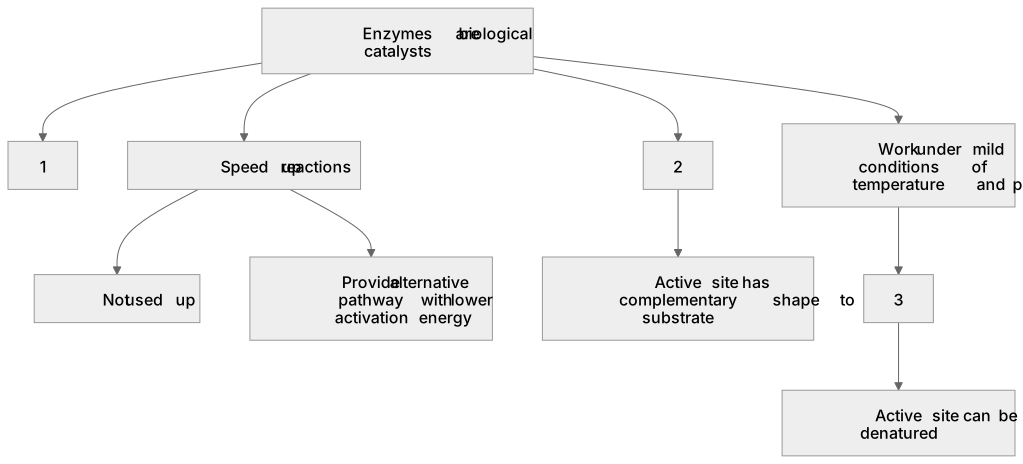
1Box 1
2Box 2
3Box 3
There is more to this lesson
The full lesson goes on to check your understanding and help you earn the marks. Create a free account to carry on, with your progress saved.
A week of Premium from your first lesson · Then the free plan continues · No card, no charge
Test your understanding of Catalysts: Enzymes act as catalysts in biological systems.
Active recall beats re-reading. Take an instant quiz now to test what you’ve learned and lock it into long-term memory.
A week of Premium from your first lesson · Then the free plan continues · No card, no charge