OCR · A-Level · Chemistry
Course version: H432 · Version from Sept 2017
Acids: Acid–base titrations
An acid–base titration uses a burette to add a solution of known concentration to a measured volume of the other solution until the reaction is just complete, marked by an indicator colour change…
- Point 5 of 7
- 4 key terms
Study notes
From the teaching notes for this specification point.
The idea
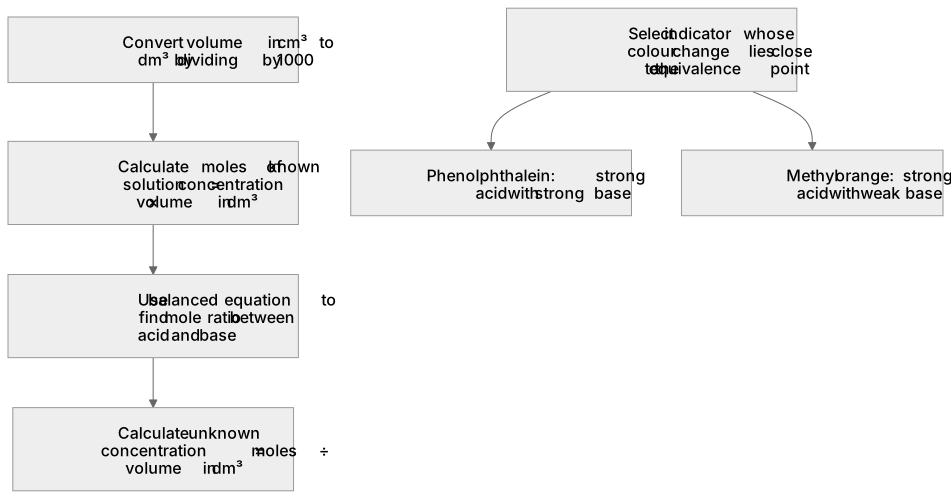
An acid–base titration uses a burette to add a solution of known concentration to a measured volume of the other solution until the reaction is just complete, marked by an indicator colour change or a pH meter. A suitable indicator changes colour close to the equivalence point; phenolphthalein suits a strong acid with a strong base, while methyl orange suits a strong acid with a weak base. The result allows calculation of an unknown concentration: moles = concentration × volume in dm³, and the balanced equation gives the reacting ratio.
For example: If 25.0 cm³ of 0.100 mol dm⁻³ NaOH needs 20.0 cm³ of HCl, then moles of NaOH = 0.100 × 0.0250 = 2.50 × 10⁻³ mol, and the 1:1 equation gives the acid concentration as 2.50 × 10⁻³ ÷ 0.0200 = 0.125 mol dm⁻³.
What earns the marks
- Converts a volume in cm³ to dm³ by dividing by 1000 before multiplying by concentration.
- Calculates moles of the known solution as concentration multiplied by volume in dm³.
- Uses the balanced equation to find the mole ratio between acid and base.
- Selects an indicator whose colour change lies close to the equivalence point.
- Calculates the unknown concentration by dividing moles by the volume in dm³.
- Reads a burette to the bottom of the meniscus and records to two decimal places.
Common mistakes and how to put them right
Uses the volume in cm³ directly in the moles calculation.
Put it right: Divide by 1000 to convert to dm³ first.
Ignores the mole ratio from the balanced equation.
Put it right: Apply the coefficients before comparing moles.
Chooses an indicator that changes colour far from the equivalence point.
Put it right: Match the indicator to the acid and base strength.
Reads the burette from the top of the meniscus.
Put it right: Read the bottom of the meniscus at eye level.
Exam tips
- Always convert volumes to dm³ before using moles = concentration × volume.
- Write the balanced equation first so the mole ratio is clear.
- Check that the indicator's colour change matches the pH at the equivalence point.
- Keep units consistent and give the final concentration in mol dm⁻³.
Try the lesson
The start of the Acids: Acid–base titrations lesson, made from teaching notes for this specification point.
Listen
An acid–base titration uses a burette to add a solution of known concentration to a measured volume of the other solution until the reaction is just complete, marked by an indicator colour change or a pH meter. A suitable indicator changes colour close to the equivalence point; phenolphthalein suits a strong acid with a strong base, while methyl orange suits a strong acid with a weak base. The result allows calculation of an unknown concentration: moles = concentration × volume in dm³, and the balanced equation gives the reacting ratio. For example, if 25.0 cm³ of 0.100 mol dm⁻³ NaOH needs 20.0 cm³ of HCl, then moles of NaOH = 0.100 × 0.0250 = 2.50 × 10⁻³ mol, and the 1:1 equation gives the acid concentration as 2.50 × 10⁻³ ÷ 0.0200 = 0.125 mol dm⁻³. A strong answer earns marks for these points. Converts a volume in cm³ to dm³ by dividing by 1000 before multiplying by concentration. Calculates moles of the known solution as concentration multiplied by volume in dm³. Uses the balanced equation to find the mole ratio between acid and base. Selects an indicator whose colour change lies close to the equivalence point. Exam tip: Always convert volumes to dm³ before using moles = concentration × volume.
See it
Key words
Say what each word means before you turn the card.
Acid–base titration
Try answering aloud or in your head before turning the card.
Equivalence point
Try answering aloud or in your head before turning the card.
Indicator choice
Try answering aloud or in your head before turning the card.
Mole calculations from concentration and volume
Try answering aloud or in your head before turning the card.
See every definition
- Acid–base titration
- Uses a burette to add a solution of known concentration to a measured volume of the other solution until the reaction is just complete, marked by an indicator colour change or a pH meter.
- Equivalence point
- The point at which the reaction is just complete; a suitable indicator changes colour close to it.
- Indicator choice
- A suitable indicator changes colour close to the equivalence point; phenolphthalein suits a strong acid with a strong base, while methyl orange suits a strong acid with a weak base.
- Mole calculations from concentration and volume
- Moles = concentration × volume in dm³, and the balanced equation gives the reacting ratio, allowing calculation of an unknown concentration.
Label the diagram
Some boxes have lost their names. Pick the right name for each number.
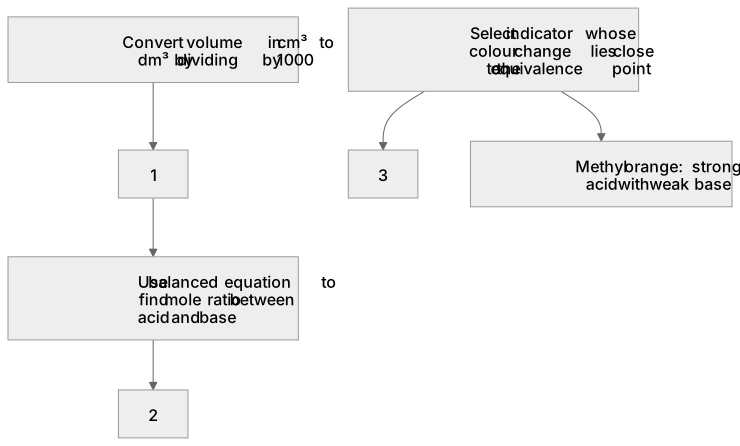
1Box 1
2Box 2
3Box 3
There is more to this lesson
The full lesson goes on to check your understanding and help you earn the marks. Create a free account to carry on, with your progress saved.
A week of Premium from your first lesson · Then the free plan continues · No card, no charge
Test your understanding of Acids: Acid–base titrations
Active recall beats re-reading. Take an instant quiz now to test what you’ve learned and lock it into long-term memory.
A week of Premium from your first lesson · Then the free plan continues · No card, no charge