OCR · A-Level · Chemistry
Course version: H432 · Version from Sept 2017
(i) identification of individual functional groups
Full specification wording
Alcohols, haloalkanes and analysis - 4.2.3 Organic synthesis: (i) identification of individual functional groups
Functional-group identification means reading a displayed or condensed structure and naming each group it contains, one at a time, rather than labelling the whole molecule with a single class.
- Point 7 of 9
- 4 key terms
Study notes
From the teaching notes for this specification point.
The idea
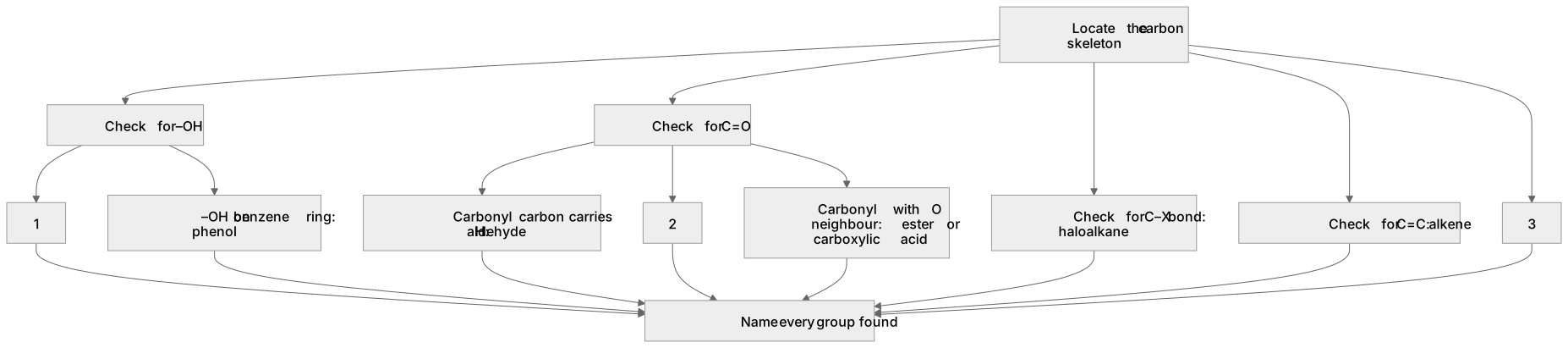
Functional-group identification means reading a displayed or condensed structure and naming each group it contains, one at a time, rather than labelling the whole molecule with a single class. Work systematically: locate the carbon skeleton, then check for an –OH attached to an sp³ carbon (alcohol), an –OH attached directly to a benzene ring (phenol), a C=O with H on the carbon (aldehyde), a C=O between two carbons (ketone), a C=O with an O neighbour (ester or carboxylic acid), a C–X bond (haloalkane), C=C (alkene) and N–H or C≡N groups. A molecule may carry several groups, so a correct answer names all of them and does not stop at the first. Distinguish aldehyde from ketone by what is bonded to the carbonyl carbon, and alcohol from phenol by whether the –OH sits on the ring.
What earns the marks
- Names each functional group present in the displayed structure separately rather than assigning one class to the whole molecule.
- Distinguishes an aldehyde from a ketone by identifying whether the carbonyl carbon carries a hydrogen atom.
- Distinguishes an alcohol from a phenol by identifying whether the hydroxyl group is bonded directly to an aromatic ring.
- Identifies a haloalkane by locating a carbon–halogen bond and states which halogen is present.
- Recognises an ester by the carbonyl carbon bonded to an oxygen that links to a further carbon chain.
- Selects the option that accounts for every functional group present when a molecule contains more than one.
Common mistakes and how to put them right
Labels a molecule containing both an alkene and a hydroxyl group with only one group name.
Put it right: List every group the structure contains.
Calls a ketone an aldehyde because a carbonyl is present.
Put it right: Check whether the carbonyl carbon is bonded to hydrogen.
Describes a phenol as an alcohol.
Put it right: Check whether the –OH is attached directly to the benzene ring.
Treats a C–X bond as a substituent with no functional significance.
Put it right: Identify it as a haloalkane group and name the halogen.
Exam tips
- Redraw or annotate the structure and tick each group as you find it, so none is missed.
- Check the atoms bonded to each carbonyl carbon before deciding aldehyde or ketone.
- Compare each option against the structure group by group and reject any option that invents a group.
- Watch for condensed formulae where the –OH or C=O is easy to overlook.
Try the lesson
The start of the Alcohols, haloalkanes and analysis - 4.2.3 Organic synthesis: (i) identification of individual functional groups lesson, made from teaching notes for this specification point.
Listen
Functional-group identification means reading a displayed or condensed structure and naming each group it contains, one at a time, rather than labelling the whole molecule with a single class. Work systematically: locate the carbon skeleton, then check for an –OH attached to an sp³ carbon (alcohol), an –OH attached directly to a benzene ring (phenol), a C=O with H on the carbon (aldehyde), a C=O between two carbons (ketone), a C=O with an O neighbour (ester or carboxylic acid), a C–X bond (haloalkane), C=C (alkene) and N–H or C≡N groups. A molecule may carry several groups, so a correct answer names all of them and does not stop at the first. Distinguish aldehyde from ketone by what is bonded to the carbonyl carbon, and alcohol from phenol by whether the –OH sits on the ring. A strong answer earns marks for these points. Names each functional group present in the displayed structure separately rather than assigning one class to the whole molecule. Distinguishes an aldehyde from a ketone by identifying whether the carbonyl carbon carries a hydrogen atom. Distinguishes an alcohol from a phenol by identifying whether the hydroxyl group is bonded directly to an aromatic ring. Identifies a haloalkane by locating a carbon–halogen bond and states which halogen is present. Exam tip: Redraw or annotate the structure and tick each group as you find it, so none is missed.
See it

Key words
Say what each word means before you turn the card.
Systematic structural reading
Try answering aloud or in your head before turning the card.
Multiple functional groups in one molecule
Try answering aloud or in your head before turning the card.
Aldehyde versus ketone discrimination
Try answering aloud or in your head before turning the card.
Alcohol versus phenol discrimination
Try answering aloud or in your head before turning the card.
See every definition
- Systematic structural reading
- Reading a displayed or condensed structure by locating the carbon skeleton and then checking for each functional group it contains, one at a time.
- Multiple functional groups in one molecule
- A molecule may carry several groups, so a correct answer names all of them and does not stop at the first.
- Aldehyde versus ketone discrimination
- Telling these apart by what is bonded to the carbonyl carbon, since an aldehyde has a C=O with H on the carbon and a ketone has a C=O between two carbons.
- Alcohol versus phenol discrimination
- Telling these apart by whether the –OH sits on the ring, as an alcohol has an –OH attached to an sp³ carbon and a phenol has an –OH attached directly to a benzene ring.
Label the diagram
Some boxes have lost their names. Pick the right name for each number.
1Box 1
2Box 2
3Box 3
There is more to this lesson
The full lesson goes on to check your understanding and help you earn the marks. Create a free account to carry on, with your progress saved.
A week of Premium from your first lesson · Then the free plan continues · No card, no charge
Test your understanding of Alcohols, haloalkanes and analysis - 4.2.3 Organic synthesis: (i) identification of individual functional groups
Active recall beats re-reading. Take an instant quiz now to test what you’ve learned and lock it into long-term memory.
A week of Premium from your first lesson · Then the free plan continues · No card, no charge