OCR · A-Level · Chemistry
Course version: H432 · Version from Sept 2017
(ii) use as an organic feedstock for the production of plastics and other…
Full specification wording
Alkenes: (ii) use as an organic feedstock for the production of plastics and other organic chemicals
This clause sits within the alkenes topic and concerns using alkenes as an organic feedstock: the C=C bond is the reactive site that lets alkenes be converted into plastics and other organic…
- Point 25 of 27
- 4 key terms
Study notes
From the teaching notes for this specification point.
The idea
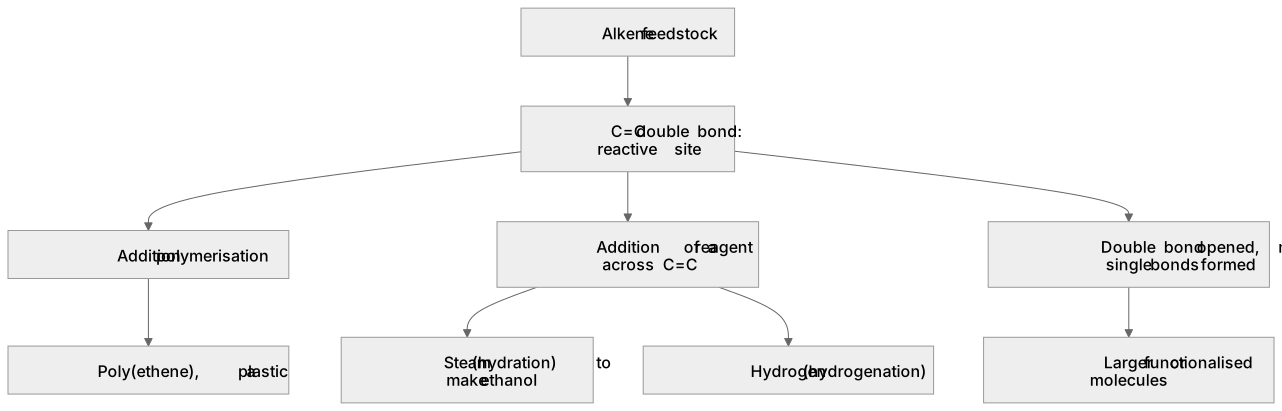
This clause sits within the alkenes topic and concerns using alkenes as an organic feedstock: the C=C bond is the reactive site that lets alkenes be converted into plastics and other organic chemicals. Ethene is the key example. Ethene molecules undergo addition polymerisation, joining through their double bonds to form poly(ethene), a plastic. Other organic chemicals are made by adding reagents across the C=C bond, for example steam in hydration to make ethanol, or hydrogen in hydrogenation. The feedstock is therefore valuable because the double bond can be opened and new single bonds formed, building larger or functionalised molecules. A multiple-choice question may ask why alkenes are useful feedstocks, which product comes from ethene, or what feature of the alkene enables these conversions.
What earns the marks
- Identifies the C=C double bond as the reactive site that allows alkenes to be converted into plastics and other organic chemicals.
- States that ethene undergoes addition polymerisation to form poly(ethene), a plastic.
- Describes addition of a reagent across the C=C bond, such as steam to form ethanol, as a route to other organic chemicals.
- Explains that opening the double bond to form new single bonds builds larger or functionalised molecules from the feedstock.
Common mistakes and how to put them right
Confuses addition polymerisation with condensation polymerisation.
Put it right: State that alkene polymerisation adds monomers across C=C bonds with no small molecule eliminated.
Claims the double bond is unreactive.
Put it right: State that the C=C bond is the reactive site exploited in feedstock chemistry.
Names a product that does not arise from the alkene.
Put it right: Check that the stated plastic or chemical is actually made from the alkene feedstock.
Exam tips
- Read the stem to see whether it asks about the reactive feature, the polymer product or another chemical made from the alkene.
- Link each option back to the C=C bond: the correct answer usually depends on that double bond being opened.
- Eliminate options that describe saturated alkanes as the reactive feedstock, since alkanes lack the C=C bond.
Try the lesson
The start of the Alkenes: (ii) use as an organic feedstock for the production of plastics and other organic chemicals lesson, made from teaching notes for this specification point.
Listen
This clause sits within the alkenes topic and concerns using alkenes as an organic feedstock: the C=C bond is the reactive site that lets alkenes be converted into plastics and other organic chemicals. Ethene is the key example. Ethene molecules undergo addition polymerisation, joining through their double bonds to form poly(ethene), a plastic. Other organic chemicals are made by adding reagents across the C=C bond, for example steam in hydration to make ethanol, or hydrogen in hydrogenation. The feedstock is therefore valuable because the double bond can be opened and new single bonds formed, building larger or functionalised molecules. A multiple-choice question may ask why alkenes are useful feedstocks, which product comes from ethene, or what feature of the alkene enables these conversions. A strong answer earns marks for these points. Identifies the C=C double bond as the reactive site that allows alkenes to be converted into plastics and other organic chemicals. States that ethene undergoes addition polymerisation to form poly(ethene), a plastic. Describes addition of a reagent across the C=C bond, such as steam to form ethanol, as a route to other organic chemicals. Explains that opening the double bond to form new single bonds builds larger or functionalised molecules from the feedstock. Exam tip: Read the stem to see whether it asks about the reactive feature, the polymer product or another chemical made from the alkene.
See it
Key words
Say what each word means before you turn the card.
C=C bond reactivity
Try answering aloud or in your head before turning the card.
Addition polymerisation to plastics
Try answering aloud or in your head before turning the card.
Addition reactions forming other organic chemicals
Try answering aloud or in your head before turning the card.
Ethene as an industrial feedstock
Try answering aloud or in your head before turning the card.
See every definition
- C=C bond reactivity
- The C=C bond is the reactive site that lets alkenes be converted into plastics and other organic chemicals.
- Addition polymerisation to plastics
- Ethene molecules undergo addition polymerisation, joining through their double bonds to form poly(ethene), a plastic.
- Addition reactions forming other organic chemicals
- Other organic chemicals are made by adding reagents across the C=C bond, for example steam in hydration to make ethanol, or hydrogen in hydrogenation.
- Ethene as an industrial feedstock
- The feedstock is valuable because the double bond can be opened and new single bonds formed, building larger or functionalised molecules.
Label the diagram
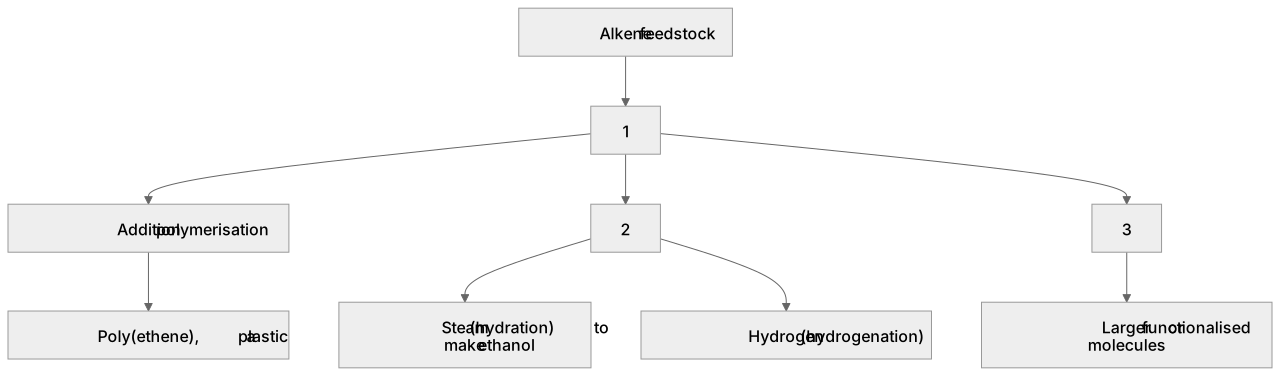
Some boxes have lost their names. Pick the right name for each number.
1Box 1
2Box 2
3Box 3
There is more to this lesson
The full lesson goes on to check your understanding and help you earn the marks. Create a free account to carry on, with your progress saved.
A week of Premium from your first lesson · Then the free plan continues · No card, no charge
Test your understanding of Alkenes: (ii) use as an organic feedstock for the production of plastics and other organic chemicals
Active recall beats re-reading. Take an instant quiz now to test what you’ve learned and lock it into long-term memory.
A week of Premium from your first lesson · Then the free plan continues · No card, no charge