OCR · A-Level · Chemistry
Course version: H432 · Version from Sept 2017
(e) use of infrared spectroscopy to monitor gases causing air pollution…
Full specification wording
Analytical techniques: (e) use of infrared spectroscopy to monitor gases causing air pollution (e.g. CO and NO from car emissions) and in modern breathalysers to measure ethanol in the breath
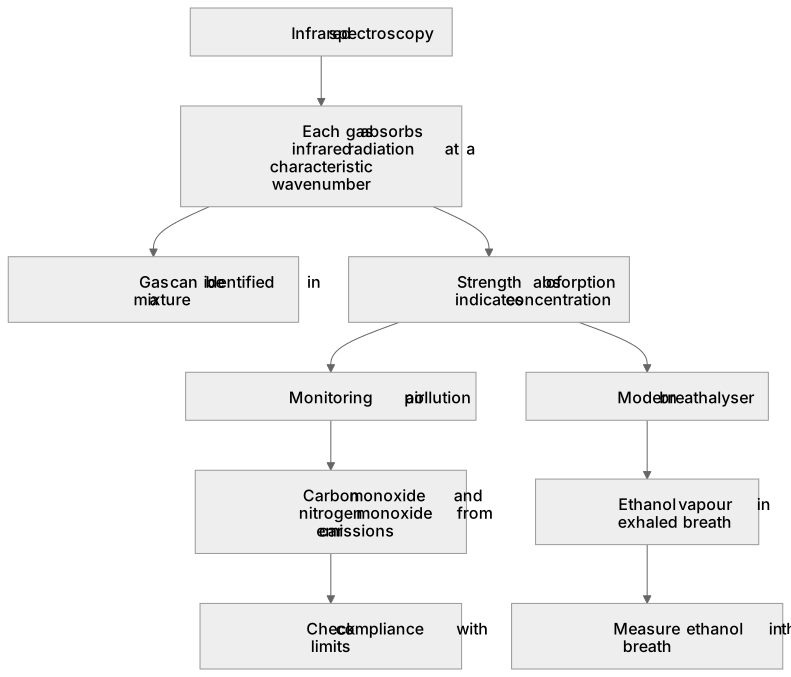
Infrared spectroscopy detects gases because each gas absorbs at characteristic wavenumbers, and the strength of absorption indicates concentration.
- Point 8 of 13
- 4 key terms
Study notes
From the teaching notes for this specification point.
The idea
Infrared spectroscopy detects gases because each gas absorbs at characteristic wavenumbers, and the strength of absorption indicates concentration. Carbon monoxide and nitrogen monoxide from car emissions absorb infrared radiation at their own characteristic wavenumbers, so an infrared detector can monitor their concentration in exhaust or roadside air and check compliance with limits. In a modern breathalyser, ethanol vapour in exhaled breath absorbs infrared radiation at a characteristic wavenumber; the amount of absorption is proportional to the ethanol concentration, which gives a measure of alcohol in the breath. The method is non-destructive and can give a continuous reading, which suits monitoring pollution and roadside testing.
What earns the marks
- Explains that each gas absorbs infrared radiation at a characteristic wavenumber, allowing it to be identified in a mixture.
- Relates the strength of infrared absorption to the concentration of the gas being monitored.
- Applies infrared monitoring to carbon monoxide and nitrogen monoxide from car emissions as air pollutants.
- Describes how a modern breathalyser uses infrared absorption by ethanol vapour to measure ethanol in the breath.
Common mistakes and how to put them right
Claims that infrared spectroscopy measures the mass of gas present.
Put it right: State that it measures absorption, which is related to concentration.
Assumes all gases absorb at the same wavenumber.
Put it right: Each gas has its own characteristic absorption.
Describes the breathalyser as detecting ethanol by colour change.
Put it right: Link the breathalyser to infrared absorption by ethanol.
Exam tips
- Name the specific gas and its characteristic infrared absorption when explaining monitoring.
- Link absorption strength to concentration explicitly, because that link is what makes monitoring quantitative.
- Keep the pollution example and the breathalyser example distinct, and state the gas monitored in each.
Try the lesson
The start of the Analytical techniques: (e) use of infrared spectroscopy to monitor gases causing air pollution (e.g. CO and NO from car emissions) and in modern breathalysers to measure ethanol in the breath lesson, made from teaching notes for this specification point.
Listen
Infrared spectroscopy detects gases because each gas absorbs at characteristic wavenumbers, and the strength of absorption indicates concentration. Carbon monoxide and nitrogen monoxide from car emissions absorb infrared radiation at their own characteristic wavenumbers, so an infrared detector can monitor their concentration in exhaust or roadside air and check compliance with limits. In a modern breathalyser, ethanol vapour in exhaled breath absorbs infrared radiation at a characteristic wavenumber; the amount of absorption is proportional to the ethanol concentration, which gives a measure of alcohol in the breath. The method is non-destructive and can give a continuous reading, which suits monitoring pollution and roadside testing. A strong answer earns marks for these points. Explains that each gas absorbs infrared radiation at a characteristic wavenumber, allowing it to be identified in a mixture. Relates the strength of infrared absorption to the concentration of the gas being monitored. Applies infrared monitoring to carbon monoxide and nitrogen monoxide from car emissions as air pollutants. Describes how a modern breathalyser uses infrared absorption by ethanol vapour to measure ethanol in the breath. Exam tip: Name the specific gas and its characteristic infrared absorption when explaining monitoring.
See it
Key words
Say what each word means before you turn the card.
Characteristic infrared absorption of gases
Try answering aloud or in your head before turning the card.
Relating absorption strength to concentration
Try answering aloud or in your head before turning the card.
Monitoring air pollutants such as CO and NO
Try answering aloud or in your head before turning the card.
Infrared breathalysers measuring ethanol in breath
Try answering aloud or in your head before turning the card.
See every definition
- Characteristic infrared absorption of gases
- Each gas absorbs infrared radiation at a characteristic wavenumber, allowing it to be identified in a mixture.
- Relating absorption strength to concentration
- The strength of infrared absorption is related to the concentration of the gas being monitored.
- Monitoring air pollutants such as CO and NO
- Carbon monoxide and nitrogen monoxide from car emissions absorb infrared radiation at their own characteristic wavenumbers, so an infrared detector can monitor their concentration in exhaust or roadside air.
- Infrared breathalysers measuring ethanol in breath
- Ethanol vapour in exhaled breath absorbs infrared radiation at a characteristic wavenumber, and the amount of absorption is proportional to the ethanol concentration.
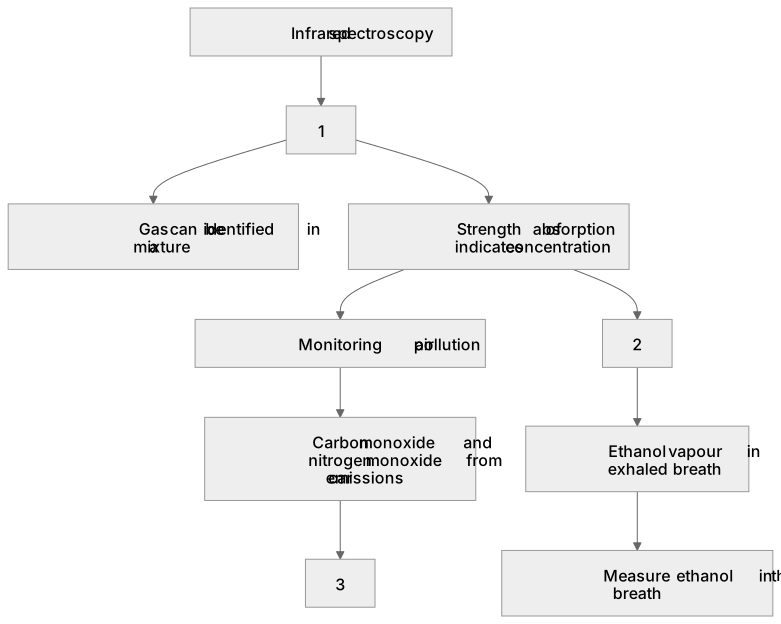
Label the diagram
Some boxes have lost their names. Pick the right name for each number.
1Box 1
2Box 2
3Box 3
There is more to this lesson
The full lesson goes on to check your understanding and help you earn the marks. Create a free account to carry on, with your progress saved.
A week of Premium from your first lesson · Then the free plan continues · No card, no charge
Test your understanding of Analytical techniques: (e) use of infrared spectroscopy to monitor gases causing air pollution (e.g. CO and NO from car emissions) and in modern breathalysers to measure ethanol in the breath
Active recall beats re-reading. Take an instant quiz now to test what you’ve learned and lock it into long-term memory.
A week of Premium from your first lesson · Then the free plan continues · No card, no charge