OCR · A-Level · Chemistry
Course version: H432 · Version from Sept 2017
(f) use of a mass spectrum of an organic compound to identify the…
Full specification wording
Analytical techniques: (f) use of a mass spectrum of an organic compound to identify the molecular ion peak and hence to determine molecular mass
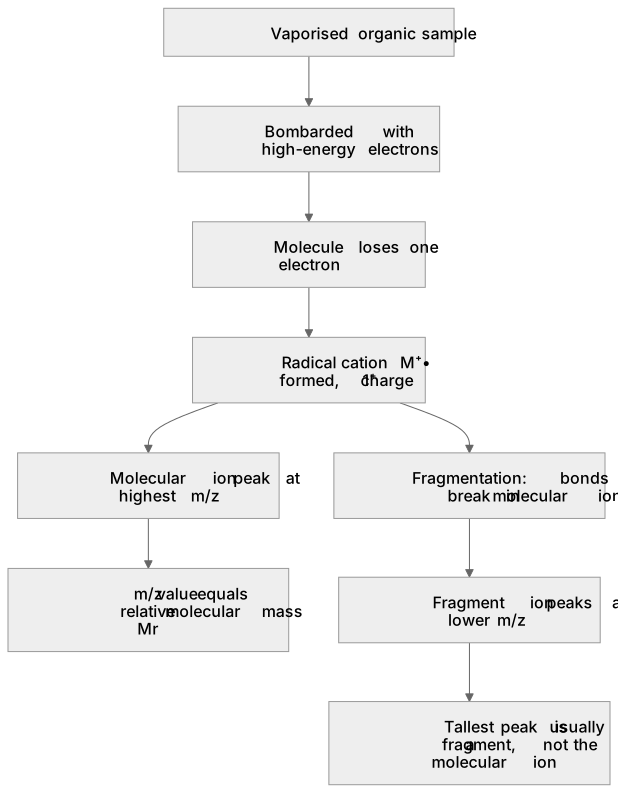
In electron impact ionisation a vaporised organic sample is bombarded with high-energy electrons.
- Point 9 of 13
- 4 key terms
Study notes
From the teaching notes for this specification point.
The idea
In electron impact ionisation a vaporised organic sample is bombarded with high-energy electrons. Each molecule that loses one electron forms a radical cation, written M⁺• (often shown simply as M⁺), with a 1⁺ charge and the same relative isotopic composition as the intact molecule. The molecular ion appears as a small peak at the highest m/z value in the spectrum, and that m/z value equals the relative molecular mass Mr of the compound. Fragmentation then produces lower-mass ions, so the tallest peak is usually a fragment, not the molecular ion. For example, ethanol (Mr = 46) shows a molecular ion peak at m/z 46 and fragment peaks at m/z 45, 31 and 29. Read the highest significant m/z, check it is consistent with a plausible formula, and use it to confirm Mr.
What earns the marks
- Identifies the molecular ion peak as the peak at the highest m/z value in the spectrum, excluding tiny isotope peaks.
- States that the m/z value of the molecular ion peak equals the relative molecular mass of the compound.
- Describes the molecular ion as a radical cation formed when a molecule loses one electron, carrying a 1⁺ charge.
- Distinguishes the molecular ion peak from fragment ion peaks, which arise from bonds breaking in the molecular ion.
- Uses a given m/z value to state the Mr of the compound and to check it against a proposed formula.
Common mistakes and how to put them right
Selects the tallest peak as the molecular ion.
Put it right: Recognise that the base peak is usually a fragment and the molecular ion sits at the highest m/z.
Treats the molecular ion as a 2⁺ dication.
Put it right: Write it as a radical cation with a 1⁺ charge, M⁺•.
Assumes the molecular ion peak is always large.
Put it right: Accept that it can be weak or absent when fragmentation is extensive.
Reads a small peak one or two units above the molecular ion as the molecular ion.
Put it right: Identify such peaks as contributions from ¹³C-containing molecules.
Exam tips
- Quote the m/z value of the highest significant peak and state explicitly that this equals Mr.
- Explain why the base peak is not used for Mr, referring to fragmentation.
- Check the Mr against a candidate formula by adding relative atomic masses before committing to an answer.
Try the lesson
The start of the Analytical techniques: (f) use of a mass spectrum of an organic compound to identify the molecular ion peak and hence to determine molecular mass lesson, made from teaching notes for this specification point.
Listen
In electron impact ionisation a vaporised organic sample is bombarded with high-energy electrons. Each molecule that loses one electron forms a radical cation, written M⁺• (often shown simply as M⁺), with a 1⁺ charge and the same relative isotopic composition as the intact molecule. The molecular ion appears as a small peak at the highest m/z value in the spectrum, and that m/z value equals the relative molecular mass Mr of the compound. Fragmentation then produces lower-mass ions, so the tallest peak is usually a fragment, not the molecular ion. For example, ethanol (Mr = 46) shows a molecular ion peak at m/z 46 and fragment peaks at m/z 45, 31 and 29. Read the highest significant m/z, check it is consistent with a plausible formula, and use it to confirm Mr. A strong answer earns marks for these points. Identifies the molecular ion peak as the peak at the highest m/z value in the spectrum, excluding tiny isotope peaks. States that the m/z value of the molecular ion peak equals the relative molecular mass of the compound. Describes the molecular ion as a radical cation formed when a molecule loses one electron, carrying a 1⁺ charge. Distinguishes the molecular ion peak from fragment ion peaks, which arise from bonds breaking in the molecular ion. Exam tip: Quote the m/z value of the highest significant peak and state explicitly that this equals Mr.
See it
Key words
Say what each word means before you turn the card.
Electron impact ionisation
Try answering aloud or in your head before turning the card.
Molecular ion peak
Try answering aloud or in your head before turning the card.
Fragmentation
Try answering aloud or in your head before turning the card.
Radical cation
Try answering aloud or in your head before turning the card.
See every definition
- Electron impact ionisation
- A vaporised organic sample is bombarded with high-energy electrons, and each molecule that loses one electron forms a radical cation.
- Molecular ion peak
- A small peak at the highest m/z value in the spectrum, whose m/z value equals the relative molecular mass of the compound.
- Fragmentation
- Produces lower-mass ions, so the tallest peak is usually a fragment, not the molecular ion.
- Radical cation
- Formed when a molecule loses one electron, written M⁺•, with a 1⁺ charge and the same relative isotopic composition as the intact molecule.
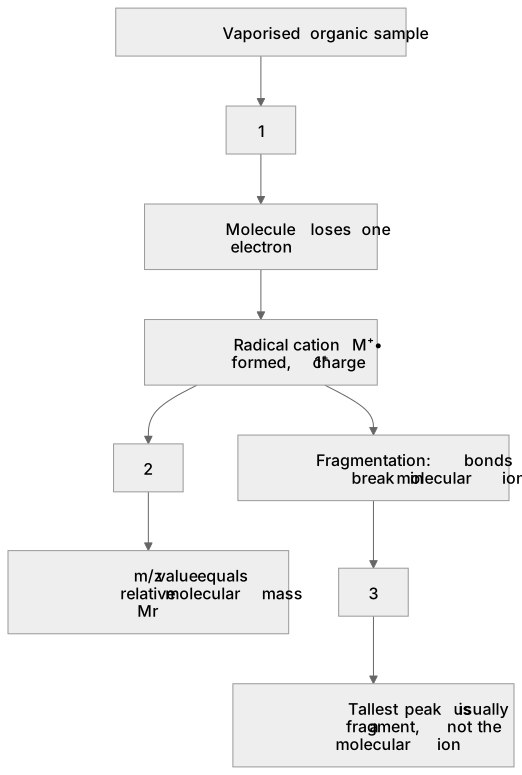
Label the diagram
Some boxes have lost their names. Pick the right name for each number.
1Box 1
2Box 2
3Box 3
There is more to this lesson
The full lesson goes on to check your understanding and help you earn the marks. Create a free account to carry on, with your progress saved.
A week of Premium from your first lesson · Then the free plan continues · No card, no charge
Test your understanding of Analytical techniques: (f) use of a mass spectrum of an organic compound to identify the molecular ion peak and hence to determine molecular mass
Active recall beats re-reading. Take an instant quiz now to test what you’ve learned and lock it into long-term memory.
A week of Premium from your first lesson · Then the free plan continues · No card, no charge