OCR · A-Level · Chemistry
Course version: H432 · Version from Sept 2017
(g) analysis of fragmentation peaks in a mass spectrum to identify parts…
Full specification wording
Analytical techniques: (g) analysis of fragmentation peaks in a mass spectrum to identify parts of structures.
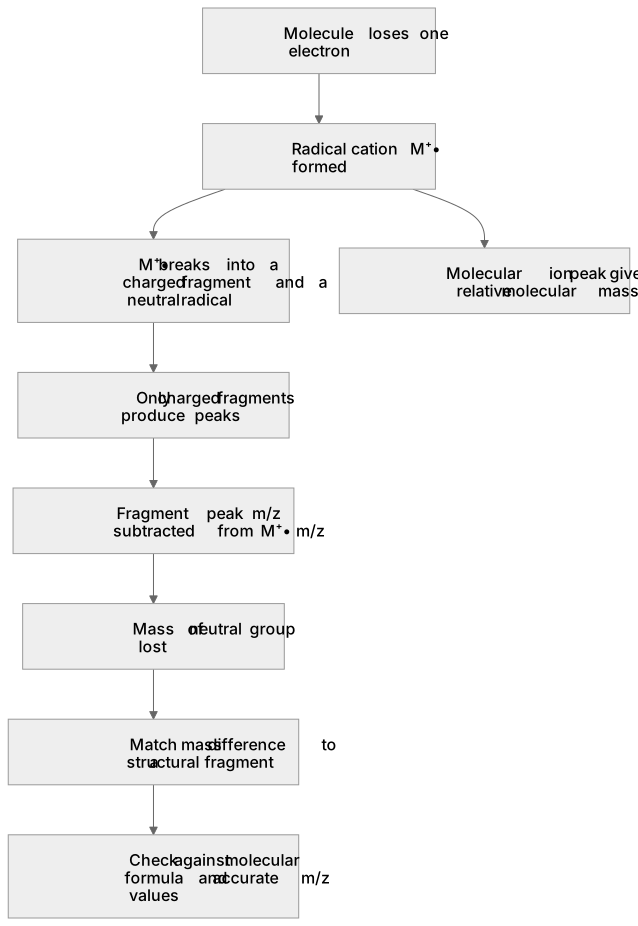
In electron impact ionisation a molecule loses an electron to form a radical cation, M⁺•, which can break into a charged fragment and a neutral radical.
- Point 10 of 13
- 4 key terms
Study notes
From the teaching notes for this specification point.
The idea
In electron impact ionisation a molecule loses an electron to form a radical cation, M⁺•, which can break into a charged fragment and a neutral radical. Only charged fragments appear as peaks, so the molecular ion peak gives the relative molecular mass and each fragment peak corresponds to a charged piece of the structure. To analyse a spectrum, subtract each fragment m/z value from the molecular ion m/z value to find the mass of the neutral group lost, then match that difference to a structural fragment. For example, a peak 15 units below M⁺• is consistent with loss of a methyl group, CH₃•, leaving a charged remainder. Use accurate m/z values and the molecular formula to decide which bonds can break and which fragments are plausible.
What earns the marks
- Identifies the molecular ion peak as the radical cation formed when the molecule loses one electron, giving the relative molecular mass.
- Calculates the mass of a neutral fragment lost by subtracting a fragment peak m/z value from the molecular ion m/z value.
- Matches a mass difference to a structural fragment such as a methyl group of mass 15 or an ethyl group of mass 29.
- Explains that only positively charged fragments produce peaks because the detector records ions, not neutral radicals.
- Uses the molecular formula and accurate m/z values to check that a proposed fragment is consistent with the structure.
Common mistakes and how to put them right
Assumes every peak represents a neutral fragment.
Put it right: Only charged fragments are detected and the neutral radical is not seen.
Treats the tallest peak as the molecular ion peak.
Put it right: Check the highest m/z value against the relative molecular mass instead.
Ignores the mass of the electron lost when forming the radical cation.
Put it right: Use the molecular ion m/z value as the starting point for subtraction.
Matches a mass difference to a fragment without checking the molecular formula.
Put it right: Confirm that the proposed fragment can actually form from the structure.
Exam tips
- Write the molecular ion as M⁺• and state its m/z value before analysing any fragment peaks.
- Show each subtraction explicitly, for example M⁺• m/z minus fragment m/z, so the neutral group lost is clear.
- Link each fragment peak to a named part of the structure rather than quoting a number alone.
Try the lesson
The start of the Analytical techniques: (g) analysis of fragmentation peaks in a mass spectrum to identify parts of structures. lesson, made from teaching notes for this specification point.
Listen
In electron impact ionisation a molecule loses an electron to form a radical cation, M⁺•, which can break into a charged fragment and a neutral radical. Only charged fragments appear as peaks, so the molecular ion peak gives the relative molecular mass and each fragment peak corresponds to a charged piece of the structure. To analyse a spectrum, subtract each fragment m/z value from the molecular ion m/z value to find the mass of the neutral group lost, then match that difference to a structural fragment. For example, a peak 15 units below M⁺• is consistent with loss of a methyl group, CH₃•, leaving a charged remainder. Use accurate m/z values and the molecular formula to decide which bonds can break and which fragments are plausible. A strong answer earns marks for these points. Identifies the molecular ion peak as the radical cation formed when the molecule loses one electron, giving the relative molecular mass. Calculates the mass of a neutral fragment lost by subtracting a fragment peak m/z value from the molecular ion m/z value. Matches a mass difference to a structural fragment such as a methyl group of mass 15 or an ethyl group of mass 29. Explains that only positively charged fragments produce peaks because the detector records ions, not neutral radicals. Exam tip: Write the molecular ion as M⁺• and state its m/z value before analysing any fragment peaks.
See it
Key words
Say what each word means before you turn the card.
Electron impact ionisation
Try answering aloud or in your head before turning the card.
Molecular ion peak
Try answering aloud or in your head before turning the card.
Fragmentation
Try answering aloud or in your head before turning the card.
Mass difference
Try answering aloud or in your head before turning the card.
See every definition
- Electron impact ionisation
- A molecule loses an electron to form a radical cation, M⁺•, which can break into a charged fragment and a neutral radical.
- Molecular ion peak
- The peak of the radical cation formed when the molecule loses one electron, giving the relative molecular mass.
- Fragmentation
- The process in which the radical cation breaks into a charged fragment and a neutral radical, with only charged fragments appearing as peaks.
- Mass difference
- Found by subtracting each fragment m/z value from the molecular ion m/z value to give the mass of the neutral group lost, then matched to a structural fragment.
Label the diagram
Some boxes have lost their names. Pick the right name for each number.
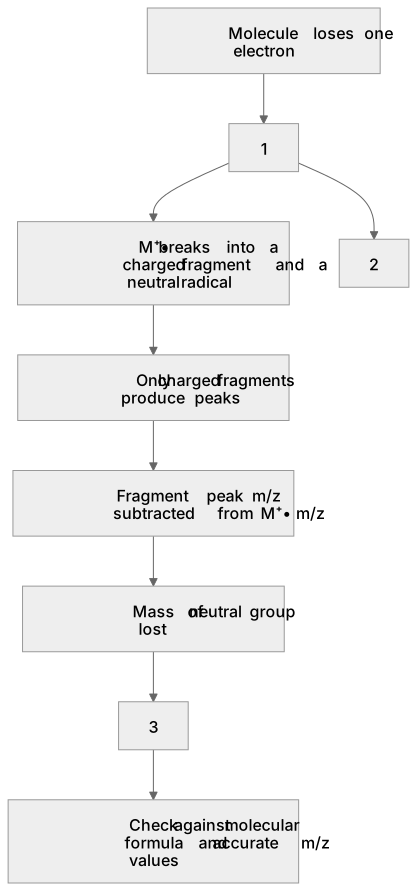
1Box 1
2Box 2
3Box 3
There is more to this lesson
The full lesson goes on to check your understanding and help you earn the marks. Create a free account to carry on, with your progress saved.
A week of Premium from your first lesson · Then the free plan continues · No card, no charge
Test your understanding of Analytical techniques: (g) analysis of fragmentation peaks in a mass spectrum to identify parts of structures.
Active recall beats re-reading. Take an instant quiz now to test what you’ve learned and lock it into long-term memory.
A week of Premium from your first lesson · Then the free plan continues · No card, no charge