OCR · A-Level · Chemistry
Course version: H432 · Version from Sept 2017
Analytical techniques: (i) elemental analysis (see also 2.1.3c)
Elemental analysis determines the percentage by mass of each element in a compound, from which the empirical formula is calculated.
- Point 11 of 13
- 4 key terms
Study notes
From the teaching notes for this specification point.
The idea
Elemental analysis determines the percentage by mass of each element in a compound, from which the empirical formula is calculated. Divide each percentage by the relative atomic mass of that element to obtain the mole ratio, then divide through by the smallest value to give the simplest whole-number ratio. For example, a compound containing 40.0% carbon, 6.7% hydrogen and 53.3% oxygen gives mole ratios of 3.33 : 6.7 : 3.33, which simplify to CH₂O. The empirical formula combined with the relative molecular mass from mass spectrometry gives the molecular formula. This links to the earlier work on empirical and molecular formulae in section 2.1.3c.
What earns the marks
- Divides each percentage by mass by the relative atomic mass of the element to obtain the number of moles of each element.
- Divides each mole value by the smallest mole value to obtain the simplest ratio.
- Multiplies the ratio to remove fractions and give whole numbers for the empirical formula.
- Uses the relative molecular mass together with the empirical formula mass to find the molecular formula.
Common mistakes and how to put them right
Divides the percentage by the relative molecular mass instead of the relative atomic mass.
Put it right: Divide each percentage by the relative atomic mass of that element.
Rounds intermediate mole ratios too early and loses the whole-number ratio.
Put it right: Keep values to two decimal places until the final step.
Confuses the empirical formula with the molecular formula.
Put it right: Use the relative molecular mass to scale the empirical formula.
Exam tips
- Set out the calculation in a table with columns for percentage, relative atomic mass and moles.
- Check that the final ratio consists of whole numbers before writing the empirical formula.
- Use the relative molecular mass to confirm whether the empirical and molecular formulae differ.
Try the lesson
The start of the Analytical techniques: (i) elemental analysis (see also 2.1.3c) lesson, made from teaching notes for this specification point.
Listen
Elemental analysis determines the percentage by mass of each element in a compound, from which the empirical formula is calculated. Divide each percentage by the relative atomic mass of that element to obtain the mole ratio, then divide through by the smallest value to give the simplest whole-number ratio. For example, a compound containing 40.0% carbon, 6.7% hydrogen and 53.3% oxygen gives mole ratios of 3.33 : 6.7 : 3.33, which simplify to CH₂O. The empirical formula combined with the relative molecular mass from mass spectrometry gives the molecular formula. This links to the earlier work on empirical and molecular formulae in section 2.1.3c. A strong answer earns marks for these points. Divides each percentage by mass by the relative atomic mass of the element to obtain the number of moles of each element. Divides each mole value by the smallest mole value to obtain the simplest ratio. Multiplies the ratio to remove fractions and give whole numbers for the empirical formula. Uses the relative molecular mass together with the empirical formula mass to find the molecular formula. Exam tip: Set out the calculation in a table with columns for percentage, relative atomic mass and moles.
See it
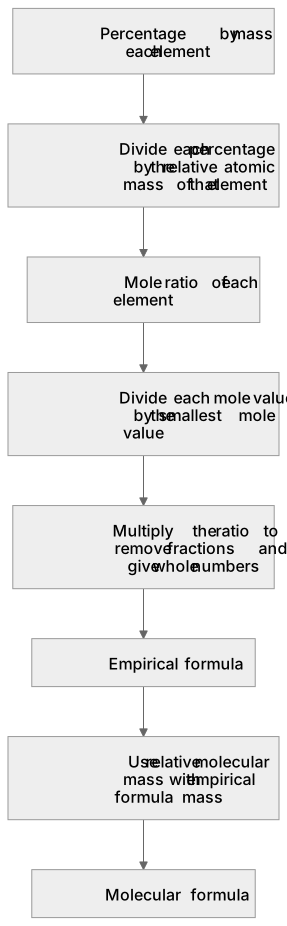
Put it in order
Put these steps in the order they happen.
- 1. Multiply the ratio to remove fractions and give whole numbers
- 2. Molecular formula
- 3. Empirical formula
- 4. Percentage by mass of each element
- 5. Divide each percentage by the relative atomic mass of that element
- 6. Use relative molecular mass with empirical formula mass
- 7. Mole ratio of each element
- 8. Divide each mole value by the smallest mole value
Key words
Say what each word means before you turn the card.
Percentage composition by mass
Try answering aloud or in your head before turning the card.
Mole ratio and simplest whole-number ratio
Try answering aloud or in your head before turning the card.
Empirical formula
Try answering aloud or in your head before turning the card.
Molecular formula from relative molecular mass
Try answering aloud or in your head before turning the card.
See every definition
- Percentage composition by mass
- The percentage by mass of each element in a compound, determined by elemental analysis.
- Mole ratio and simplest whole-number ratio
- Dividing each percentage by the relative atomic mass of that element gives the mole ratio, then dividing through by the smallest value gives the simplest whole-number ratio.
- Empirical formula
- The formula calculated from the percentage by mass of each element in a compound.
- Molecular formula from relative molecular mass
- The empirical formula combined with the relative molecular mass from mass spectrometry gives the molecular formula.
Label the diagram
Some boxes have lost their names. Pick the right name for each number.
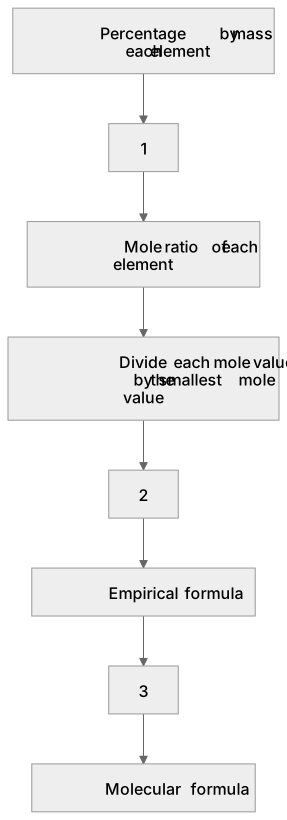
1Box 1
2Box 2
3Box 3
There is more to this lesson
The full lesson goes on to check your understanding and help you earn the marks. Create a free account to carry on, with your progress saved.
A week of Premium from your first lesson · Then the free plan continues · No card, no charge
Test your understanding of Analytical techniques: (i) elemental analysis (see also 2.1.3c)
Active recall beats re-reading. Take an instant quiz now to test what you’ve learned and lock it into long-term memory.
A week of Premium from your first lesson · Then the free plan continues · No card, no charge