OCR · A-Level · Chemistry
Course version: H432 · Version from Sept 2017
(j) the relative ease of electrophilic substitution of phenol compared…
Full specification wording
Aromatic compounds: (j) the relative ease of electrophilic substitution of phenol compared with benzene, in terms of electron pair donation to the π-system from an oxygen p-orbital in phenol (see also 4.1.3 a)
Phenol undergoes electrophilic substitution more readily than benzene.
- Point 14 of 16
- 3 key terms
Study notes
From the teaching notes for this specification point.
The idea
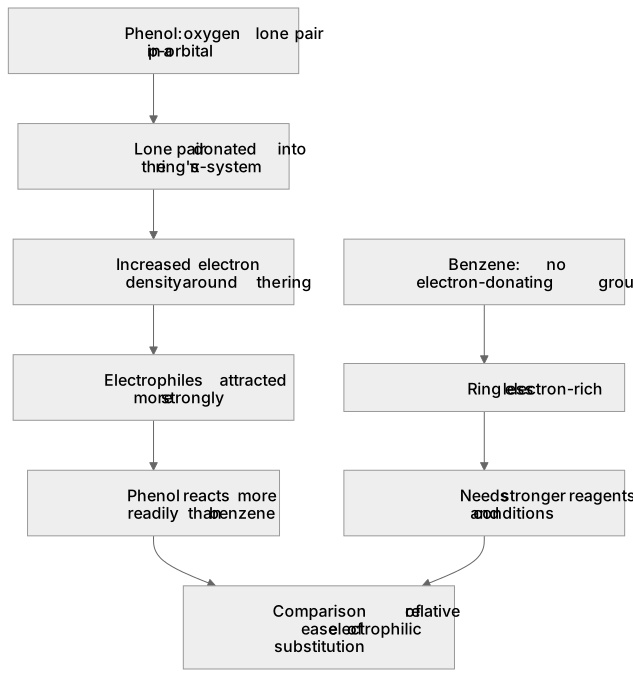
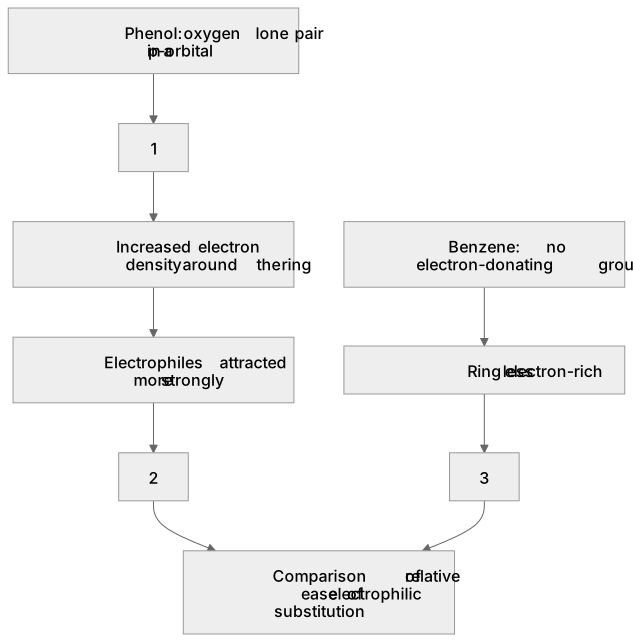
Phenol undergoes electrophilic substitution more readily than benzene. The oxygen atom of the –OH group has a lone pair in a p-orbital that overlaps with the delocalised π-system of the ring. Donating this electron pair into the π-system increases the electron density around the ring, especially at the 2- and 4-positions. A higher electron density attracts electrophiles more strongly, so the ring reacts faster and under milder conditions than benzene. Benzene has no such electron-donating group, so its π-system is less electron-rich and it needs stronger reagents and conditions. A question may ask you to compare reactivity, to explain the role of the oxygen p-orbital, or to link electron density to the rate of substitution.
What earns the marks
- States that phenol reacts more readily than benzene in electrophilic substitution.
- Explains that a lone pair in an oxygen p-orbital is donated into the ring's π-system.
- Links the increased electron density of the ring to stronger attraction of electrophiles and faster reaction.
- Contrasts this with benzene, whose ring lacks an electron-donating group and so is less reactive.
Common mistakes and how to put them right
Claims the –OH group withdraws electron density.
Put it right by stating that the oxygen lone pair is donated into the π-system, increasing electron density.
Says phenol reacts more slowly than benzene.
Put it right by stating that phenol reacts more readily because its ring is more electron-rich.
Attributes the greater reactivity to the hydrogen of the –OH group.
Put it right by focusing on the oxygen p-orbital lone pair donated to the π-system.
Exam tips
- Use the phrase 'lone pair in a p-orbital donated into the π-system' to gain the explanation mark.
- Always compare with benzene explicitly, since the question asks for relative ease.
- Link electron density to the attraction of electrophiles to explain the faster rate.
Try the lesson
The start of the Aromatic compounds: (j) the relative ease of electrophilic substitution of phenol compared with benzene, in terms of electron pair donation to the π-system from an oxygen p-orbital in phenol (see also 4.1.3 a) lesson, made from teaching notes for this specification point.
Listen
Phenol undergoes electrophilic substitution more readily than benzene. The oxygen atom of the –OH group has a lone pair in a p-orbital that overlaps with the delocalised π-system of the ring. Donating this electron pair into the π-system increases the electron density around the ring, especially at the 2- and 4-positions. A higher electron density attracts electrophiles more strongly, so the ring reacts faster and under milder conditions than benzene. Benzene has no such electron-donating group, so its π-system is less electron-rich and it needs stronger reagents and conditions. A question may ask you to compare reactivity, to explain the role of the oxygen p-orbital, or to link electron density to the rate of substitution. A strong answer earns marks for these points. States that phenol reacts more readily than benzene in electrophilic substitution. Explains that a lone pair in an oxygen p-orbital is donated into the ring's π-system. Links the increased electron density of the ring to stronger attraction of electrophiles and faster reaction. Contrasts this with benzene, whose ring lacks an electron-donating group and so is less reactive. A common slip: Claims the –OH group withdraws electron density. Instead, stating that the oxygen lone pair is donated into the π-system, increasing electron density. Exam tip: Use the phrase 'lone pair in a p-orbital donated into the π-system' to gain the explanation mark.
See it
Key words
Say what each word means before you turn the card.
Relative reactivity of phenol and benzene
Try answering aloud or in your head before turning the card.
Electron pair donation from an oxygen p-orbital
Try answering aloud or in your head before turning the card.
Delocalised π-system and electron density
Try answering aloud or in your head before turning the card.
See every definition
- Relative reactivity of phenol and benzene
- Phenol reacts more readily than benzene in electrophilic substitution, because its ring is more electron-rich and so attracts electrophiles more strongly.
- Electron pair donation from an oxygen p-orbital
- A lone pair in an oxygen p-orbital of the –OH group is donated into the ring's π-system, increasing the electron density around the ring.
- Delocalised π-system and electron density
- Donating the oxygen lone pair into the delocalised π-system increases the electron density, especially at the 2- and 4-positions, and a higher electron density attracts electrophiles more strongly.
Label the diagram
Some boxes have lost their names. Pick the right name for each number.
1Box 1
2Box 2
3Box 3
There is more to this lesson
The full lesson goes on to check your understanding and help you earn the marks. Create a free account to carry on, with your progress saved.
A week of Premium from your first lesson · Then the free plan continues · No card, no charge
Test your understanding of Aromatic compounds: (j) the relative ease of electrophilic substitution of phenol compared with benzene, in terms of electron pair donation to the π-system from an oxygen p-orbital in phenol (see also 4.1.3 a)
Active recall beats re-reading. Take an instant quiz now to test what you’ve learned and lock it into long-term memory.
A week of Premium from your first lesson · Then the free plan continues · No card, no charge