OCR · A-Level · Chemistry
Course version: H432 · Version from Sept 2017
(f) use of the term average bond enthalpy as a measurement of covalent…
Full specification wording
Bonding and structure: (f) use of the term average bond enthalpy as a measurement of covalent bond strength
Average bond enthalpy is the enthalpy change when one mole of a specified gaseous covalent bond is broken, averaged over the same bond in a range of similar compounds.
- Point 11 of 24
- 3 key terms
Study notes
From the teaching notes for this specification point.
The idea
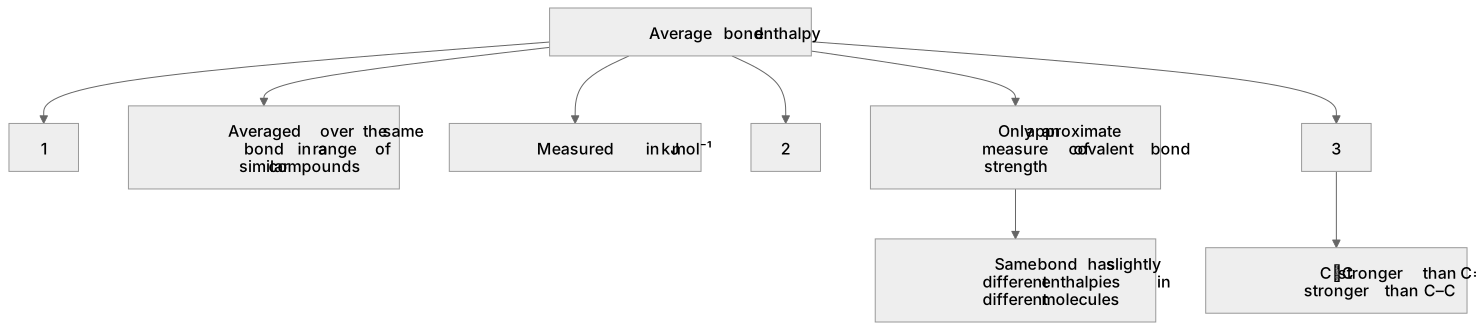
Average bond enthalpy is the enthalpy change when one mole of a specified gaseous covalent bond is broken, averaged over the same bond in a range of similar compounds. It is measured in kJ mol⁻¹ and is always positive because bond breaking is endothermic. Because the value is an average, it measures covalent bond strength only approximately: the same bond has slightly different enthalpies in different molecules. In methane, the successive bond dissociation enthalpies differ because the remaining fragment changes after each bond breaks, so the average is used instead. A larger average bond enthalpy indicates a stronger bond, so C≡C is stronger than C=C, which is stronger than C–C.
What earns the marks
- Defines average bond enthalpy as the enthalpy change when one mole of a specified gaseous covalent bond is broken, averaged over similar compounds.
- States that average bond enthalpy is always positive because breaking bonds is endothermic.
- Explains that the value is an average because the same bond has slightly different enthalpies in different environments.
- Uses a larger average bond enthalpy to identify a stronger covalent bond, for example C≡C stronger than C=C stronger than C–C.
- Gives the units as kJ mol⁻¹ and specifies the gaseous state in the definition.
Common mistakes and how to put them right
Attributes the differing successive bond dissociation enthalpies in methane to non-identical immediate environments of the four C–H bonds.
Put it right by explaining that the four C–H bonds are equivalent and the successive values differ because the remaining fragment changes after each bond breaks.
Gives average bond enthalpy a negative sign.
Put it right by stating that bond breaking is endothermic and the value is positive.
Compares bond strengths without stating that the values are averages.
Put it right by noting that average values give only an approximate measure of strength.
Exam tips
- Check that the definition includes 'one mole', 'gaseous' and 'averaged', because options often omit one of these.
- Remember that a larger value means a stronger bond, so rank bonds by magnitude rather than by sign.
- Reject any option that treats average bond enthalpy as an exact value for a single molecule.
Try the lesson
The start of the Bonding and structure: (f) use of the term average bond enthalpy as a measurement of covalent bond strength lesson, made from teaching notes for this specification point.
Listen
Average bond enthalpy is the enthalpy change when one mole of a specified gaseous covalent bond is broken, averaged over the same bond in a range of similar compounds. It is measured in kJ mol⁻¹ and is always positive because bond breaking is endothermic. Because the value is an average, it measures covalent bond strength only approximately: the same bond has slightly different enthalpies in different molecules. In methane, the successive bond dissociation enthalpies differ because the remaining fragment changes after each bond breaks, so the average is used instead. A larger average bond enthalpy indicates a stronger bond, so C≡C is stronger than C=C, which is stronger than C–C. A strong answer earns marks for these points. Defines average bond enthalpy as the enthalpy change when one mole of a specified gaseous covalent bond is broken, averaged over similar compounds. States that average bond enthalpy is always positive because breaking bonds is endothermic. Explains that the value is an average because the same bond has slightly different enthalpies in different environments. Uses a larger average bond enthalpy to identify a stronger covalent bond, for example C≡C stronger than C=C stronger than C–C. A common slip: Attributes the differing successive bond dissociation enthalpies in methane to non-identical immediate environments of the four C–H bonds. Instead, explaining that the four C–H bonds are equivalent and the successive values differ because the remaining fragment changes after each bond breaks. Exam tip: Check that the definition includes 'one mole', 'gaseous' and 'averaged', because options often omit one of these.
See it

Key words
Say what each word means before you turn the card.
Average bond enthalpy
Try answering aloud or in your head before turning the card.
Endothermic nature of bond breaking
Try answering aloud or in your head before turning the card.
Averaging over similar compounds and its limitation
Try answering aloud or in your head before turning the card.
See every definition
- Average bond enthalpy
- The enthalpy change when one mole of a specified gaseous covalent bond is broken, averaged over the same bond in a range of similar compounds.
- Endothermic nature of bond breaking
- Bond breaking is endothermic, so average bond enthalpy is always positive.
- Averaging over similar compounds and its limitation
- Because the value is an average, it measures covalent bond strength only approximately, as the same bond has slightly different enthalpies in different molecules.
Label the diagram
Some boxes have lost their names. Pick the right name for each number.
1Box 1
2Box 2
3Box 3
There is more to this lesson
The full lesson goes on to check your understanding and help you earn the marks. Create a free account to carry on, with your progress saved.
A week of Premium from your first lesson · Then the free plan continues · No card, no charge
Test your understanding of Bonding and structure: (f) use of the term average bond enthalpy as a measurement of covalent bond strength
Active recall beats re-reading. Take an instant quiz now to test what you’ve learned and lock it into long-term memory.
A week of Premium from your first lesson · Then the free plan continues · No card, no charge