OCR · A-Level · Chemistry
Course version: H432 · Version from Sept 2017
(c) calculation of the entropy change of a system, ∆S, and related…
Full specification wording
Enthalpy and entropy: (c) calculation of the entropy change of a system, ∆S, and related quantities for a reaction given the entropies of the reactants and products
This point requires you to calculate the entropy change of the system for a reaction from tabulated standard entropies.
- Point 4 of 7
- 4 key terms
Study notes
From the teaching notes for this specification point.
The idea
This point requires you to calculate the entropy change of the system for a reaction from tabulated standard entropies. Use ∆S = ΣS(products) − ΣS(reactants), multiplying each standard entropy by its stoichiometric coefficient from the balanced equation. Entropies are usually quoted in J K⁻¹ mol⁻¹, so the result is in J K⁻¹ mol⁻¹; divide by 1000 to express it in kJ K⁻¹ mol⁻¹ when a related quantity needs that unit. A positive ∆S means the system entropy increases, which is typical when gaseous moles increase. Related quantities include the value per mole of a named reactant and unit conversions, so keep track of coefficients and units throughout.
What earns the marks
- Applies ∆S = ΣS(products) − ΣS(reactants) using the standard entropies supplied.
- Multiplies each standard entropy by the stoichiometric coefficient from the balanced equation before summing.
- Expresses the result in J K⁻¹ mol⁻¹ and converts correctly to kJ K⁻¹ mol⁻¹ by dividing by 1000 when required.
- Interprets the sign of ∆S as an increase or decrease in the entropy of the system.
- Calculates a related quantity such as the entropy change per mole of a specified reactant by dividing by its coefficient.
Common mistakes and how to put them right
Subtracts reactants from products without applying coefficients.
Put it right: Multiply each entropy by its coefficient first.
Reverses the subtraction and reports products minus reactants as reactants minus products.
Put it right: Keep products minus reactants.
Mixes units by adding J K⁻¹ mol⁻¹ values to kJ K⁻¹ mol⁻¹ values.
Put it right: Convert to a single unit before combining.
Exam tips
- Write out the sum for products and the sum for reactants separately before subtracting to avoid sign slips.
- State the unit with every numerical answer and convert to kJ K⁻¹ mol⁻¹ only when the question requires it.
- Check the balanced equation first, because wrong coefficients give a wrong ∆S even with correct arithmetic.
Try the lesson
The start of the Enthalpy and entropy: (c) calculation of the entropy change of a system, ∆S, and related quantities for a reaction given the entropies of the reactants and products lesson, made from teaching notes for this specification point.
Listen
This point requires you to calculate the entropy change of the system for a reaction from tabulated standard entropies. Use ∆S = ΣS(products) − ΣS(reactants), multiplying each standard entropy by its stoichiometric coefficient from the balanced equation. Entropies are usually quoted in J K⁻¹ mol⁻¹, so the result is in J K⁻¹ mol⁻¹; divide by 1000 to express it in kJ K⁻¹ mol⁻¹ when a related quantity needs that unit. A positive ∆S means the system entropy increases, which is typical when gaseous moles increase. Related quantities include the value per mole of a named reactant and unit conversions, so keep track of coefficients and units throughout. A strong answer earns marks for these points. Applies ∆S = ΣS(products) − ΣS(reactants) using the standard entropies supplied. Multiplies each standard entropy by the stoichiometric coefficient from the balanced equation before summing. Expresses the result in J K⁻¹ mol⁻¹ and converts correctly to kJ K⁻¹ mol⁻¹ by dividing by 1000 when required. Interprets the sign of ∆S as an increase or decrease in the entropy of the system. Exam tip: Write out the sum for products and the sum for reactants separately before subtracting to avoid sign slips.
See it
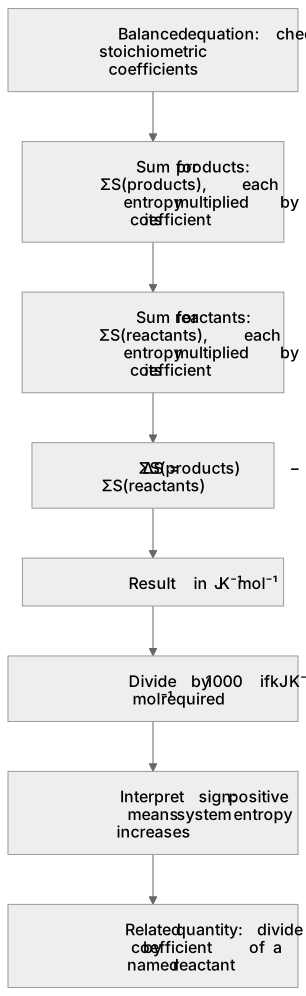
Put it in order
Put these steps in the order they happen.
- 1. Result in J K⁻¹ mol⁻¹
- 2. Related quantity: divide by coefficient of a named reactant
- 3. Divide by 1000 if kJ K⁻¹ mol⁻¹ required
- 4. Balanced equation: check stoichiometric coefficients
- 5. Sum for products: ΣS(products), each entropy multiplied by its coefficient
- 6. Interpret sign: positive means system entropy increases
- 7. Sum for reactants: ΣS(reactants), each entropy multiplied by its coefficient
- 8. ∆S = ΣS(products) − ΣS(reactants)
Key words
Say what each word means before you turn the card.
Standard entropy values and their units
Try answering aloud or in your head before turning the card.
Calculating ∆S of the system from products and reactants
Try answering aloud or in your head before turning the card.
Applying stoichiometric coefficients in entropy sums
Try answering aloud or in your head before turning the card.
Unit conversion between J K⁻¹ mol⁻¹ and kJ K⁻¹ mol⁻¹
Try answering aloud or in your head before turning the card.
See every definition
- Standard entropy values and their units
- Tabulated entropies of reactants and products, usually quoted in J K⁻¹ mol⁻¹, used to calculate the entropy change of a system.
- Calculating ∆S of the system from products and reactants
- Applying ∆S = ΣS(products) − ΣS(reactants) using the standard entropies supplied, keeping products minus reactants.
- Applying stoichiometric coefficients in entropy sums
- Multiplying each standard entropy by the stoichiometric coefficient from the balanced equation before summing.
- Unit conversion between J K⁻¹ mol⁻¹ and kJ K⁻¹ mol⁻¹
- Dividing by 1000 to express a result in J K⁻¹ mol⁻¹ as kJ K⁻¹ mol⁻¹ when a related quantity needs that unit.
Label the diagram
Some boxes have lost their names. Pick the right name for each number.
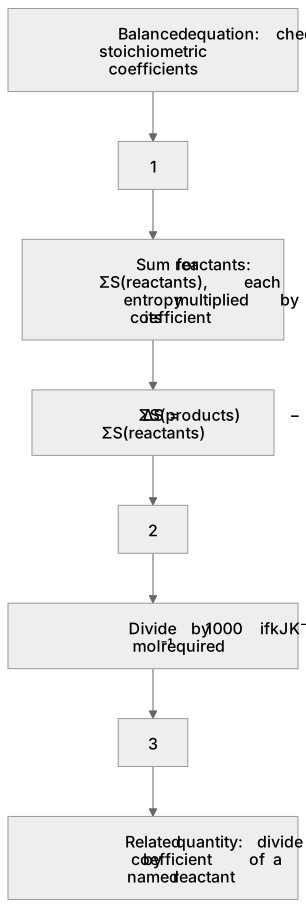
1Box 1
2Box 2
3Box 3
There is more to this lesson
The full lesson goes on to check your understanding and help you earn the marks. Create a free account to carry on, with your progress saved.
A week of Premium from your first lesson · Then the free plan continues · No card, no charge
Test your understanding of Enthalpy and entropy: (c) calculation of the entropy change of a system, ∆S, and related quantities for a reaction given the entropies of the reactants and products
Active recall beats re-reading. Take an instant quiz now to test what you’ve learned and lock it into long-term memory.
A week of Premium from your first lesson · Then the free plan continues · No card, no charge