OCR · A-Level · Chemistry
Course version: H432 · Version from Sept 2017
(i) standard conditions and standard states (physical states under…
Full specification wording
Enthalpy changes: (i) standard conditions and standard states (physical states under standard conditions)
Standard conditions are the agreed reference conditions used so that enthalpy values can be compared between reactions: a pressure of 100 kPa (1.00 × 10⁵ Pa) and a stated temperature,…
- Point 5 of 20
- 3 key terms
Study notes
From the teaching notes for this specification point.
The idea
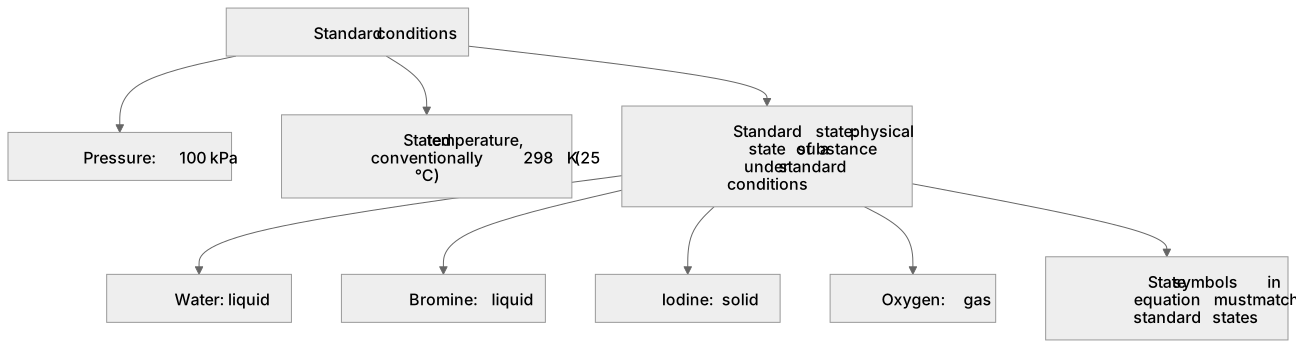
Standard conditions are the agreed reference conditions used so that enthalpy values can be compared between reactions: a pressure of 100 kPa (1.00 × 10⁵ Pa) and a stated temperature, conventionally 298 K (25 °C). A standard state is the physical state of an element or compound under those standard conditions — for example, water is liquid, bromine is liquid, iodine is solid and oxygen is gas at 298 K and 100 kPa. The standard state of a substance is not simply its most common state anywhere; it is the state at the specified reference conditions. When you write a standard enthalpy change, the equation must show each species in its standard state, so state symbols matter. A substance whose standard state differs from the state in a given equation cannot be used directly as a reference without accounting for the change of state.
What earns the marks
- States that standard conditions are 100 kPa and a stated temperature, conventionally 298 K (25 °C).
- Defines a standard state as the physical state of a substance under standard conditions.
- Identifies the standard state of a named substance at 298 K and 100 kPa, such as liquid water or gaseous oxygen.
- Explains that state symbols in an equation must match the standard states when a standard enthalpy change is quoted.
Common mistakes and how to put them right
Uses 1 atm instead of 100 kPa.
Put it right: Correct this to the standard pressure of 100 kPa.
Treats the standard state as whatever state a substance happens to be in; correct this by linking the state to the specified reference conditions.
Omits the temperature when quoting standard conditions.
Put it right by stating 298 K (25 °C) alongside 100 kPa.
Exam tips
- Learn the pair of values together: 100 kPa and 298 K, so neither is forgotten.
- Check state symbols in any equation before deciding whether it represents standard conditions.
- Recall specific standard states, such as liquid bromine and solid iodine, rather than guessing from everyday appearance.
Try the lesson
The start of the Enthalpy changes: (i) standard conditions and standard states (physical states under standard conditions) lesson, made from teaching notes for this specification point.
Listen
Standard conditions are the agreed reference conditions used so that enthalpy values can be compared between reactions: a pressure of 100 kPa (1.00 × 10⁵ Pa) and a stated temperature, conventionally 298 K (25 °C). A standard state is the physical state of an element or compound under those standard conditions — for example, water is liquid, bromine is liquid, iodine is solid and oxygen is gas at 298 K and 100 kPa. The standard state of a substance is not simply its most common state anywhere; it is the state at the specified reference conditions. When you write a standard enthalpy change, the equation must show each species in its standard state, so state symbols matter. A substance whose standard state differs from the state in a given equation cannot be used directly as a reference without accounting for the change of state. A strong answer earns marks for these points. States that standard conditions are 100 kPa and a stated temperature, conventionally 298 K (25 °C). Defines a standard state as the physical state of a substance under standard conditions. Identifies the standard state of a named substance at 298 K and 100 kPa, such as liquid water or gaseous oxygen. Explains that state symbols in an equation must match the standard states when a standard enthalpy change is quoted. A common slip: Treats the standard state as whatever state a substance happens to be in. Instead, linking the state to the specified reference conditions. Exam tip: Learn the pair of values together: 100 kPa and 298 K, so neither is forgotten.
See it
Key words
Say what each word means before you turn the card.
Standard conditions
Try answering aloud or in your head before turning the card.
Standard state
Try answering aloud or in your head before turning the card.
State symbols
Try answering aloud or in your head before turning the card.
See every definition
- Standard conditions
- The agreed reference conditions of 100 kPa and a stated temperature, conventionally 298 K (25 °C), used so that enthalpy values can be compared between reactions.
- Standard state
- The physical state of an element or compound under standard conditions, such as liquid water or gaseous oxygen at 298 K and 100 kPa.
- State symbols
- Symbols in an equation that must match the standard states when a standard enthalpy change is quoted.
Label the diagram
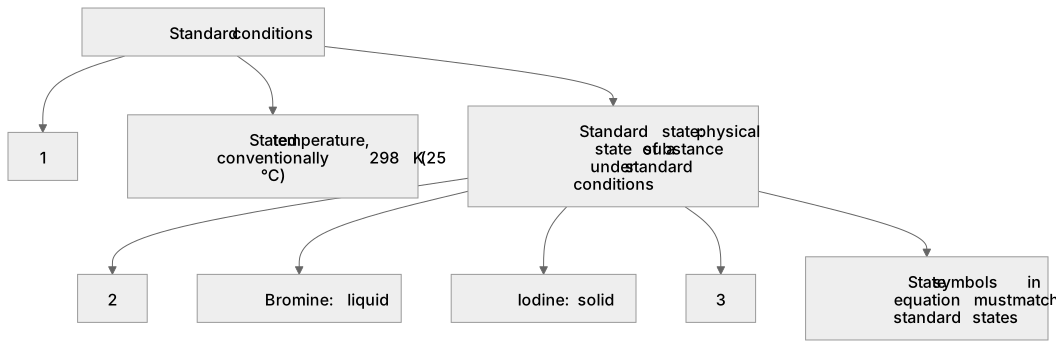
Some boxes have lost their names. Pick the right name for each number.
1Box 1
2Box 2
3Box 3
There is more to this lesson
The full lesson goes on to check your understanding and help you earn the marks. Create a free account to carry on, with your progress saved.
A week of Premium from your first lesson · Then the free plan continues · No card, no charge
Test your understanding of Enthalpy changes: (i) standard conditions and standard states (physical states under standard conditions)
Active recall beats re-reading. Take an instant quiz now to test what you’ve learned and lock it into long-term memory.
A week of Premium from your first lesson · Then the free plan continues · No card, no charge