OCR · A-Level · Chemistry
Course version: H432 · Version from Sept 2017
Implementing: (b) appropriate units for measurements
Practical work in OCR A Level Chemistry requires you to record every measured quantity with a unit that matches the instrument and the quantity itself.
- Point 2 of 3
- 4 key terms
Study notes
From the teaching notes for this specification point.
The idea
Practical work in OCR A Level Chemistry requires you to record every measured quantity with a unit that matches the instrument and the quantity itself. Mass is recorded in grams (g) or kilograms (kg), volume of solution in cubic centimetres (cm³) or decimetres cubed (dm³), temperature in kelvin (K) or degrees Celsius (°C), time in seconds (s), and concentration in mol dm⁻³. Choose the unit that fits the scale of the apparatus: a burette reading is normally in cm³ to two decimal places, while a balance reading is in g to the precision of the balance. Convert consistently, remembering that 1 dm³ = 1000 cm³, so 25.0 cm³ = 0.0250 dm³, and that a concentration in mol dm⁻³ multiplied by a volume in dm³ gives an amount in mol. Never attach a unit that belongs to a different quantity, and never leave a numerical result unitless.
What earns the marks
- Selects the unit that matches the measured quantity, such as g for mass or cm³ for burette volume.
- States the unit alongside the numerical value rather than leaving the measurement unitless.
- Converts between cm³ and dm³ using the factor 1000, for example 25.0 cm³ = 0.0250 dm³.
- Uses mol dm⁻³ for concentration and combines it with volume in dm³ to obtain amount in mol.
- Rejects a unit that belongs to a different quantity, such as reporting a volume in grams.
Common mistakes and how to put them right
Omits the unit from a recorded measurement.
Put it right: Attach the correct unit to every value.
Uses the wrong unit for the quantity, such as giving a mass in cm³.
Put it right: Match the unit to what was measured.
Converts cm³ to dm³ by multiplying by 1000 instead of dividing.
Put it right: Divide by 1000 to move from cm³ to dm³.
Writes concentration without units.
Put it right: Express concentration in mol dm⁻³.
Exam tips
- Read the question carefully to see whether it asks for a unit, a value with a unit, or a conversion, and answer exactly that.
- Check each conversion by asking whether the number should get larger or smaller when moving between cm³ and dm³.
- In multiple-choice items, eliminate options whose unit does not match the quantity before comparing numerical values.
Try the lesson
The start of the Implementing: (b) appropriate units for measurements lesson, made from teaching notes for this specification point.
Listen
Practical work in OCR A Level Chemistry requires you to record every measured quantity with a unit that matches the instrument and the quantity itself. Mass is recorded in grams (g) or kilograms (kg), volume of solution in cubic centimetres (cm³) or decimetres cubed (dm³), temperature in kelvin (K) or degrees Celsius (°C), time in seconds (s), and concentration in mol dm⁻³. Choose the unit that fits the scale of the apparatus: a burette reading is normally in cm³ to two decimal places, while a balance reading is in g to the precision of the balance. Convert consistently, remembering that 1 dm³ = 1000 cm³, so 25.0 cm³ = 0.0250 dm³, and that a concentration in mol dm⁻³ multiplied by a volume in dm³ gives an amount in mol. Never attach a unit that belongs to a different quantity, and never leave a numerical result unitless. A strong answer earns marks for these points. Selects the unit that matches the measured quantity, such as g for mass or cm³ for burette volume. States the unit alongside the numerical value rather than leaving the measurement unitless. Converts between cm³ and dm³ using the factor 1000, for example 25.0 cm³ = 0.0250 dm³. Uses mol dm⁻³ for concentration and combines it with volume in dm³ to obtain amount in mol. Exam tip: Read the question carefully to see whether it asks for a unit, a value with a unit, or a conversion, and answer exactly that.
See it
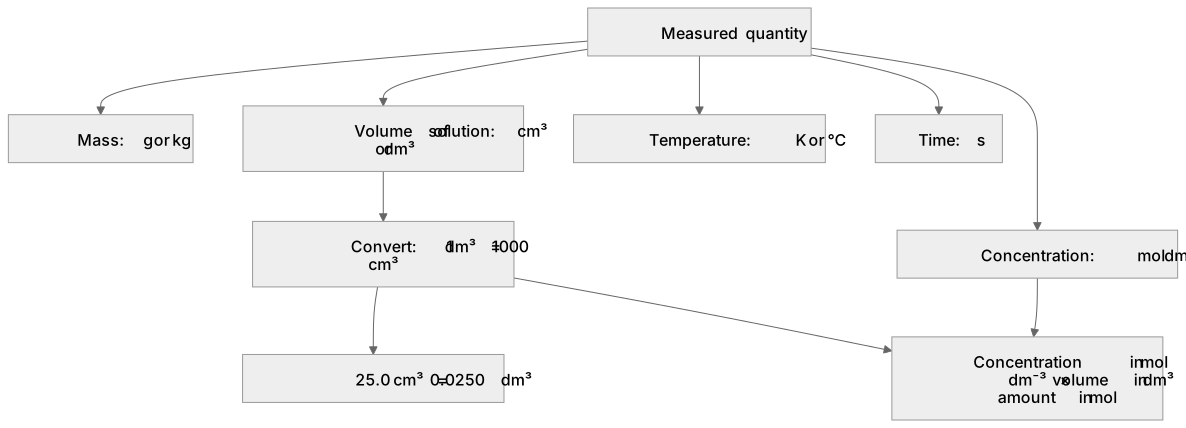
Key words
Say what each word means before you turn the card.
Matching units to measured quantities
Try answering aloud or in your head before turning the card.
Recording values with units
Try answering aloud or in your head before turning the card.
Converting between cm³ and dm³
Try answering aloud or in your head before turning the card.
Using mol dm⁻³ for concentration
Try answering aloud or in your head before turning the card.
See every definition
- Matching units to measured quantities
- Recording every measured quantity with a unit that matches the instrument and the quantity itself, never attaching a unit that belongs to a different quantity.
- Recording values with units
- Stating the unit alongside the numerical value rather than leaving the measurement unitless, so that no numerical result is left without a unit.
- Converting between cm³ and dm³
- Converting consistently using the factor 1000, remembering that 1 dm³ = 1000 cm³, so 25.0 cm³ = 0.0250 dm³.
- Using mol dm⁻³ for concentration
- Expressing concentration in mol dm⁻³ and multiplying it by a volume in dm³ to give an amount in mol.
Label the diagram
Some boxes have lost their names. Pick the right name for each number.
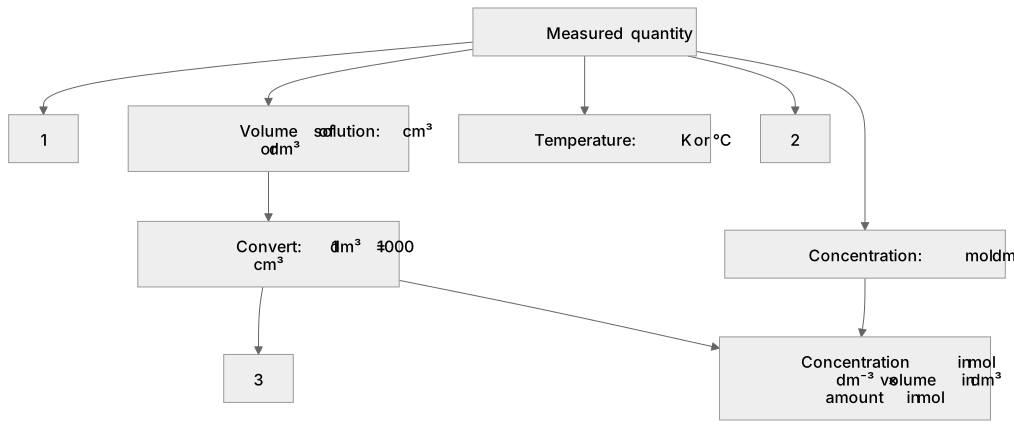
1Box 1
2Box 2
3Box 3
There is more to this lesson
The full lesson goes on to check your understanding and help you earn the marks. Create a free account to carry on, with your progress saved.
A week of Premium from your first lesson · Then the free plan continues · No card, no charge
Test your understanding of Implementing: (b) appropriate units for measurements
Active recall beats re-reading. Take an instant quiz now to test what you’ve learned and lock it into long-term memory.
A week of Premium from your first lesson · Then the free plan continues · No card, no charge