OCR · A-Level · Chemistry
Course version: H432 · Version from Sept 2017
(b) for an organic molecule containing several functional groups:
Full specification wording
Nitrogen compounds, polymers and synthesis - 6.2.5 Organic synthesis: (b) for an organic molecule containing several functional groups:
This sub-statement sets the scene for working with an organic molecule that carries more than one functional group.
- Point 9 of 11
- 4 key terms
Study notes
From the teaching notes for this specification point.
The idea
This sub-statement sets the scene for working with an organic molecule that carries more than one functional group. The skill is to read a displayed structure and treat each group on its own merits rather than assuming one group dominates. For example, a molecule might contain both a hydroxyl group and a carbonyl group, or an amine alongside a carboxylic acid. You identify each group separately, then decide how the molecule would behave in a chosen reaction. Because several groups are present, a reagent may attack one site while leaving another untouched, so you must justify which group reacts and why. The following sub-statement (i) narrows this to identifying the individual functional groups.
What earns the marks
- Identifies each functional group present in a displayed structure and names them separately.
- Distinguishes between functional groups that share similar atoms, such as an alcohol and a carboxylic acid.
- Explains that a molecule with several functional groups can react at more than one site.
- Selects the group that reacts with a given reagent and justifies the choice from the structure.
Common mistakes and how to put them right
Names only the most obvious functional group and ignores the others.
Put it right: List every group in the structure.
Treats a molecule with several groups as if it had a single reactive site.
Put it right: Consider each group before predicting a reaction.
Confuses a hydroxyl group in an alcohol with the carboxyl group of an acid.
Put it right: Check which atoms are bonded together.
Exam tips
- Read the whole displayed structure before naming any group, so none is missed.
- Underline each functional group on the structure as you identify it.
- When a question asks which group reacts, state the group and the reason in one sentence.
Try the lesson
The start of the Nitrogen compounds, polymers and synthesis - 6.2.5 Organic synthesis: (b) for an organic molecule containing several functional groups: lesson, made from teaching notes for this specification point.
Listen
This sub-statement sets the scene for working with an organic molecule that carries more than one functional group. The skill is to read a displayed structure and treat each group on its own merits rather than assuming one group dominates. For example, a molecule might contain both a hydroxyl group and a carbonyl group, or an amine alongside a carboxylic acid. You identify each group separately, then decide how the molecule would behave in a chosen reaction. Because several groups are present, a reagent may attack one site while leaving another untouched, so you must justify which group reacts and why. The following sub-statement (i) narrows this to identifying the individual functional groups. A strong answer earns marks for these points. Identifies each functional group present in a displayed structure and names them separately. Distinguishes between functional groups that share similar atoms, such as an alcohol and a carboxylic acid. Explains that a molecule with several functional groups can react at more than one site. Selects the group that reacts with a given reagent and justifies the choice from the structure. Exam tip: Read the whole displayed structure before naming any group, so none is missed.
See it
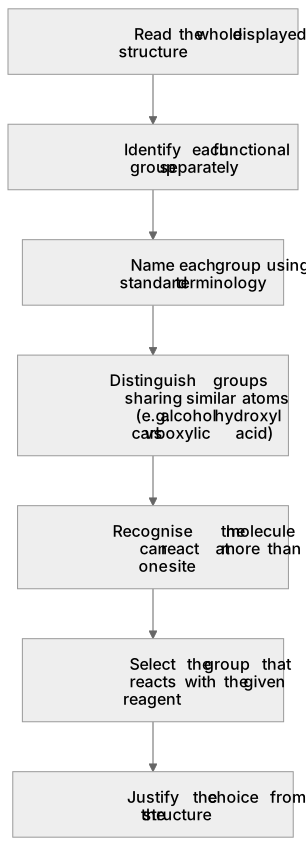
Put it in order
Put these steps in the order they happen.
- 1. Justify the choice from the structure
- 2. Select the group that reacts with the given reagent
- 3. Name each group using standard terminology
- 4. Recognise the molecule can react at more than one site
- 5. Read the whole displayed structure
- 6. Identify each functional group separately
- 7. Distinguish groups sharing similar atoms (e.g. alcohol hydroxyl vs carboxylic acid)
Key words
Say what each word means before you turn the card.
Functional group recognition
Try answering aloud or in your head before turning the card.
Polyfunctional organic molecules
Try answering aloud or in your head before turning the card.
Site of reaction
Try answering aloud or in your head before turning the card.
Structure interpretation
Try answering aloud or in your head before turning the card.
See every definition
- Functional group recognition
- Identifying each functional group present in a displayed structure and naming them separately.
- Polyfunctional organic molecules
- Organic molecules containing several functional groups, which can react at more than one site.
- Site of reaction
- The group that reacts with a given reagent, chosen and justified from the structure.
- Structure interpretation
- Reading a displayed structure and treating each group on its own merits rather than assuming one group dominates.
Label the diagram
Some boxes have lost their names. Pick the right name for each number.
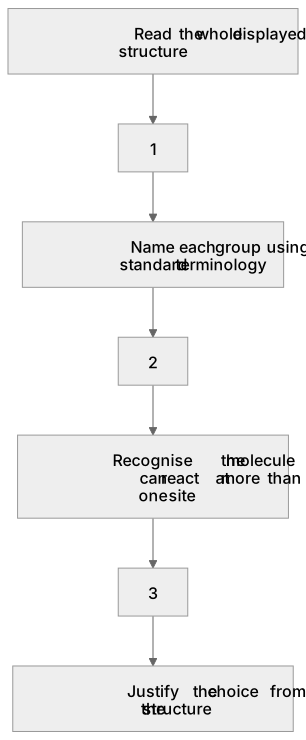
1Box 1
2Box 2
3Box 3
There is more to this lesson
The full lesson goes on to check your understanding and help you earn the marks. Create a free account to carry on, with your progress saved.
A week of Premium from your first lesson · Then the free plan continues · No card, no charge
Test your understanding of Nitrogen compounds, polymers and synthesis - 6.2.5 Organic synthesis: (b) for an organic molecule containing several functional groups:
Active recall beats re-reading. Take an instant quiz now to test what you’ve learned and lock it into long-term memory.
A week of Premium from your first lesson · Then the free plan continues · No card, no charge