OCR · A-Level · Chemistry
Course version: H432 · Version from Sept 2017
• filtration under reduced pressure
Full specification wording
Nitrogen compounds, polymers and synthesis - 6.2.5 Organic synthesis: • filtration under reduced pressure
Filtration under reduced pressure (suction filtration) separates a solid from a liquid quickly by pulling air out of the receiving flask with a water pump or vacuum line, so the pressure below the…
- Point 6 of 11
- 4 key terms
Study notes
From the teaching notes for this specification point.
The idea
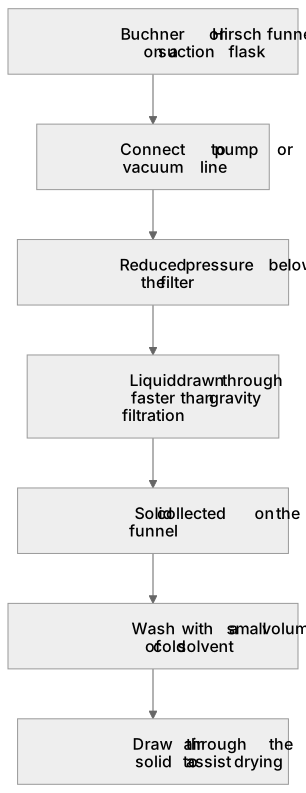
Filtration under reduced pressure (suction filtration) separates a solid from a liquid quickly by pulling air out of the receiving flask with a water pump or vacuum line, so the pressure below the filter is lower than atmospheric pressure and liquid is drawn through faster than under gravity. The solid is collected on a sintered-glass or Hirsch funnel, washed with a little cold solvent, and air is drawn through it to help drying. The technique suits organic preparations where a crude solid must be isolated before recrystallisation. Learners should recognise the apparatus, the reason for the reduced pressure, and why the solid is washed and dried by suction rather than left wet with mother liquor.
What earns the marks
- Identifies the apparatus as a Buchner or Hirsch funnel seated on a suction flask connected to a pump or vacuum line.
- Explains that reduced pressure below the filter draws liquid through the filter faster than gravity filtration.
- States that the solid is washed with a small volume of cold solvent to remove soluble impurities and mother liquor.
- Describes drawing air through the collected solid to remove residual solvent and assist drying.
- Recognises that the technique isolates a solid product from a liquid mixture rather than separating two liquids.
Common mistakes and how to put them right
Uses the term 'distillation' for this separation.
Put it right by naming suction filtration and its solid-from-liquid purpose.
Claims the reduced pressure boils the filtrate to dryness.
Put it right by explaining that the pump only lowers pressure to speed liquid through the filter.
Washes the solid with large volumes of hot solvent.
Put it right by using a small volume of cold solvent so product does not redissolve.
Exam tips
- Link the reduced pressure directly to the faster rate of separation when explaining the method.
- Name the funnel type and the suction flask when describing the apparatus in a practical question.
- Justify the cold wash by referring to minimising loss of product while removing soluble impurities.
Try the lesson
The start of the Nitrogen compounds, polymers and synthesis - 6.2.5 Organic synthesis: • filtration under reduced pressure lesson, made from teaching notes for this specification point.
Listen
Filtration under reduced pressure (suction filtration) separates a solid from a liquid quickly by pulling air out of the receiving flask with a water pump or vacuum line, so the pressure below the filter is lower than atmospheric pressure and liquid is drawn through faster than under gravity. The solid is collected on a sintered-glass or Hirsch funnel, washed with a little cold solvent, and air is drawn through it to help drying. The technique suits organic preparations where a crude solid must be isolated before recrystallisation. Learners should recognise the apparatus, the reason for the reduced pressure, and why the solid is washed and dried by suction rather than left wet with mother liquor. A strong answer earns marks for these points. Identifies the apparatus as a Buchner or Hirsch funnel seated on a suction flask connected to a pump or vacuum line. Explains that reduced pressure below the filter draws liquid through the filter faster than gravity filtration. States that the solid is washed with a small volume of cold solvent to remove soluble impurities and mother liquor. Describes drawing air through the collected solid to remove residual solvent and assist drying. A common slip: Uses the term 'distillation' for this separation. Instead, naming suction filtration and its solid-from-liquid purpose. Exam tip: Link the reduced pressure directly to the faster rate of separation when explaining the method.
See it
Put it in order
Put these steps in the order they happen.
- 1. Draw air through the solid to assist drying
- 2. Wash with a small volume of cold solvent
- 3. Reduced pressure below the filter
- 4. Solid collected on the funnel
- 5. Buchner or Hirsch funnel on a suction flask
- 6. Connect to pump or vacuum line
- 7. Liquid drawn through faster than gravity filtration
Key words
Say what each word means before you turn the card.
Filtration under reduced pressure
Try answering aloud or in your head before turning the card.
Reduced pressure
Try answering aloud or in your head before turning the card.
Washing and drying a crude solid
Try answering aloud or in your head before turning the card.
Practical technique within organic synthesis
Try answering aloud or in your head before turning the card.
See every definition
- Filtration under reduced pressure
- Separates a solid from a liquid quickly by pulling air out of the receiving flask with a water pump or vacuum line, so liquid is drawn through faster than under gravity.
- Reduced pressure
- Pressure below the filter that is lower than atmospheric pressure, which draws liquid through the filter faster than gravity filtration.
- Washing and drying a crude solid
- The solid is washed with a little cold solvent to remove soluble impurities and mother liquor, and air is drawn through it to help drying.
- Practical technique within organic synthesis
- Suits organic preparations where a crude solid must be isolated before recrystallisation, isolating a solid product from a liquid mixture rather than separating two liquids.
Label the diagram
Some boxes have lost their names. Pick the right name for each number.
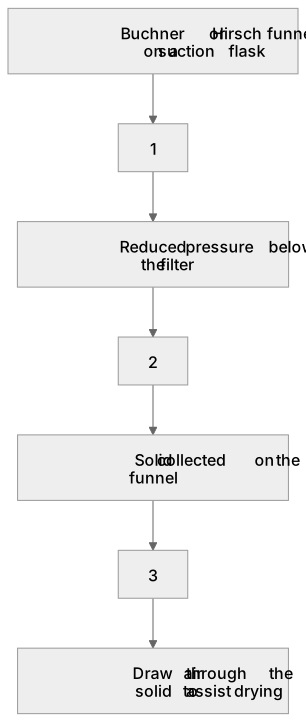
1Box 1
2Box 2
3Box 3
There is more to this lesson
The full lesson goes on to check your understanding and help you earn the marks. Create a free account to carry on, with your progress saved.
A week of Premium from your first lesson · Then the free plan continues · No card, no charge
Test your understanding of Nitrogen compounds, polymers and synthesis - 6.2.5 Organic synthesis: • filtration under reduced pressure
Active recall beats re-reading. Take an instant quiz now to test what you’ve learned and lock it into long-term memory.
A week of Premium from your first lesson · Then the free plan continues · No card, no charge