OCR · A-Level · Chemistry
Course version: H432 · Version from Sept 2017
• recrystallisation
Full specification wording
Nitrogen compounds, polymers and synthesis - 6.2.5 Organic synthesis: • recrystallisation
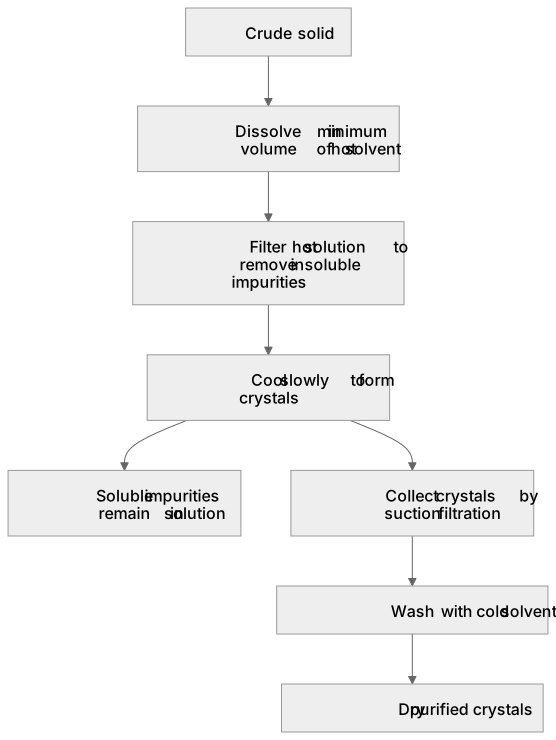
Recrystallisation purifies a crude solid by dissolving it in the minimum volume of hot solvent, then cooling so the purified compound crystallises while impurities stay dissolved or are removed by…
- Point 7 of 11
- 4 key terms
Study notes
From the teaching notes for this specification point.
The idea
Recrystallisation purifies a crude solid by dissolving it in the minimum volume of hot solvent, then cooling so the purified compound crystallises while impurities stay dissolved or are removed by filtration. The solvent is chosen so the compound is very soluble when hot but only slightly soluble when cold. The hot solution is filtered to remove insoluble impurities, cooled slowly to form crystals, and the crystals are collected by suction filtration, washed with cold solvent and dried. Learners should recognise the purpose of each step, why the minimum volume of hot solvent is used, and why slow cooling gives purer, larger crystals.
What earns the marks
- States that the crude solid is dissolved in the minimum volume of hot solvent to form a saturated solution.
- Explains that cooling the hot solution causes the purified compound to crystallise while soluble impurities remain in solution.
- Describes filtering the hot solution to remove insoluble impurities before cooling.
- Identifies collecting the crystals by suction filtration and washing with cold solvent to remove mother liquor.
- Explains that the chosen solvent dissolves the compound well when hot but poorly when cold.
Common mistakes and how to put them right
Uses a large excess of hot solvent.
Put it right by using the minimum volume so crystals form readily on cooling.
Cools the solution rapidly in ice.
Put it right by cooling slowly to obtain purer, larger crystals.
Washes the crystals with hot solvent.
Put it right by using cold solvent to avoid redissolving the product.
Exam tips
- Explain the solvent choice in terms of solubility differences between hot and cold conditions.
- Justify each step by naming the impurity it removes or the product loss it prevents.
- Link recrystallisation to the earlier suction filtration step when describing a full purification sequence.
Try the lesson
The start of the Nitrogen compounds, polymers and synthesis - 6.2.5 Organic synthesis: • recrystallisation lesson, made from teaching notes for this specification point.
Listen
Recrystallisation purifies a crude solid by dissolving it in the minimum volume of hot solvent, then cooling so the purified compound crystallises while impurities stay dissolved or are removed by filtration. The solvent is chosen so the compound is very soluble when hot but only slightly soluble when cold. The hot solution is filtered to remove insoluble impurities, cooled slowly to form crystals, and the crystals are collected by suction filtration, washed with cold solvent and dried. Learners should recognise the purpose of each step, why the minimum volume of hot solvent is used, and why slow cooling gives purer, larger crystals. A strong answer earns marks for these points. States that the crude solid is dissolved in the minimum volume of hot solvent to form a saturated solution. Explains that cooling the hot solution causes the purified compound to crystallise while soluble impurities remain in solution. Describes filtering the hot solution to remove insoluble impurities before cooling. Identifies collecting the crystals by suction filtration and washing with cold solvent to remove mother liquor. A common slip: Uses a large excess of hot solvent. Instead, using the minimum volume so crystals form readily on cooling. Exam tip: Explain the solvent choice in terms of solubility differences between hot and cold conditions.
See it
Key words
Say what each word means before you turn the card.
Recrystallisation
Try answering aloud or in your head before turning the card.
Solvent selection by temperature-dependent solubility
Try answering aloud or in your head before turning the card.
Removal of soluble and insoluble impurities
Try answering aloud or in your head before turning the card.
Practical technique within organic synthesis
Try answering aloud or in your head before turning the card.
See every definition
- Recrystallisation
- Purifies a crude solid by dissolving it in the minimum volume of hot solvent, then cooling so the purified compound crystallises while impurities stay dissolved or are removed by filtration.
- Solvent selection by temperature-dependent solubility
- The solvent is chosen so the compound is very soluble when hot but only slightly soluble when cold.
- Removal of soluble and insoluble impurities
- The hot solution is filtered to remove insoluble impurities, and cooling causes the purified compound to crystallise while soluble impurities remain in solution.
- Practical technique within organic synthesis
- The hot solution is filtered, cooled slowly to form crystals, and the crystals are collected by suction filtration, washed with cold solvent and dried.
Label the diagram
Some boxes have lost their names. Pick the right name for each number.
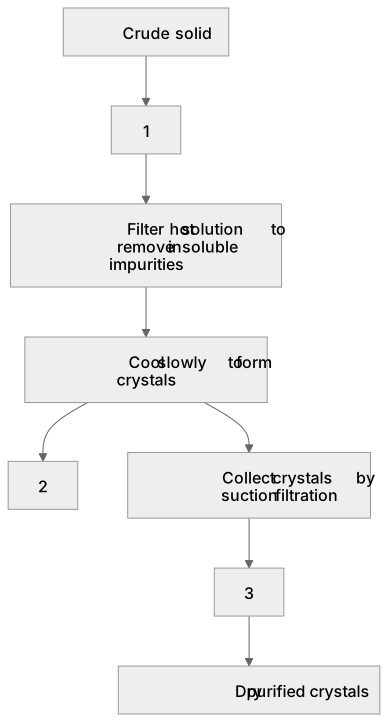
1Box 1
2Box 2
3Box 3
There is more to this lesson
The full lesson goes on to check your understanding and help you earn the marks. Create a free account to carry on, with your progress saved.
A week of Premium from your first lesson · Then the free plan continues · No card, no charge
Test your understanding of Nitrogen compounds, polymers and synthesis - 6.2.5 Organic synthesis: • recrystallisation
Active recall beats re-reading. Take an instant quiz now to test what you’ve learned and lock it into long-term memory.
A week of Premium from your first lesson · Then the free plan continues · No card, no charge