OCR · A-Level · Chemistry
Course version: H432 · Version from Sept 2017
(f) use of the term standard electrode (redox) potential, E⦵, including…
Full specification wording
Redox and electrode potentials: (f) use of the term standard electrode (redox) potential, E⦵, including its measurement using a hydrogen electrode
A standard electrode (redox) potential, E⦵, measures the tendency of a half-cell to gain electrons relative to the standard hydrogen electrode (SHE), which is assigned E⦵ = 0.00 V. Standard…
- Point 7 of 14
- 4 key terms
Study notes
From the teaching notes for this specification point.
The idea
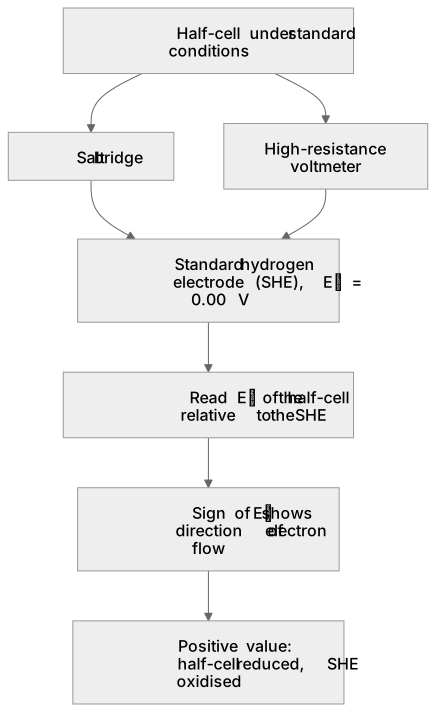
A standard electrode (redox) potential, E⦵, measures the tendency of a half-cell to gain electrons relative to the standard hydrogen electrode (SHE), which is assigned E⦵ = 0.00 V. Standard conditions are 298 K, a solution concentration of 1 mol dm⁻³ for each aqueous species, and a gas pressure of 100 kPa (1 bar) for any gaseous species; a solid electrode such as platinum is used where the half-cell has no metal of its own. To measure E⦵, connect the half-cell to the SHE with a high-resistance voltmeter and a salt bridge, keeping the half-cell under those standard conditions. The sign of E⦵ shows the direction of electron flow: a positive value means the half-cell is reduced and the SHE is oxidised.
What earns the marks
- States that E⦵ is measured relative to the standard hydrogen electrode, which is assigned a value of exactly 0.00 V.
- Identifies the standard conditions as 298 K, 1 mol dm⁻³ aqueous concentration and 100 kPa gas pressure.
- Explains that a high-resistance voltmeter and a salt bridge connect the half-cell to the SHE during measurement.
- Interprets the sign of E⦵ as showing whether the half-cell is reduced or oxidised relative to the SHE.
Common mistakes and how to put them right
States the standard gas pressure as 1 atm rather than 100 kPa.
Put it right: Use 100 kPa (1 bar) as the standard pressure.
Treats the SHE as having a variable potential.
Put it right: Assign it exactly 0.00 V as the reference.
Omits the salt bridge or voltmeter from the measurement setup.
Put it right: Include both to complete the circuit and read the potential.
Exam tips
- Learn the three standard conditions (298 K, 1 mol dm⁻³, 100 kPa) as a fixed set and quote all three when asked.
- Remember the SHE is the reference with E⦵ = 0.00 V, so all other values are relative to it.
- Link the sign of E⦵ to the direction of electron flow to explain which half-cell is reduced.
Try the lesson
The start of the Redox and electrode potentials: (f) use of the term standard electrode (redox) potential, E⦵, including its measurement using a hydrogen electrode lesson, made from teaching notes for this specification point.
Listen
A standard electrode (redox) potential, E⦵, measures the tendency of a half-cell to gain electrons relative to the standard hydrogen electrode (SHE), which is assigned E⦵ = 0.00 V. Standard conditions are 298 K, a solution concentration of 1 mol dm⁻³ for each aqueous species, and a gas pressure of 100 kPa (1 bar) for any gaseous species; a solid electrode such as platinum is used where the half-cell has no metal of its own. To measure E⦵, connect the half-cell to the SHE with a high-resistance voltmeter and a salt bridge, keeping the half-cell under those standard conditions. The sign of E⦵ shows the direction of electron flow: a positive value means the half-cell is reduced and the SHE is oxidised. A strong answer earns marks for these points. States that E⦵ is measured relative to the standard hydrogen electrode, which is assigned a value of exactly 0.00 V. Identifies the standard conditions as 298 K, 1 mol dm⁻³ aqueous concentration and 100 kPa gas pressure. Explains that a high-resistance voltmeter and a salt bridge connect the half-cell to the SHE during measurement. Interprets the sign of E⦵ as showing whether the half-cell is reduced or oxidised relative to the SHE. Exam tip: Learn the three standard conditions (298 K, 1 mol dm⁻³, 100 kPa) as a fixed set and quote all three when asked.
See it
Key words
Say what each word means before you turn the card.
Standard electrode (redox) potential
Try answering aloud or in your head before turning the card.
Standard hydrogen electrode
Try answering aloud or in your head before turning the card.
Standard conditions
Try answering aloud or in your head before turning the card.
Measurement using voltmeter and salt bridge
Try answering aloud or in your head before turning the card.
See every definition
- Standard electrode (redox) potential
- Measures the tendency of a half-cell to gain electrons relative to the standard hydrogen electrode, which is assigned E⦵ = 0.00 V.
- Standard hydrogen electrode
- The reference to which a half-cell is connected, assigned a value of exactly 0.00 V.
- Standard conditions
- 298 K, a solution concentration of 1 mol dm⁻³ for each aqueous species, and a gas pressure of 100 kPa (1 bar) for any gaseous species.
- Measurement using voltmeter and salt bridge
- The half-cell is connected to the standard hydrogen electrode with a high-resistance voltmeter and a salt bridge, keeping the half-cell under standard conditions.
Label the diagram
Some boxes have lost their names. Pick the right name for each number.
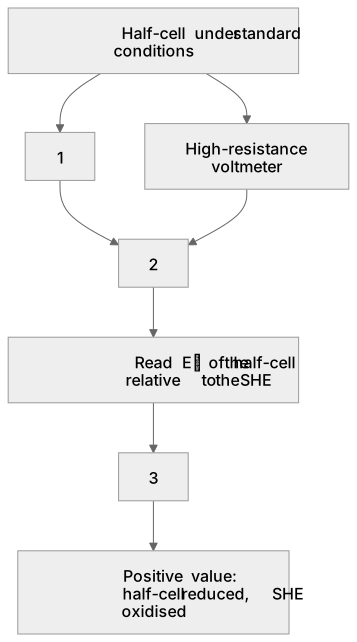
1Box 1
2Box 2
3Box 3
There is more to this lesson
The full lesson goes on to check your understanding and help you earn the marks. Create a free account to carry on, with your progress saved.
A week of Premium from your first lesson · Then the free plan continues · No card, no charge
Test your understanding of Redox and electrode potentials: (f) use of the term standard electrode (redox) potential, E⦵, including its measurement using a hydrogen electrode
Active recall beats re-reading. Take an instant quiz now to test what you’ve learned and lock it into long-term memory.
A week of Premium from your first lesson · Then the free plan continues · No card, no charge