OCR · A-Level · Chemistry
Course version: H432 · Version from Sept 2017
Redox and electrode potentials: (ii) non-familiar redox systems
Non-familiar redox systems test whether you can transfer the standard electrode-potential method to a cell you have not met in the specification.
- Point 6 of 14
- 4 key terms
Study notes
From the teaching notes for this specification point.
The idea
Non-familiar redox systems test whether you can transfer the standard electrode-potential method to a cell you have not met in the specification. Read the description of the two half-cells, identify which species is oxidised and which is reduced, and write each half-equation with the correct number of electrons and charge balance. Then combine them so electrons cancel, giving the overall cell equation. Use E° values to decide the spontaneous direction: the half-cell with the more positive E° is reduced, and the other is oxidised. Calculate E°cell = E°(reduction) − E°(oxidation), keeping signs. Check that the cell diagram, ion charges and state symbols are consistent, and that any unfamiliar ion, such as a complex or an oxoanion, is balanced for atoms, charge and electrons before you choose an answer.
What earns the marks
- Identifies the half-cell with the more positive standard electrode potential as the one that is reduced.
- Writes each half-equation with atoms, charge and electrons balanced before combining them.
- Combines the half-equations so that the electrons cancel and gives the overall cell equation.
- Calculates E°cell by subtracting the oxidation half-cell potential from the reduction half-cell potential, retaining signs.
- Checks that unfamiliar ions and complexes are balanced for atoms, charge and electrons.
Common mistakes and how to put them right
Reverses the subtraction order and reports E°cell with the wrong sign.
Put it right: Subtract the oxidation potential from the reduction potential.
Leaves electrons unbalanced between the two half-equations.
Put it right: Multiply each half-equation so the electron numbers match.
Treats an unfamiliar complex ion as if its charge were neutral.
Put it right: Work out the charge from the ligands and the metal oxidation state.
Assumes the more negative E° half-cell is reduced.
Put it right: The more positive E° half-cell is the one reduced.
Exam tips
- Write both half-equations first, then combine, rather than trying to balance the overall equation directly.
- State the reduction and oxidation half-cells explicitly before calculating E°cell.
- Check charge balance on each half-equation by counting total charge on both sides.
- Use the unfamiliar species' formula to deduce oxidation states rather than guessing.
Try the lesson
The start of the Redox and electrode potentials: (ii) non-familiar redox systems lesson, made from teaching notes for this specification point.
Listen
Non-familiar redox systems test whether you can transfer the standard electrode-potential method to a cell you have not met in the specification. Read the description of the two half-cells, identify which species is oxidised and which is reduced, and write each half-equation with the correct number of electrons and charge balance. Then combine them so electrons cancel, giving the overall cell equation. Use E° values to decide the spontaneous direction: the half-cell with the more positive E° is reduced, and the other is oxidised. Calculate E°cell = E°(reduction) − E°(oxidation), keeping signs. Check that the cell diagram, ion charges and state symbols are consistent, and that any unfamiliar ion, such as a complex or an oxoanion, is balanced for atoms, charge and electrons before you choose an answer. A strong answer earns marks for these points. Identifies the half-cell with the more positive standard electrode potential as the one that is reduced. Writes each half-equation with atoms, charge and electrons balanced before combining them. Combines the half-equations so that the electrons cancel and gives the overall cell equation. Calculates E°cell by subtracting the oxidation half-cell potential from the reduction half-cell potential, retaining signs. Exam tip: Write both half-equations first, then combine, rather than trying to balance the overall equation directly.
See it
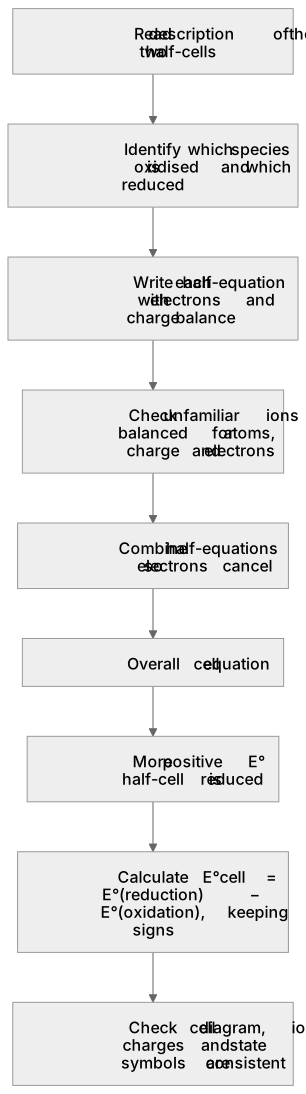
Key words
Say what each word means before you turn the card.
Standard electrode potentials and spontaneity
Try answering aloud or in your head before turning the card.
Half-equation writing and electron balance
Try answering aloud or in your head before turning the card.
Combining half-equations into a cell equation
Try answering aloud or in your head before turning the card.
Applying familiar redox method to unfamiliar systems
Try answering aloud or in your head before turning the card.
See every definition
- Standard electrode potentials and spontaneity
- The half-cell with the more positive E° is reduced and the other is oxidised, giving the spontaneous direction.
- Half-equation writing and electron balance
- Each half-equation is written with atoms, charge and electrons balanced before combining them.
- Combining half-equations into a cell equation
- The half-equations are combined so that the electrons cancel, giving the overall cell equation.
- Applying familiar redox method to unfamiliar systems
- Any unfamiliar ion, such as a complex or an oxoanion, is balanced for atoms, charge and electrons before an answer is chosen.
Label the diagram
Some boxes have lost their names. Pick the right name for each number.
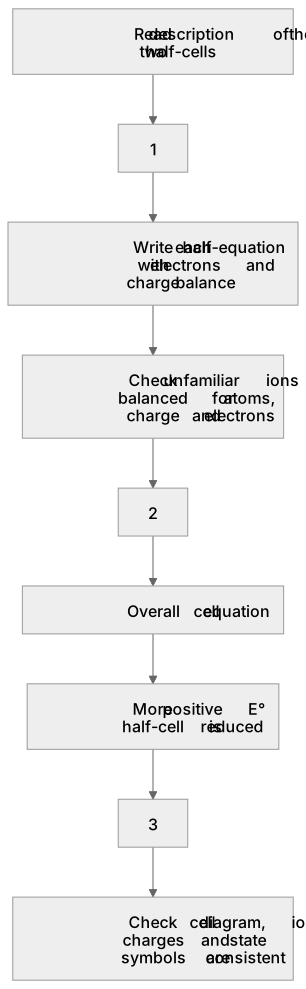
1Box 1
2Box 2
3Box 3
There is more to this lesson
The full lesson goes on to check your understanding and help you earn the marks. Create a free account to carry on, with your progress saved.
A week of Premium from your first lesson · Then the free plan continues · No card, no charge
Test your understanding of Redox and electrode potentials: (ii) non-familiar redox systems
Active recall beats re-reading. Take an instant quiz now to test what you’ve learned and lock it into long-term memory.
A week of Premium from your first lesson · Then the free plan continues · No card, no charge