OCR · A-Level · Chemistry
Course version: H432 · Version from Sept 2017
(h) ligand substitution reactions and the accompanying colour changes in…
Full specification wording
Transition elements: (h) ligand substitution reactions and the accompanying colour changes in the formation of:
Ligand substitution occurs when one ligand in a complex is replaced by another.
- Point 15 of 24
- 2 key terms
Study notes
From the teaching notes for this specification point.
The idea
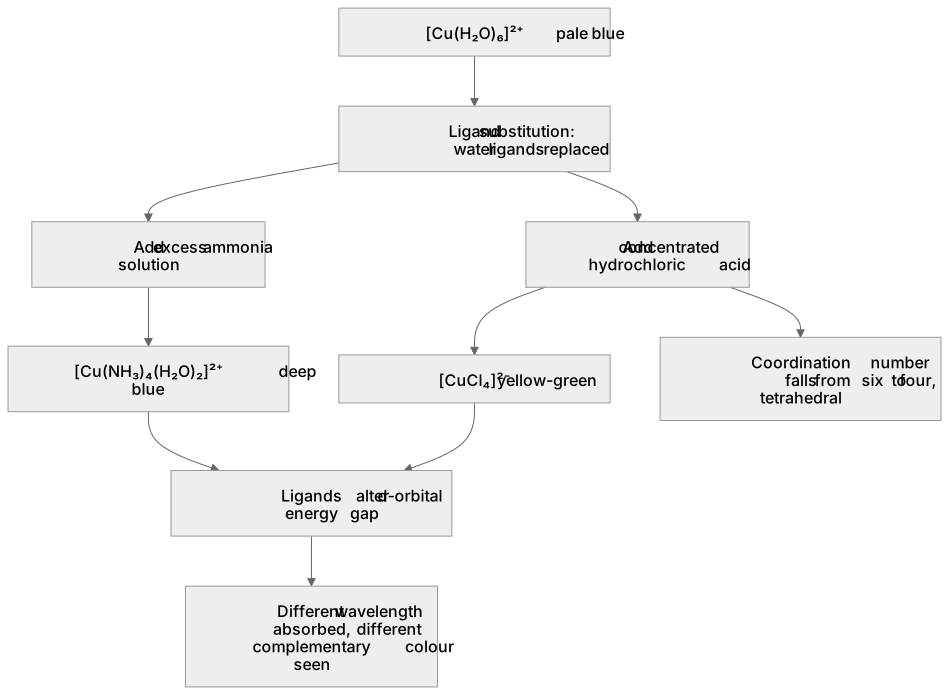
Ligand substitution occurs when one ligand in a complex is replaced by another. In aqueous solution the hexaaqua ion [Cu(H₂O)₆]²⁺ is pale blue; adding excess ammonia solution replaces water ligands to give [Cu(NH₃)₄(H₂O)₂]²⁺, a deep blue solution, and adding concentrated hydrochloric acid replaces water ligands to give [CuCl₄]²⁻, a yellow-green solution. The colour change arises because the ligands alter the energy gap between the d orbitals, so a different wavelength of visible light is absorbed and the complementary colour is seen. The coordination number can change: six-coordinate octahedral becomes four-coordinate tetrahedral with chloride.
What earns the marks
- Identifies that a ligand substitution reaction replaces one ligand in a complex ion with a different ligand.
- States that [Cu(H₂O)₆]²⁺ is pale blue and that replacing water with ammonia ligands gives a deep blue solution.
- States that replacing water ligands with chloride ions gives a yellow-green solution of [CuCl₄]²⁻.
- Explains that the change in ligands alters the energy gap between d orbitals, so a different wavelength is absorbed and a different complementary colour is observed.
- Recognises that the coordination number falls from six to four when [CuCl₄]²⁻ forms, giving a tetrahedral shape.
Common mistakes and how to put them right
Describes the colour change as a redox reaction.
Put it right by identifying it as ligand substitution in which the oxidation state of copper stays 2⁺.
Claims the ammonia complex keeps six water ligands.
Put it right by noting that four ammonia ligands replace four water ligands, leaving two water ligands.
States that the colour change happens because the metal ion changes identity.
Put it right by explaining that the same copper ion absorbs a different wavelength because the ligand field changes.
Exam tips
- Learn the three copper colours together: pale blue hexaaqua, deep blue ammonia complex, yellow-green chloride complex.
- Link each colour change to the ligand that replaces water, not to a change in oxidation state.
- When asked why the colour differs, refer to the d-orbital energy gap and the complementary colour absorbed.
Try the lesson
The start of the Transition elements: (h) ligand substitution reactions and the accompanying colour changes in the formation of: lesson, made from teaching notes for this specification point.
Listen
Ligand substitution occurs when one ligand in a complex is replaced by another. In aqueous solution the hexaaqua ion [Cu(H₂O)₆]²⁺ is pale blue; adding excess ammonia solution replaces water ligands to give [Cu(NH₃)₄(H₂O)₂]²⁺, a deep blue solution, and adding concentrated hydrochloric acid replaces water ligands to give [CuCl₄]²⁻, a yellow-green solution. The colour change arises because the ligands alter the energy gap between the d orbitals, so a different wavelength of visible light is absorbed and the complementary colour is seen. The coordination number can change: six-coordinate octahedral becomes four-coordinate tetrahedral with chloride. A strong answer earns marks for these points. Identifies that a ligand substitution reaction replaces one ligand in a complex ion with a different ligand. States that [Cu(H₂O)₆]²⁺ is pale blue and that replacing water with ammonia ligands gives a deep blue solution. States that replacing water ligands with chloride ions gives a yellow-green solution of [CuCl₄]²⁻. Explains that the change in ligands alters the energy gap between d orbitals, so a different wavelength is absorbed and a different complementary colour is observed. A common slip: Describes the colour change as a redox reaction. Instead, identifying it as ligand substitution in which the oxidation state of copper stays 2⁺. Exam tip: Learn the three copper colours together: pale blue hexaaqua, deep blue ammonia complex, yellow-green chloride complex.
See it
Key words
Say what each word means before you turn the card.
Ligand substitution
Try answering aloud or in your head before turning the card.
Colour changes in transition element complexes
Try answering aloud or in your head before turning the card.
See every definition
- Ligand substitution
- A reaction in which one ligand in a complex is replaced by another ligand.
- Colour changes in transition element complexes
- The colour change arises because the ligands alter the energy gap between the d orbitals, so a different wavelength of visible light is absorbed and the complementary colour is seen.
Label the diagram
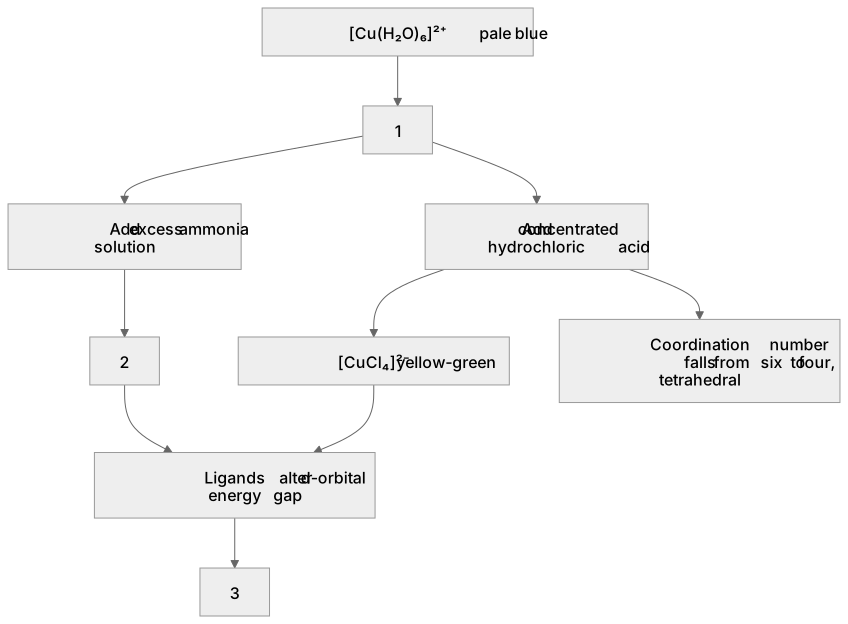
Some boxes have lost their names. Pick the right name for each number.
1Box 1
2Box 2
3Box 3
There is more to this lesson
The full lesson goes on to check your understanding and help you earn the marks. Create a free account to carry on, with your progress saved.
A week of Premium from your first lesson · Then the free plan continues · No card, no charge
Test your understanding of Transition elements: (h) ligand substitution reactions and the accompanying colour changes in the formation of:
Active recall beats re-reading. Take an instant quiz now to test what you’ve learned and lock it into long-term memory.
A week of Premium from your first lesson · Then the free plan continues · No card, no charge