OCR · A-Level · Chemistry
Course version: H432 · Version from Sept 2017
(i) an initial rate method such as a clock reaction
Full specification wording
Use of apparatus and techniques: (i) an initial rate method such as a clock reaction
An initial-rate method measures how fast a reaction is at the very start, before concentrations have changed appreciably.
- Point 16 of 17
- 4 key terms
Study notes
From the teaching notes for this specification point.
The idea
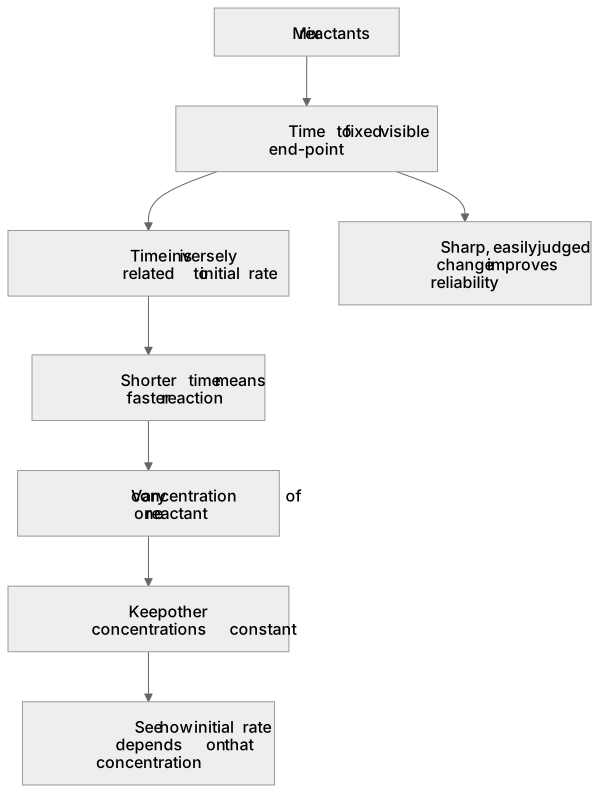
An initial-rate method measures how fast a reaction is at the very start, before concentrations have changed appreciably. A clock reaction is a common example: you mix the reactants and time how long it takes for a visible change, such as a colour appearing or a cross disappearing. Because the same visible end-point is used each time, the time taken is inversely related to the initial rate, so a shorter time means a faster reaction. By varying the concentration of one reactant while keeping others constant, you can see how initial rate depends on that concentration. The method assumes the measured time reflects the early stage of the reaction, so the change should be sharp and easy to judge.
What earns the marks
- States that an initial-rate method measures the rate at the start of the reaction before concentrations change significantly.
- Explains that in a clock reaction the time to a fixed visible end-point is inversely related to the initial rate.
- Describes varying the concentration of one reactant while holding others constant to investigate how rate depends on concentration.
- Identifies that a sharp, easily judged visible change improves the reliability of the timed end-point.
Common mistakes and how to put them right
Assumes a longer time means a faster reaction.
Put it right: Recognise that time to a fixed end-point is inversely related to rate.
Changes several reactant concentrations at once.
Put it right: Vary one concentration while keeping the others constant so the effect can be attributed.
Treats the clock time itself as the rate.
Put it right: Convert it, since rate is proportional to the reciprocal of the time.
Exam tips
- Link the timed end-point directly to rate by stating the inverse relationship rather than leaving it implied.
- When comparing runs, state explicitly which variable is changed and which are held constant.
- Justify why a clock reaction suits initial-rate measurement, referring to the fixed, observable end-point.
Try the lesson
The start of the Use of apparatus and techniques: (i) an initial rate method such as a clock reaction lesson, made from teaching notes for this specification point.
Listen
An initial-rate method measures how fast a reaction is at the very start, before concentrations have changed appreciably. A clock reaction is a common example: you mix the reactants and time how long it takes for a visible change, such as a colour appearing or a cross disappearing. Because the same visible end-point is used each time, the time taken is inversely related to the initial rate, so a shorter time means a faster reaction. By varying the concentration of one reactant while keeping others constant, you can see how initial rate depends on that concentration. The method assumes the measured time reflects the early stage of the reaction, so the change should be sharp and easy to judge. A strong answer earns marks for these points. States that an initial-rate method measures the rate at the start of the reaction before concentrations change significantly. Explains that in a clock reaction the time to a fixed visible end-point is inversely related to the initial rate. Describes varying the concentration of one reactant while holding others constant to investigate how rate depends on concentration. Identifies that a sharp, easily judged visible change improves the reliability of the timed end-point. Exam tip: Link the timed end-point directly to rate by stating the inverse relationship rather than leaving it implied.
See it
Key words
Say what each word means before you turn the card.
Initial rate method
Try answering aloud or in your head before turning the card.
Clock reaction
Try answering aloud or in your head before turning the card.
Inverse relationship between time and rate
Try answering aloud or in your head before turning the card.
Controlling variables to isolate concentration effects
Try answering aloud or in your head before turning the card.
See every definition
- Initial rate method
- A method that measures how fast a reaction is at the very start, before concentrations have changed appreciably.
- Clock reaction
- A common example of an initial-rate method in which reactants are mixed and the time taken for a visible change is measured.
- Inverse relationship between time and rate
- Because the same visible end-point is used each time, the time taken is inversely related to the initial rate, so a shorter time means a faster reaction.
- Controlling variables to isolate concentration effects
- Varying the concentration of one reactant while keeping others constant shows how initial rate depends on that concentration.
Label the diagram
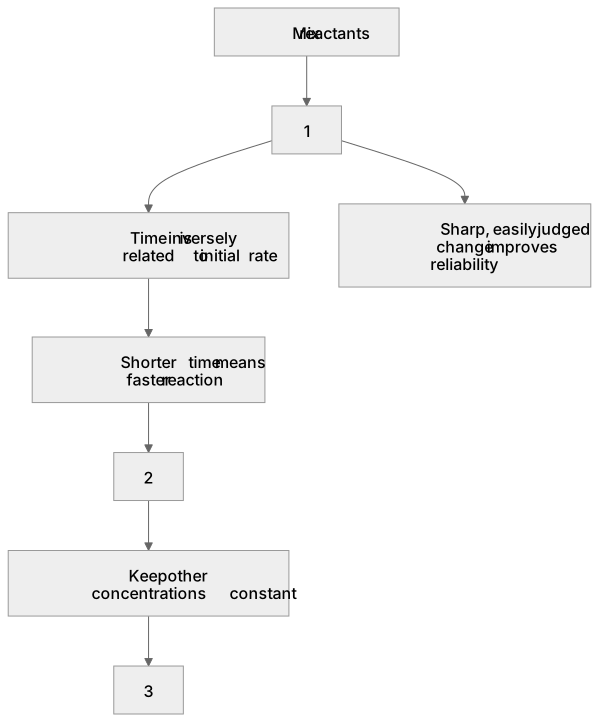
Some boxes have lost their names. Pick the right name for each number.
1Box 1
2Box 2
3Box 3
There is more to this lesson
The full lesson goes on to check your understanding and help you earn the marks. Create a free account to carry on, with your progress saved.
A week of Premium from your first lesson · Then the free plan continues · No card, no charge
Test your understanding of Use of apparatus and techniques: (i) an initial rate method such as a clock reaction
Active recall beats re-reading. Take an instant quiz now to test what you’ve learned and lock it into long-term memory.
A week of Premium from your first lesson · Then the free plan continues · No card, no charge