OCR · A-Level · Chemistry
Course version: H432 · Version from Sept 2017
(ii) a liquid product, including use of a separating funnel
Full specification wording
Use of apparatus and techniques: (ii) a liquid product, including use of a separating funnel
A liquid product is often isolated from a reaction mixture by separating two immiscible layers in a separating funnel.
- Point 11 of 17
- 4 key terms
Study notes
From the teaching notes for this specification point.
The idea
A liquid product is often isolated from a reaction mixture by separating two immiscible layers in a separating funnel. The learner pours the mixture into the funnel, allows the layers to settle, then runs off the lower layer through the tap and pours the upper layer out of the top. The organic layer is identified by its density or by a test, and the aqueous layer is often discarded. The organic layer is then dried with a drying agent such as anhydrous sodium sulfate or calcium chloride, filtered to remove the drying agent, and the pure liquid obtained by distillation. Assessment asks the learner to choose the correct order of operations, the correct layer to keep, or the purpose of each step.
What earns the marks
- Places the mixture in a separating funnel and allows the two immiscible layers to settle.
- Runs off the lower layer through the tap and pours the upper layer from the top.
- Identifies the organic layer using density or a simple test before discarding the other layer.
- Adds a drying agent such as anhydrous sodium sulfate to remove residual water.
- Filters off the drying agent and purifies the liquid by distillation.
Common mistakes and how to put them right
Shakes the funnel without venting.
Put it right: Open the tap periodically to release pressure.
Assumes the organic layer is always on top.
Put it right: Check densities before deciding which layer to keep.
Skips drying before distillation.
Put it right: Add a drying agent and filter it off first.
Exam tips
- State the order: separate, identify layers, dry, filter, distil.
- Explain the purpose of venting the funnel to release pressure.
- Name a suitable drying agent and say it is removed by filtration.
Try the lesson
The start of the Use of apparatus and techniques: (ii) a liquid product, including use of a separating funnel lesson, made from teaching notes for this specification point.
Listen
A liquid product is often isolated from a reaction mixture by separating two immiscible layers in a separating funnel. The learner pours the mixture into the funnel, allows the layers to settle, then runs off the lower layer through the tap and pours the upper layer out of the top. The organic layer is identified by its density or by a test, and the aqueous layer is often discarded. The organic layer is then dried with a drying agent such as anhydrous sodium sulfate or calcium chloride, filtered to remove the drying agent, and the pure liquid obtained by distillation. Assessment asks the learner to choose the correct order of operations, the correct layer to keep, or the purpose of each step. A strong answer earns marks for these points. Places the mixture in a separating funnel and allows the two immiscible layers to settle. Runs off the lower layer through the tap and pours the upper layer from the top. Identifies the organic layer using density or a simple test before discarding the other layer. Adds a drying agent such as anhydrous sodium sulfate to remove residual water. Exam tip: State the order: separate, identify layers, dry, filter, distil.
See it
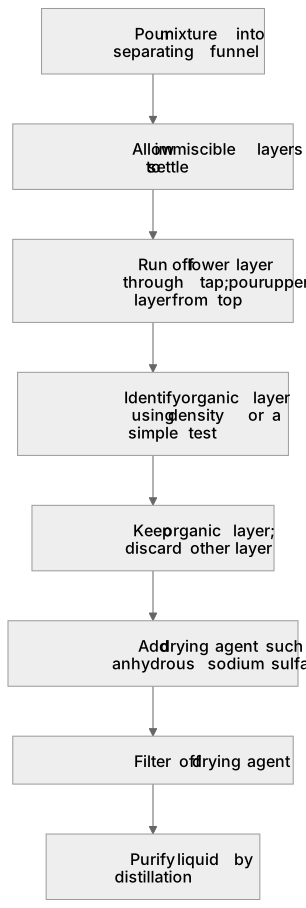
Put it in order
Put these steps in the order they happen.
- 1. Keep organic layer; discard other layer
- 2. Purify liquid by distillation
- 3. Add drying agent such as anhydrous sodium sulfate
- 4. Pour mixture into separating funnel
- 5. Allow immiscible layers to settle
- 6. Filter off drying agent
- 7. Run off lower layer through tap; pour upper layer from top
- 8. Identify organic layer using density or a simple test
Key words
Say what each word means before you turn the card.
Immiscible layer separation
Try answering aloud or in your head before turning the card.
Identifying the organic layer
Try answering aloud or in your head before turning the card.
Drying agents
Try answering aloud or in your head before turning the card.
Distillation of the purified liquid
Try answering aloud or in your head before turning the card.
See every definition
- Immiscible layer separation
- The mixture is poured into a separating funnel and the two immiscible layers are allowed to settle.
- Identifying the organic layer
- The organic layer is identified by its density or by a test before the other layer is discarded.
- Drying agents
- A drying agent such as anhydrous sodium sulfate or calcium chloride is added to remove residual water.
- Distillation of the purified liquid
- After the drying agent is filtered off, the pure liquid is obtained by distillation.
Label the diagram
Some boxes have lost their names. Pick the right name for each number.
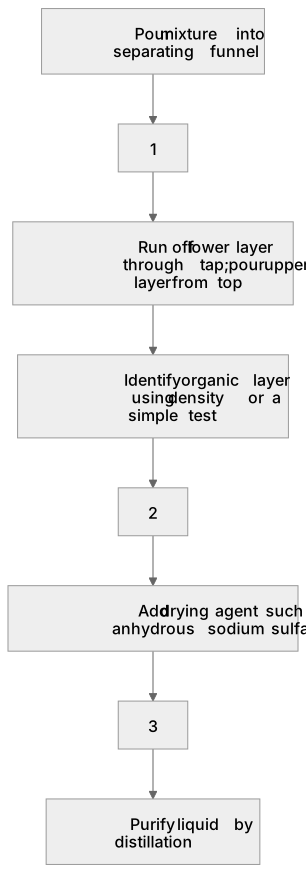
1Box 1
2Box 2
3Box 3
There is more to this lesson
The full lesson goes on to check your understanding and help you earn the marks. Create a free account to carry on, with your progress saved.
A week of Premium from your first lesson · Then the free plan continues · No card, no charge
Test your understanding of Use of apparatus and techniques: (ii) a liquid product, including use of a separating funnel
Active recall beats re-reading. Take an instant quiz now to test what you’ve learned and lock it into long-term memory.
A week of Premium from your first lesson · Then the free plan continues · No card, no charge