OCR · GCSE · English Literature
Death Be Not Proud (John Donne)
Unlock top marks with this guide to John Donne's 'Death Be Not Proud'. This resource deconstructs the poem's metaphysical arguments, unpacks its structure, and provides examiner-level insights to help you write a Grade 9 essay. It is an essential tool for any GCSE student aiming for the highest level of analysis.
- 7 min read
- 2 worked examples
- 4 practice questions
- 9 key terms
Study Notes
Overview
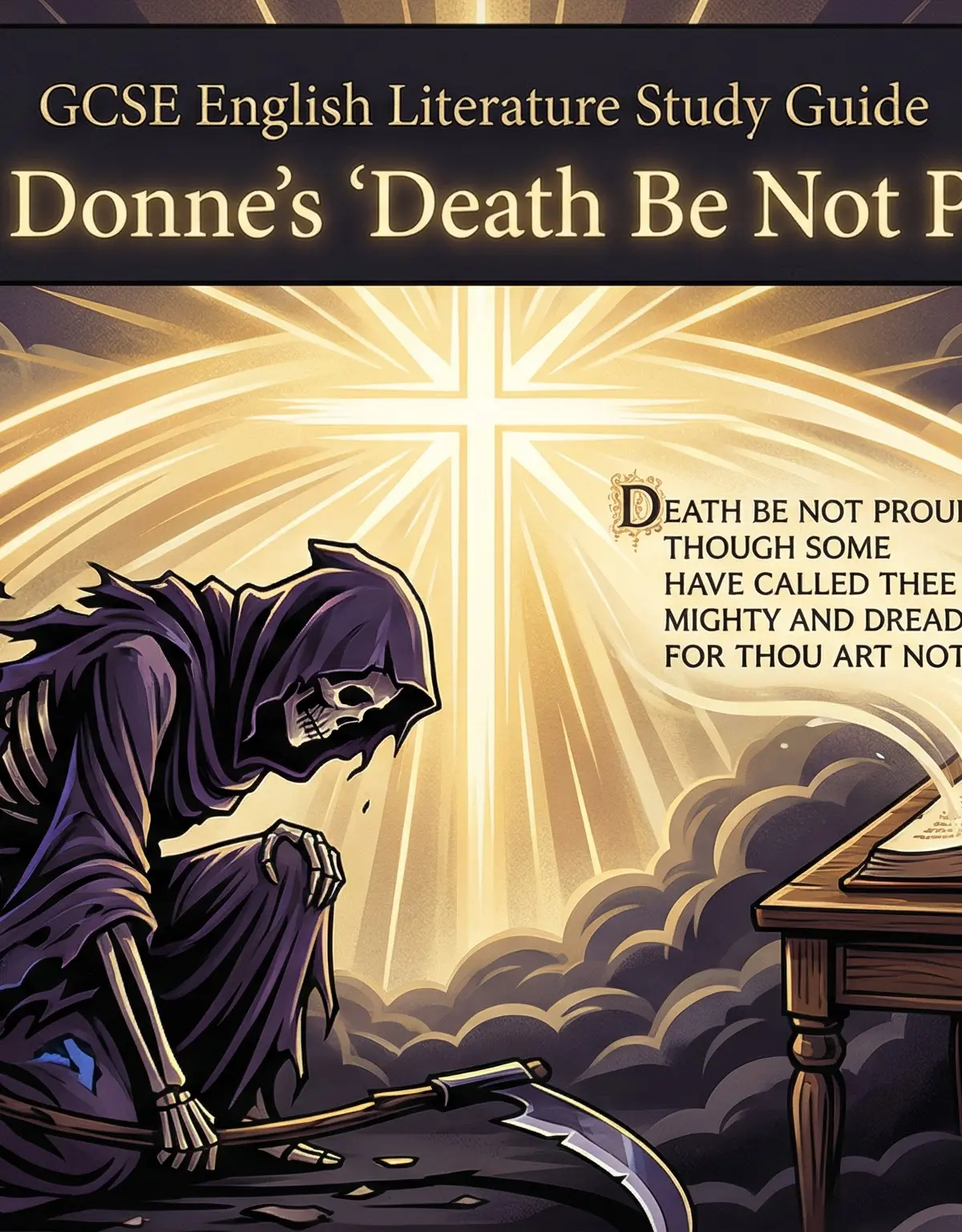
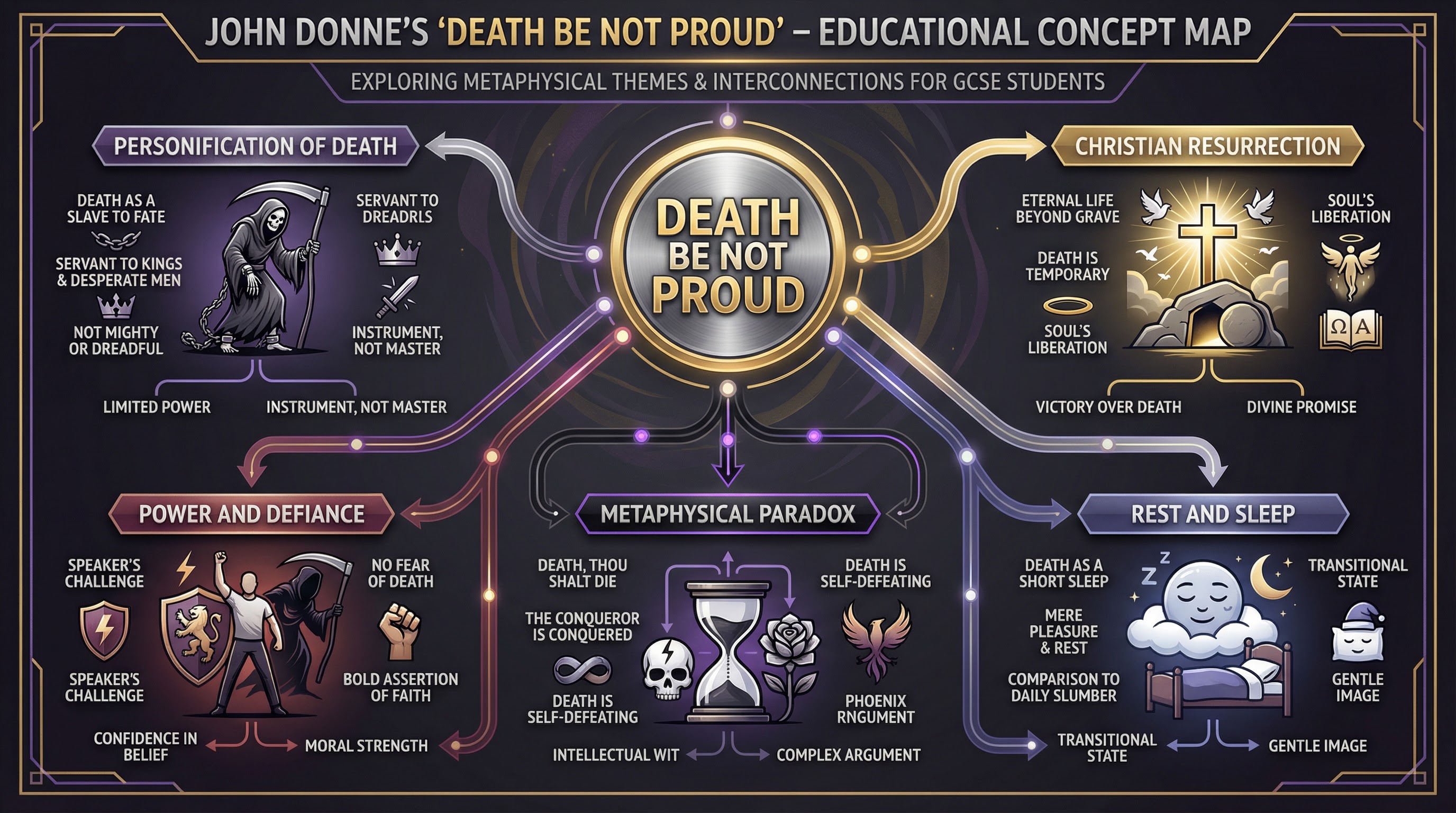
John Donne's 'Death Be Not Proud' (Holy Sonnet 10) is a cornerstone of metaphysical poetry and a frequently examined text in the OCR GCSE English Literature anthology. In this powerful sonnet, the speaker confronts the personified figure of Death, systematically dismantling its power through a combination of logical argument, defiant rhetoric, and profound Christian faith. Examiners are looking for candidates who can move beyond a surface-level reading to analyse the poem's complex intellectual and theological arguments. Credit is awarded for a clear understanding of how Donne uses the sonnet form, particularly the volta and concluding couplet, to structure his argument. Furthermore, a high-level response must integrate contextual knowledge of 17th-century religious beliefs, specifically the Christian doctrine of the Resurrection, which is the ultimate source of the speaker's confidence. This guide will equip you with the analysis, context, and exam technique required to master this challenging and rewarding poem.
Plot/Content Overview
The poem follows a clear, logical progression as it builds its case against Death. It can be broken down into three main sections, mirroring the structure of the sonnet itself.
-
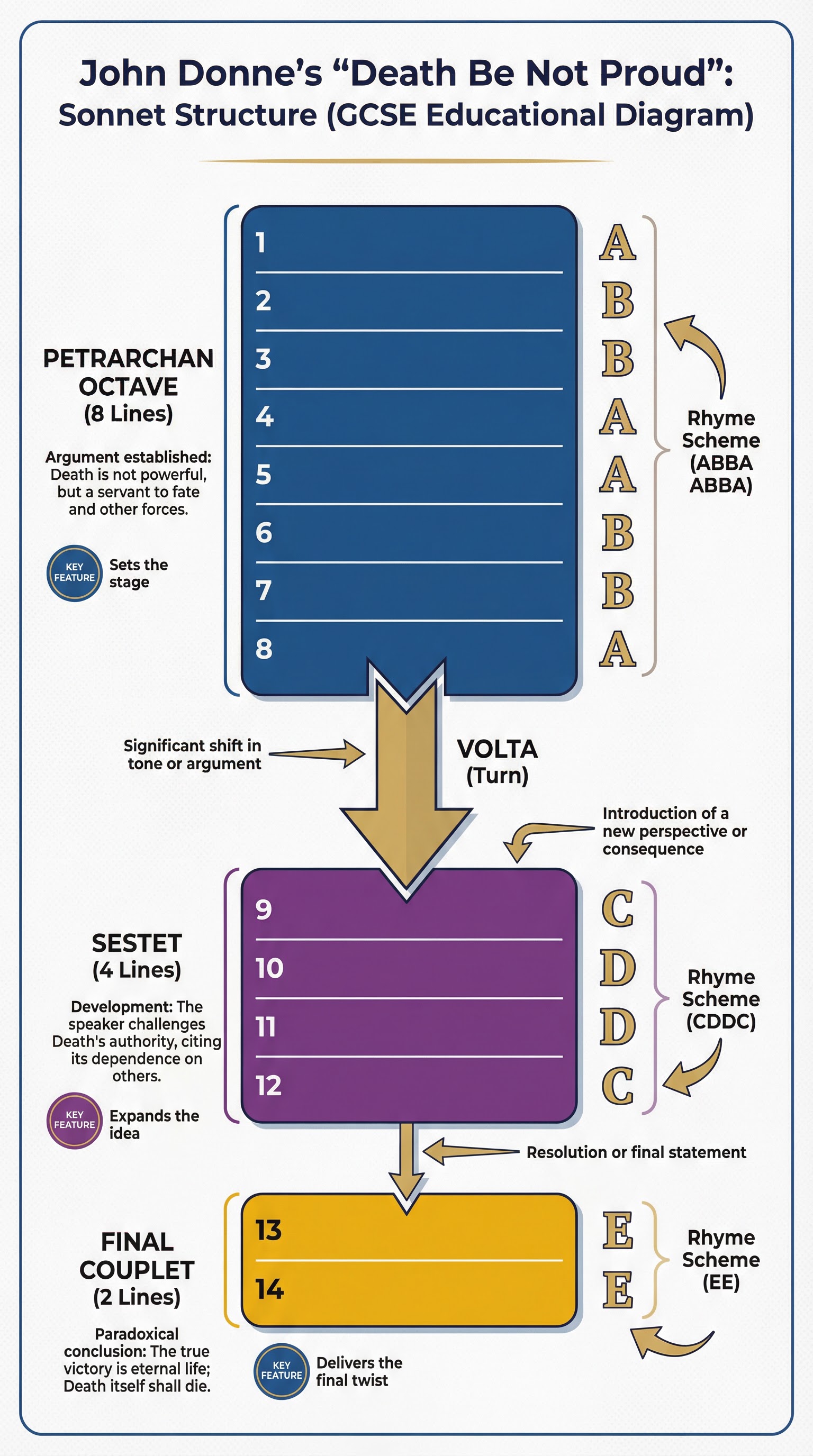
The Octave (Lines 1-8): The speaker opens with a direct challenge to Death, using apostrophe: "Death, be not proud... for thou art not so." He immediately refutes Death's reputation as "mighty and dreadful." He argues that Death does not truly kill those it thinks it does, and that it is merely a form of "rest and sleep," from which we derive pleasure. This section establishes the central argument and the speaker's defiant tone.
-
The Sestet (Lines 9-12): The argument intensifies after the volta. The speaker belittles Death, calling it a "slave to fate, chance, kings, and desperate men." Death is presented as a powerless entity, dependent on other forces (like poison, war, and sickness) to do its work. It is not a master but an instrument, and even then, inferior to other sleep-inducing substances like "poppy or charms."
-
The Concluding Couplet (Lines 13-14): The poem culminates in its famous paradox. The speaker asserts that after a "short sleep," believers "wake eternally." This leads to the final, triumphant declaration: "And death shall be no more; Death, thou shalt die." The Christian belief in resurrection renders Death itself obsolete, leading to its own demise. This powerful conclusion solidifies the speaker's victory.
Themes
Theme 1: The Powerlessness of Death
Donne's primary objective is to subvert the traditional image of Death as an omnipotent force. He systematically strips Death of its power and authority, recasting it as a weak and dependent entity. The poem is an exercise in logical dismantling, where each line adds to the argument that Death has no real power.
Key Quotes:
- "Death, be not proud, though some have called thee / Mighty and dreadful, for thou art not so" - The opening challenge immediately establishes the poem's central thesis.
- "For those whom thou think'st thou dost overthrow / Die not, poor Death, nor yet canst thou kill me." - The use of the adjective "poor" patronises Death, undermining its status.
- "And dost with poison, war, and sickness dwell, / And poppy or charms can make us sleep as well" - This line directly lists Death's associates, reducing it to a mere consequence of other, often mundane or negative, forces.
Theme 2: Faith and the Christian Resurrection
The speaker's confidence is not based on arrogance, but on a deep-seated Christian faith. The entire argument hinges on the belief in an afterlife and the resurrection of the soul. This theological context is essential for understanding the poem's meaning. For Donne, death is not an end but a transition to a better state.
Key Quotes:
- "From rest and sleep, which but thy pictures be, / Much pleasure; then from thee much more must flow." - This line establishes the analogy between sleep and death, framing death as a peaceful and even pleasant experience.
- "And soonest our best men with thee do go, / Rest of their bones, and soul's delivery." - Here, death is presented as a reward for the virtuous, a release for the soul.
- "One short sleep past, we wake eternally / And death shall be no more; Death, thou shalt die." - The concluding couplet is the ultimate expression of this theme, where faith in eternal life becomes the weapon that destroys Death itself.
Writer's Methods
Apostrophe and Personification: The entire poem is an apostrophe, a direct address to the personified figure of Death. This creates a confrontational and dramatic tone. By giving Death human characteristics (like pride), Donne makes it a tangible entity that can be debated with and ultimately defeated.
Metaphysical Conceit: The central conceit of the poem is the comparison of Death to sleep. Donne extends this comparison throughout the poem, using logical reasoning to argue that if sleep is pleasant, then Death must be even more so. This intellectual and often surprising comparison is a hallmark of metaphysical poetry.
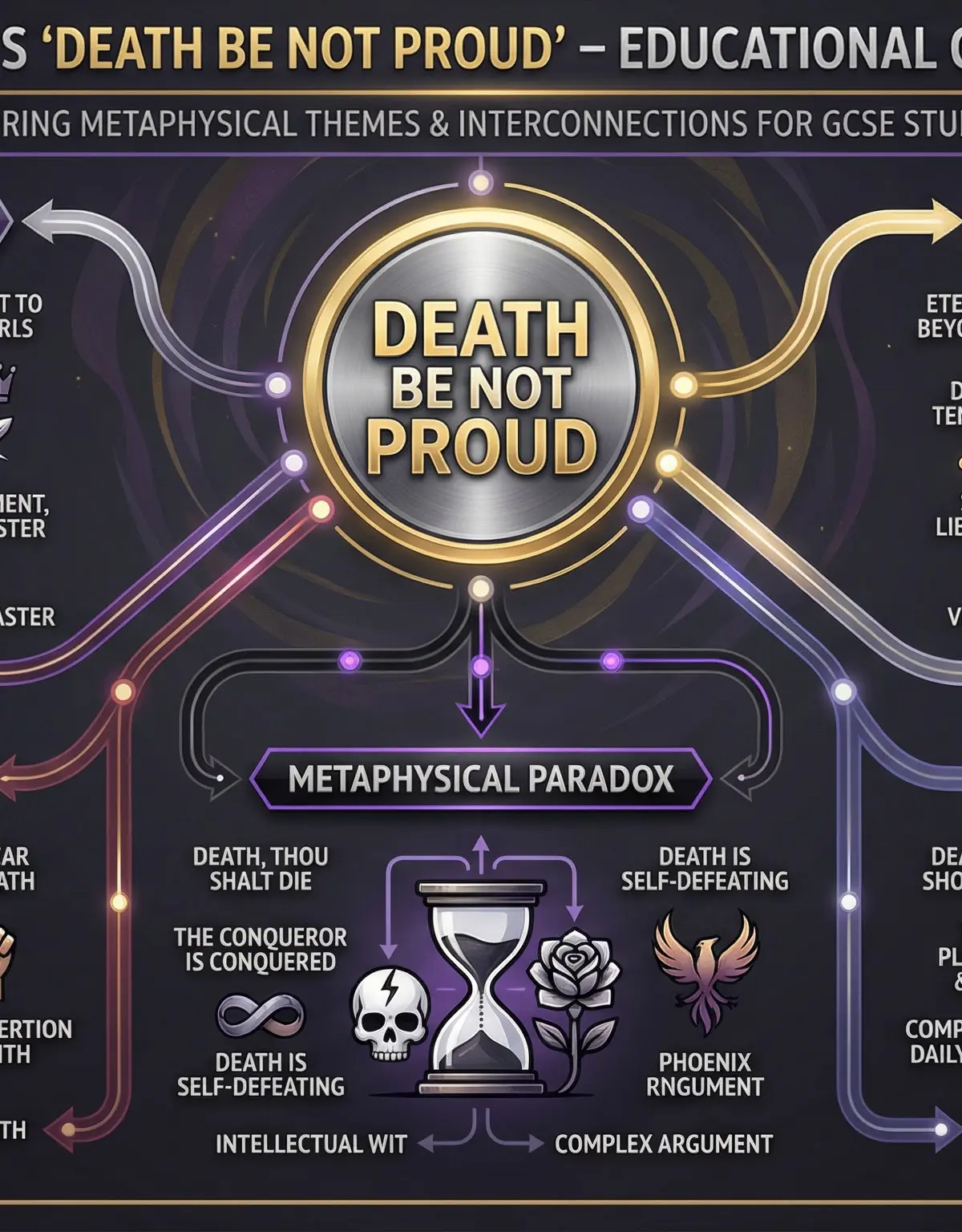
Sonnet Form: Donne uses a hybrid sonnet form, combining elements of both the Petrarchan and Shakespearean models (ABBA ABBA CDDC EE). The initial octave establishes the problem or argument, the sestet develops it, and the final rhyming couplet provides a powerful, epigrammatic conclusion. The volta (the turn in thought) after line 8 is crucial, as it marks the shift from challenging Death to actively belittling it. The rigid structure of the sonnet mirrors the logical rigidity of the speaker's argument.
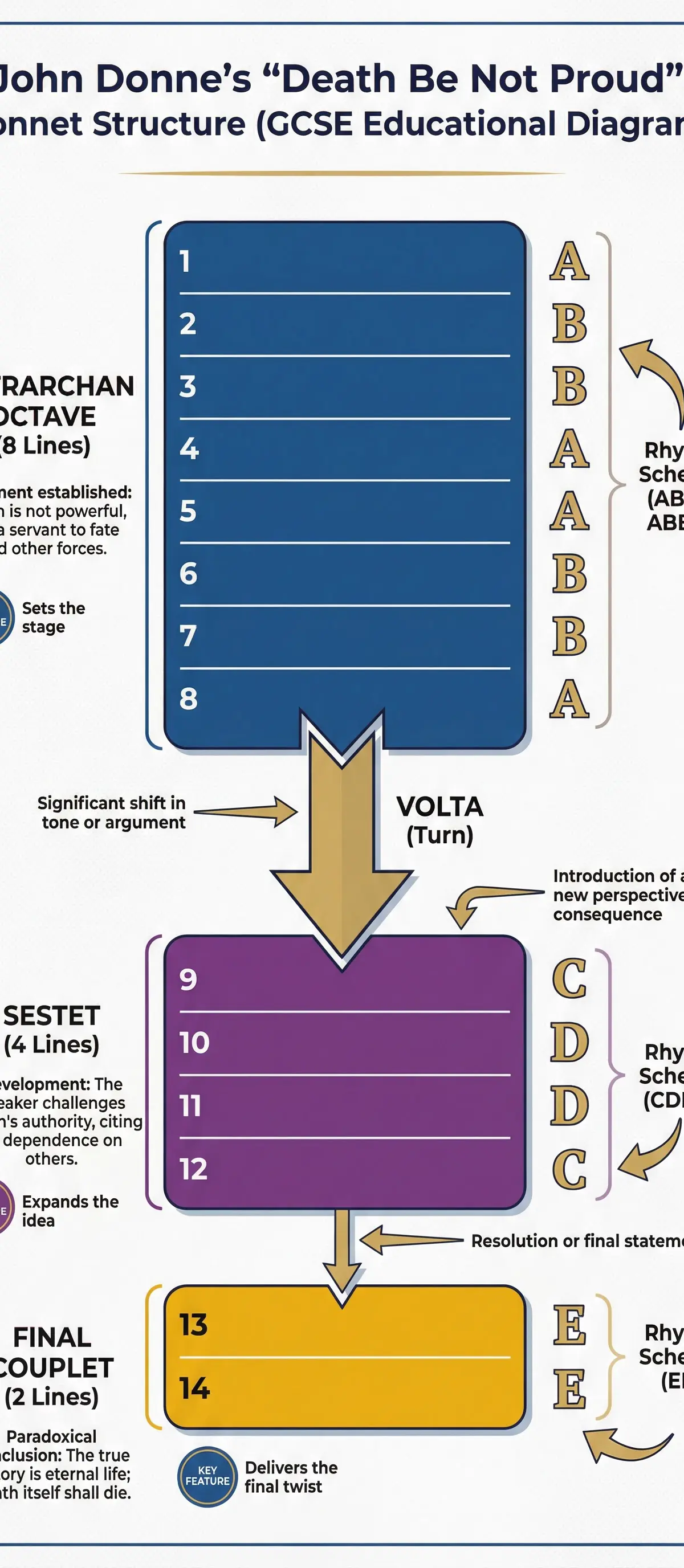
Paradox: The poem is famous for its concluding paradox: "Death, thou shalt die." A paradox is a seemingly self-contradictory statement that contains a deeper truth. In this case, the truth is theological: the eternal life promised by Christianity will make Death obsolete. This use of paradox is a key feature of metaphysical poetry, designed to make the reader think and to express complex spiritual ideas.
Context
To achieve the highest marks (AO3), candidates must integrate contextual understanding. John Donne (1572-1631) was a leading figure of the Metaphysical Poets. He was also an Anglican priest and Dean of St Paul's Cathedral, and his religious convictions are central to his work. The 17th century was a period of intense religious belief, and the Christian doctrine of the Resurrection was a fundamental part of everyday life and understanding. The poem is not a secular argument; it is a profound statement of faith. The fear of death was very real, with high mortality rates, but faith provided a powerful counter-narrative. Mentioning Donne's personal struggles with illness and his awareness of mortality can also add depth to your analysis, but it must be linked directly to the ideas within the poem itself.
Worked Examples
2 worked examples — open one to explore the question and available guidance.
Practice Questions
Test your understanding — click to reveal model answers
Explore how Donne uses language and structure to present the speaker's attitude towards death in 'Death Be Not Proud'.
Hint: Focus on the combination of confrontational language (like apostrophe) and the logical progression of the sonnet form. How do they work together?
'The speaker's confidence is arrogant and unconvincing.' To what extent do you agree with this view?
Hint: This question invites you to evaluate. Consider both sides of the argument. Is the speaker arrogant, or is his confidence rooted in something more profound (like faith)?
Starting with this poem, compare how Donne and one other poet present ideas about mortality.
Hint: Choose a poem that offers a clear point of comparison or contrast. Consider poems that also personify death, or that explore the afterlife.
How does Donne use the sonnet form to structure his argument in 'Death Be Not Proud'?
Hint: Focus specifically on the octave, sestet, volta, and couplet. What does each section contribute to the overall argument?
Test your understanding of Death Be Not Proud (John Donne)
Active recall beats re-reading. Take an instant quiz now to test what you’ve learned and lock it into long-term memory.
7 days Premium · Then free forever · No card, no charge