OCR · GCSE · English Literature
Nettles (Vernon Scannell)
Vernon Scannell's 'Nettles' is a powerful allegory for the futility of parental protection, using military metaphor to transform a simple garden injury into a meditation on the unwinnable war against life's inevitable pains. This poem rewards candidates who can sustain a conceptual comparison with another Conflict Cluster text while analysing Scannell's methods with precision.
- 11 min read
- 2 worked examples
- 4 practice questions
- 11 key terms
Study Notes
Overview
Vernon Scannell's 'Nettles' is a deceptively simple yet profoundly moving poem that explores the fierce, protective, and ultimately futile nature of parental love. At its core, the poem is an extended metaphor where a father's battle against a bed of nettles that have stung his young son becomes an allegory for the impossible war every parent wages against the inevitable pains and dangers of life. For the OCR GCSE examination, candidates are rewarded for a sharp focus on AO1 (comparison) and AO2 (writer's methods), analysing how Scannell's military language and cyclical structure present a deeply pessimistic view of conflict. This is a text that rewards close reading of its language and a conceptual understanding of its central theme: the painful realisation that a parent cannot always be there to shield their child from harm.

Plot/Content Overview
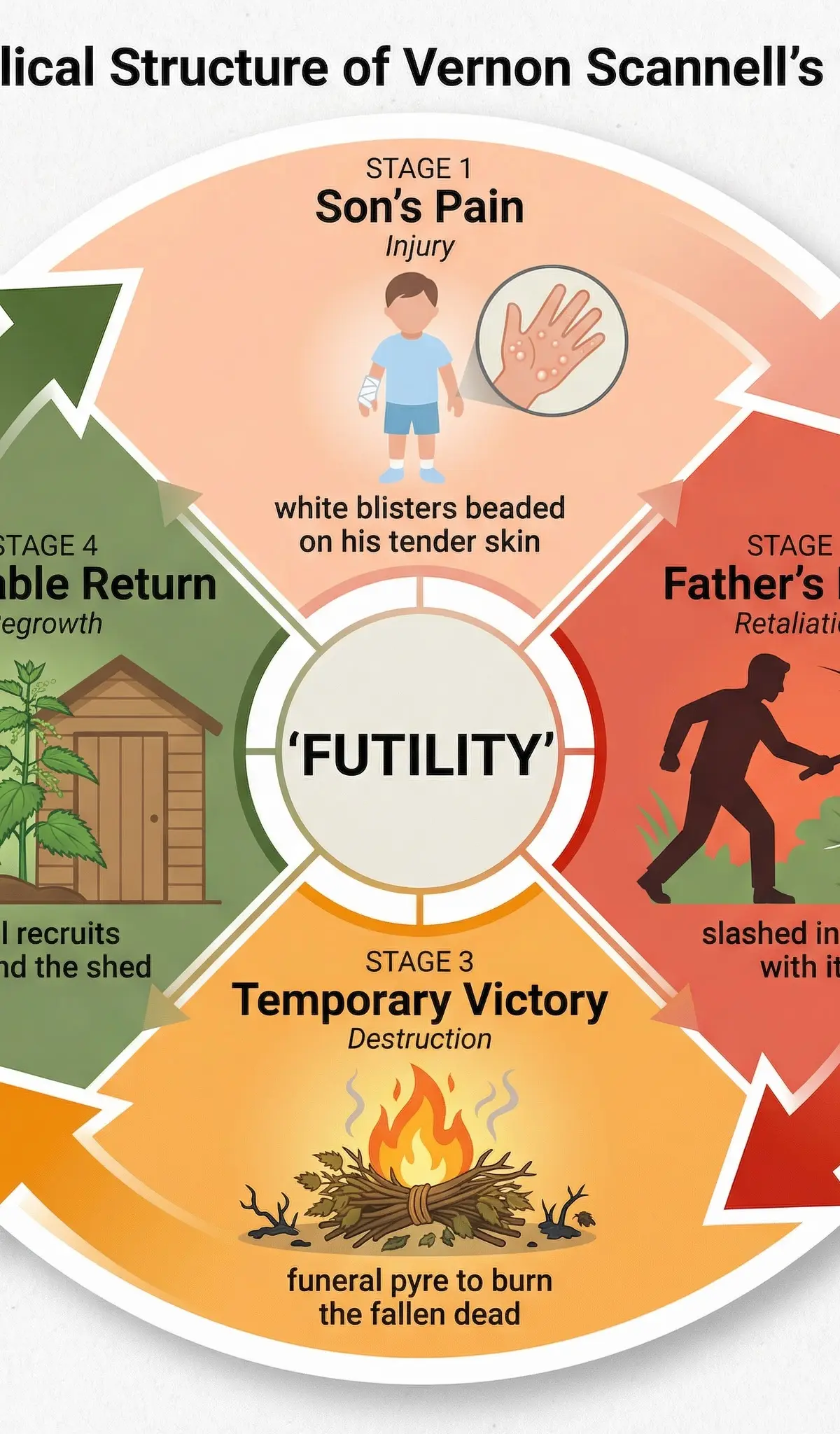
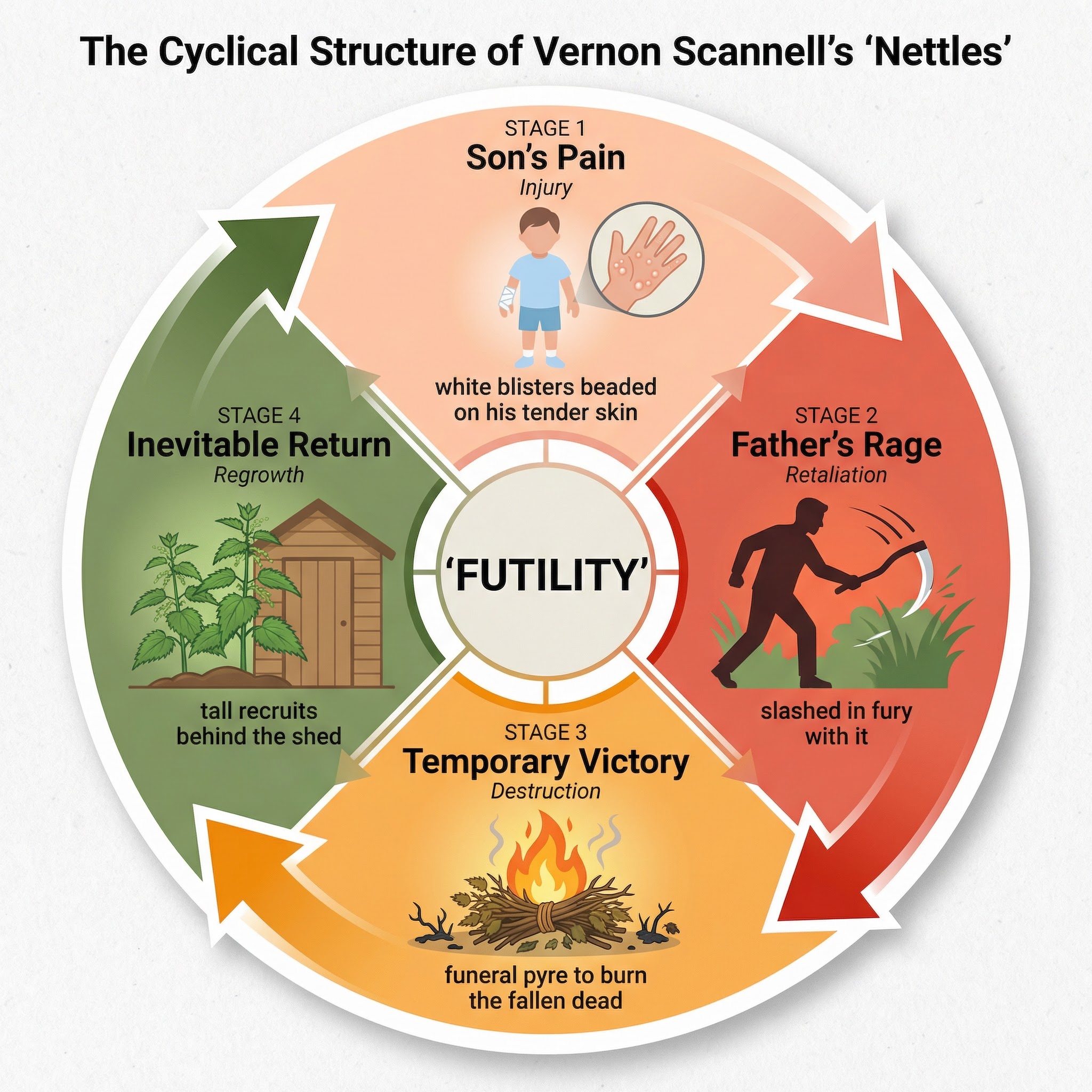
The poem follows a clear, linear narrative within a single, contained memory. A young boy, not yet three, falls into a bed of nettles and is stung, leaving 'white blisters' on his 'tender skin'. Fuelled by a protective rage, his father takes a 'billhook' and brutally destroys the entire patch of nettles, which he personifies as a hostile army. He 'slashed in fury', creating a 'funeral pyre' for the 'fallen dead'. For a moment, there is a sense of satisfaction and victory. However, the poem concludes with the father's somber realisation that just two weeks later, the nettles have returned as 'tall recruits'. This cyclical ending underscores the poem's central message: his act of vengeance was ultimately pointless, as his son 'would often feel sharp wounds again'.
Themes
Theme 1: The Futility of Parental Protection
This is the central theme of the poem. The father's violent destruction of the nettles is a desperate, instinctive act to protect his child and avenge his pain. However, the poem's cynical conclusion reveals the futility of this act. The natural world, and by extension life itself, will always present new threats. The father's realisation that the nettles have regrown and his son 'would often feel sharp wounds again' is a moment of profound parental despair. Examiners expect candidates to explore how the cyclical structure reinforces this theme of hopelessness. The poem can be read as an allegory for the broader human condition: no matter how fiercely we fight, suffering is an inevitable part of existence.
Key Quotes:
- 'And then I took my billhook, honed the blade / And went outside and slashed in fury with it' - The violent verbs 'honed' and 'slashed' reveal the depth of the father's rage, transforming a simple gardening tool into a weapon of war. The caesura after 'blade' creates a pause that emphasises the deliberate, calculated nature of his revenge.
- 'But in two weeks the busy sun and rain / Had called up tall recruits behind the shed.' - The personification of the sun and rain as agents of revival, and the nettles as 'recruits', highlights the relentless, unstoppable force of nature and, by extension, life's challenges. The word 'recruits' suggests an endless supply of replacements, emphasising the futility of the father's actions.
- 'My son would often feel sharp wounds again' - The final line is bleak and resigned. The future tense 'would' and the adverb 'often' confirm the father's understanding that this is not a one-time event but a recurring pattern.
Theme 2: Conflict and Warfare
Scannell, a WWII veteran, deliberately infuses this domestic scene with the language of warfare. This is not just a man weeding his garden; it is a soldier fighting an enemy. This military semantic field is the primary method used to elevate the poem's significance. The nettles are not merely plants but an organised, hostile force that must be eradicated. This allows Scannell to draw a parallel between a father's protective instinct and the brutal, often futile, nature of organised conflict. The poem can be read as a critique of war itself: like the father's battle against the nettles, wars are fought with fury and conviction, yet they rarely achieve lasting peace.
Key Quotes:
- 'The green spears, a regiment of spite' - This metaphor personifies the nettles as a disciplined army, immediately establishing the conflict framework. The word 'spite' suggests malicious intent, as if the nettles are actively seeking to harm the child.
- 'We soothed him till his pain was not so raw. / At last he offered us a watery grin, / And then I took my billhook, honed the blade' - The direct juxtaposition of the son's innocent pain and the father's preparation for a violent counter-attack highlights the poem's central conflict. The 'watery grin' is a moment of vulnerability that triggers the father's rage.
- 'I slashed in fury with it / Till not a nettle in that fierce parade / Stood upright any more.' - The phrase 'fierce parade' continues the military metaphor, suggesting the nettles are on display, ready for battle. The father's actions are total and uncompromising.
Theme 3: The Cycle of Pain
The poem's structure reinforces its thematic concern with cycles. The nettles are destroyed, but they inevitably return. This cyclical pattern can be interpreted as a metaphor for the recurring nature of pain and suffering throughout life. No matter how hard we try to eliminate sources of harm, they will always reappear in new forms. This theme invites comparison with other poems in the Conflict Cluster, such as 'A Poison Tree', where suppressed anger also grows back with destructive consequences.
Key Quotes:
- 'But in two weeks the busy sun and rain / Had called up tall recruits behind the shed.' - The time frame of 'two weeks' emphasises the speed of the nettles' return, suggesting that the father's victory was short-lived.
- 'My son would often feel sharp wounds again' - The cyclical nature of pain is confirmed in this final line, which looks forward to a future filled with repeated suffering.
Writer's Methods
Extended Metaphor
The entire poem functions as an extended metaphor. The nettles represent all the potential harms and pains that life holds. The father's battle is a microcosm of the larger, unwinnable war against suffering. Marks are awarded for explaining how this metaphor develops from the initial 'regiment' to the final 'recruits'. Candidates should explore how the metaphor allows Scannell to universalise a specific, personal memory, making it resonate with any reader who has experienced the desire to protect someone they love.
Military Semantic Field
Scannell's use of military language is the most striking feature of the poem. Words such as 'regiment', 'spears', 'parade', 'fallen dead', 'recruits', and 'slashed' transform a domestic scene into a battlefield. This method serves multiple purposes: it elevates the significance of the event, it reflects Scannell's own experiences as a soldier, and it allows the poem to function as a critique of war. Examiners expect candidates to identify specific examples and analyse their effects.
Structure and Form
'Nettles' is written in a single stanza of 16 lines, with a regular AABB rhyme scheme. This tight, controlled form can be interpreted in several ways. It might reflect the singular, contained nature of this powerful memory, or the father's attempt to impose order on a chaotic and painful world. The steady rhythm created by the rhyme scheme is at odds with the violent events, perhaps highlighting the father's grim determination. The lack of stanza breaks suggests the relentless, unbroken nature of the father's rage and the cyclical pattern of pain.
Juxtaposition
Scannell masterfully juxtaposes the innocence and vulnerability of the child ('tender skin', 'watery grin') with the violent, aggressive actions of the father ('slashed in fury', 'honed the blade'). This contrast serves to emphasise the fierce, primal nature of parental love and the disproportionate rage that the father feels in response to his son's minor injury. The juxtaposition also highlights the poem's central irony: the father's violent response mirrors the violence of the nettles themselves.
Personification
The nettles are consistently personified throughout the poem. They are a 'regiment', they stand in 'parade', they are 'fallen dead', and they return as 'recruits'. This personification is crucial to the poem's meaning, as it transforms the nettles from passive plants into active agents of harm. By giving the nettles human qualities, Scannell validates the father's rage and makes his battle seem justified, even as the poem ultimately reveals its futility.
Context
While context is not assessed in OCR Component 02 Section A (AO3 is weighted at 0%), understanding Scannell's background can deepen your appreciation of the poem. Vernon Scannell (1922-2007) was a British poet who served in the British Army during WWII. His experiences of war profoundly influenced his poetry, which often explores themes of violence, masculinity, and the psychological scars of conflict. However, in the exam, you must not write about this context, as it will receive no credit. Focus entirely on AO1 (comparison) and AO2 (analysis of methods).
Comparative Analysis: Pairing 'Nettles' with Other Conflict Cluster Poems
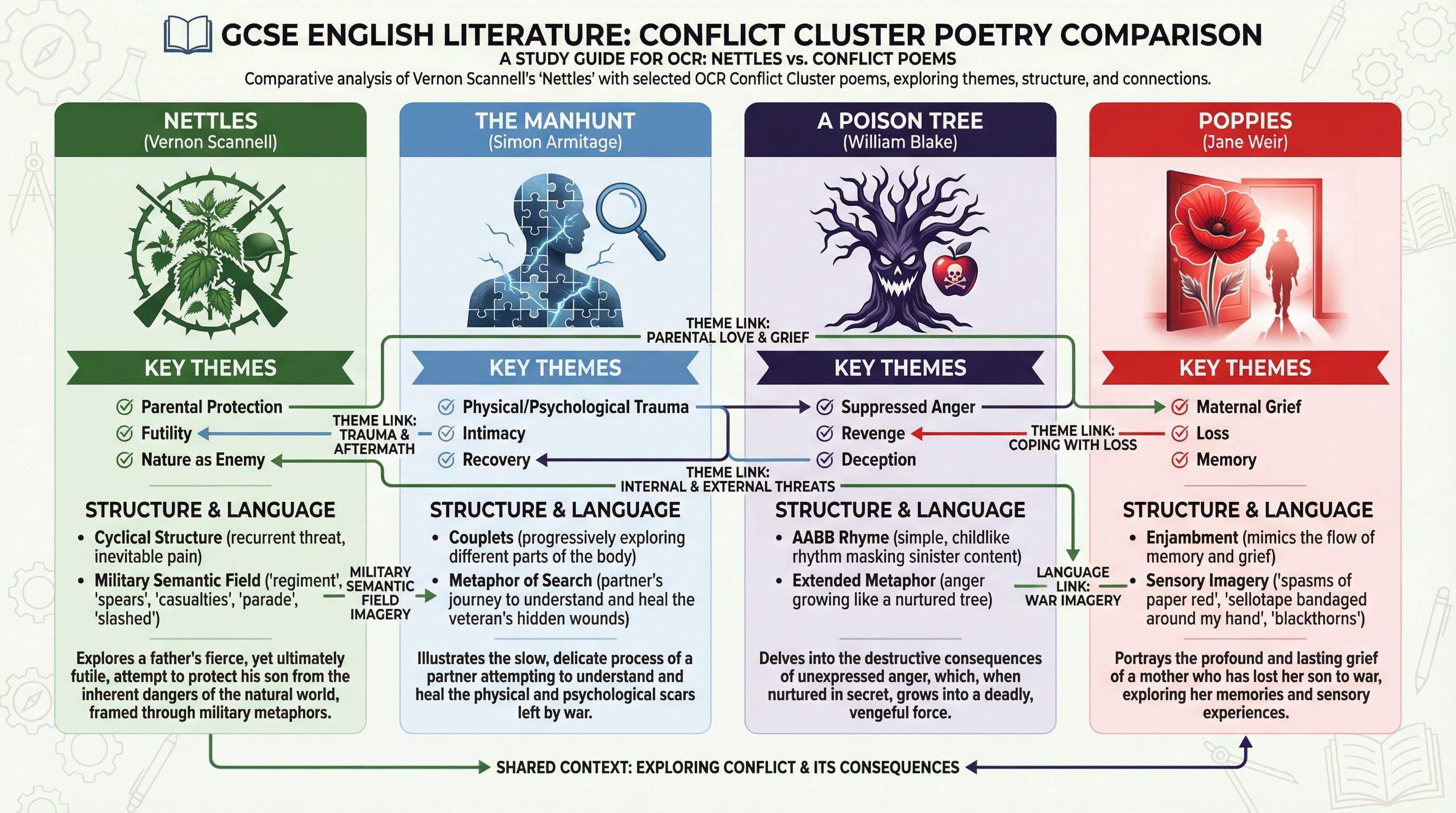
For OCR Section A, you must compare 'Nettles' with another poem from the Conflict Cluster. Here are some strong pairings:
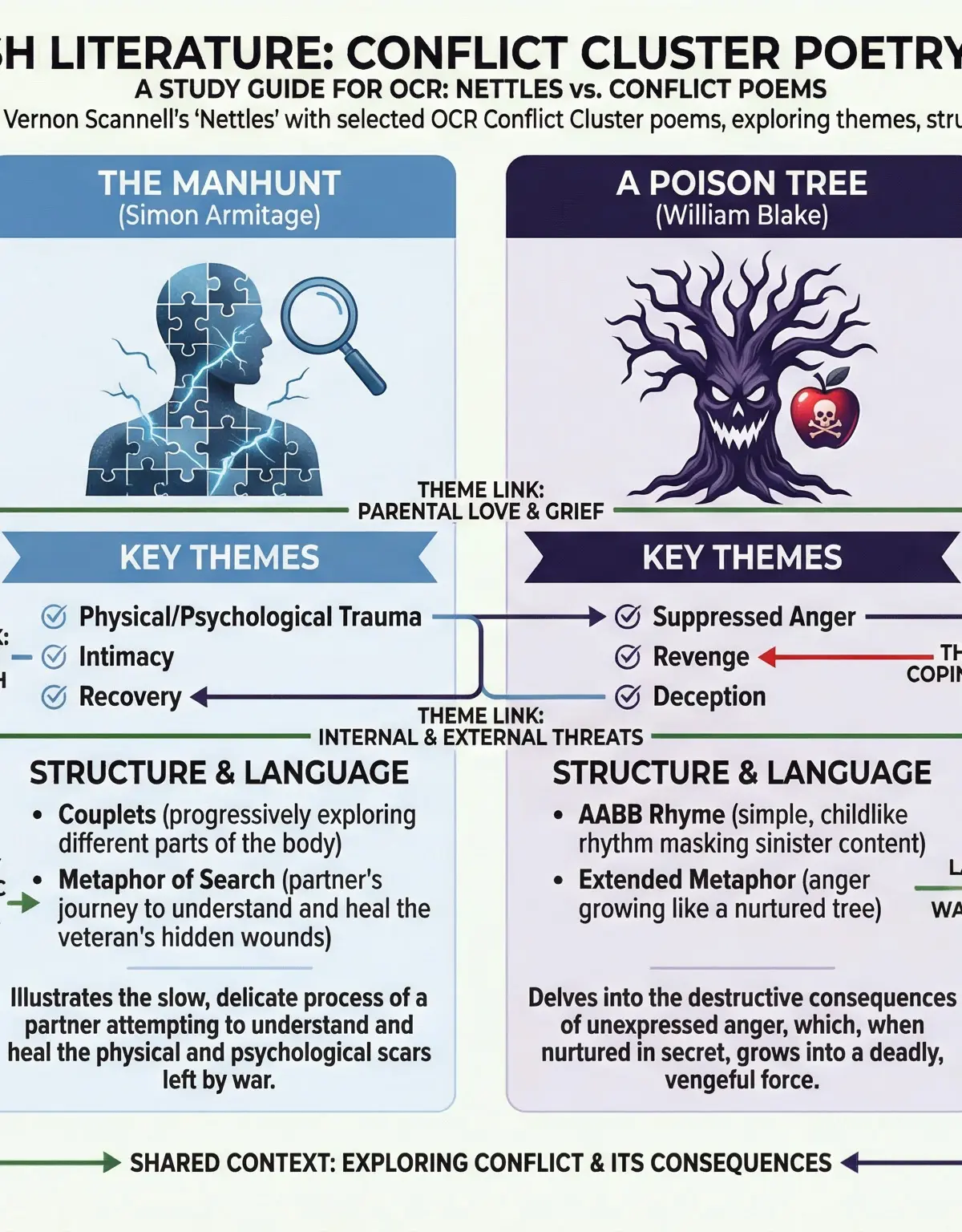
Nettles vs. The Manhunt (Simon Armitage)
Similarities: Both poems explore the aftermath of conflict and the emotional toll it takes on loved ones. Both use physical imagery to represent psychological pain.
Differences: 'The Manhunt' presents a slow, delicate process of healing and understanding, whereas 'Nettles' presents a futile, violent response that achieves nothing. Armitage's couplets suggest a gradual piecing together of the veteran's trauma, while Scannell's single stanza reflects a singular, unresolved memory.
AO1 Link: Whereas Scannell presents conflict as cyclical and unresolvable, Armitage suggests that intimacy and patience can lead to recovery, albeit a fragile one.
Nettles vs. A Poison Tree (William Blake)
Similarities: Both poems explore the destructive consequences of suppressed or misdirected anger. Both use nature as a central metaphor (nettles vs. a tree).
Differences: Blake's anger is deliberately nurtured and leads to premeditated revenge, whereas Scannell's rage is spontaneous and protective. Blake's AABB rhyme scheme creates a childlike, sinister tone, while Scannell's creates a steady, relentless rhythm.
AO1 Link: Similarly, both poets use extended metaphors rooted in nature to explore the cyclical and destructive nature of conflict, yet Blake's speaker actively cultivates his anger, whereas Scannell's father is reacting to an external threat.
Nettles vs. Poppies (Jane Weir)
Similarities: Both poems explore parental love and the pain of being unable to protect a child from harm. Both use sensory imagery to convey emotion.
Differences: 'Poppies' focuses on maternal grief and the loss of a son to war, whereas 'Nettles' focuses on a father's futile attempt to prevent future pain. Weir's enjambment mimics the flow of memory and grief, while Scannell's tight structure reflects containment.
AO1 Link: In contrast to Scannell's father, who can physically confront the source of his son's pain, Weir's mother can only watch helplessly as her son leaves for war, highlighting the different ways parents experience powerlessness.
Worked Examples
2 worked examples — open one to explore the question and available guidance.
Practice Questions
Test your understanding — click to reveal model answers
Compare how the poets present parental love in 'Nettles' and 'Poppies'. (30 marks AO1/AO2)
Hint: Consider how both poets use imagery and structure to convey the intensity of parental love and the pain of being unable to protect a child. Think about the different contexts: a minor injury vs. a son going to war.
How does Scannell use structure to present the theme of futility in 'Nettles'? (15 marks AO2)
Hint: Consider the single stanza form, the AABB rhyme scheme, and the cyclical narrative. How does each structural choice reinforce the theme of futility?
Compare how the poets present anger in 'Nettles' and 'A Poison Tree'. (30 marks AO1/AO2)
Hint: Consider how both poets use extended metaphors rooted in nature to explore anger. Think about the differences: spontaneous vs. cultivated anger, protective vs. vengeful anger.
Explore how Scannell uses imagery to present the nettles in 'Nettles'. (15 marks AO2)
Hint: Consider the military imagery, the personification, and the visual imagery of the 'white blisters' and 'funeral pyre'. How does each image contribute to the poem's meaning?
Test your understanding of Nettles (Vernon Scannell)
Active recall beats re-reading. Take an instant quiz now to test what you’ve learned and lock it into long-term memory.
7 days Premium · Then free forever · No card, no charge