OCR · GCSE · English Literature
The Strange Case of Dr Jekyll and Mr Hyde
Unlock the secrets of Stevenson's Gothic masterpiece. This guide provides a comprehensive analysis of The Strange Case of Dr Jekyll and Mr Hyde, focusing on the key themes, characters, and literary methods needed to achieve top marks in your OCR GCSE English Literature exam."
- 10 min read
- 2 worked examples
- 4 practice questions
Study Notes
Overview
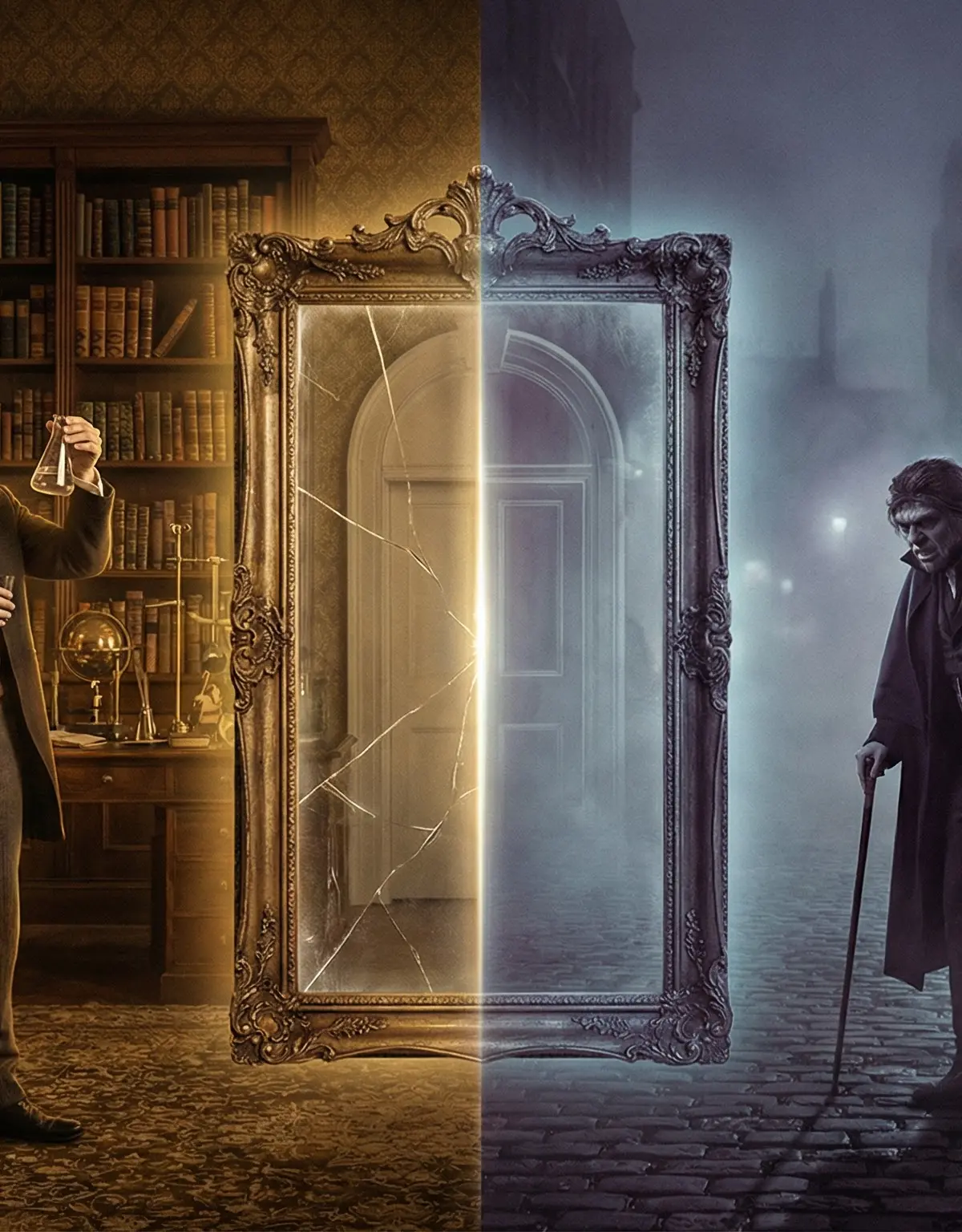
Robert Louis Stevenson's The Strange Case of Dr Jekyll and Mr Hyde (1886) is a quintessential Gothic novella that delves into the dark heart of Victorian society. For the OCR Component 01, Section B exam, candidates must demonstrate a sophisticated understanding of the text's dual nature. Part (a) demands a forensic analysis of a given extract, focusing on Stevenson's use of language and structure (AO2). Part (b) requires a broader, discursive essay that connects the extract's themes to the wider text, integrating critical context (AO3) and maintaining a clear argument (AO1). Examiners are looking for more than just plot summary; they reward candidates who can dissect Stevenson's methods and explore the novella's allegorical critique of repression, duality, and the fragility of the Victorian gentleman's identity. This guide will equip you with the analytical tools and contextual knowledge to excel.
Plot/Content Overview

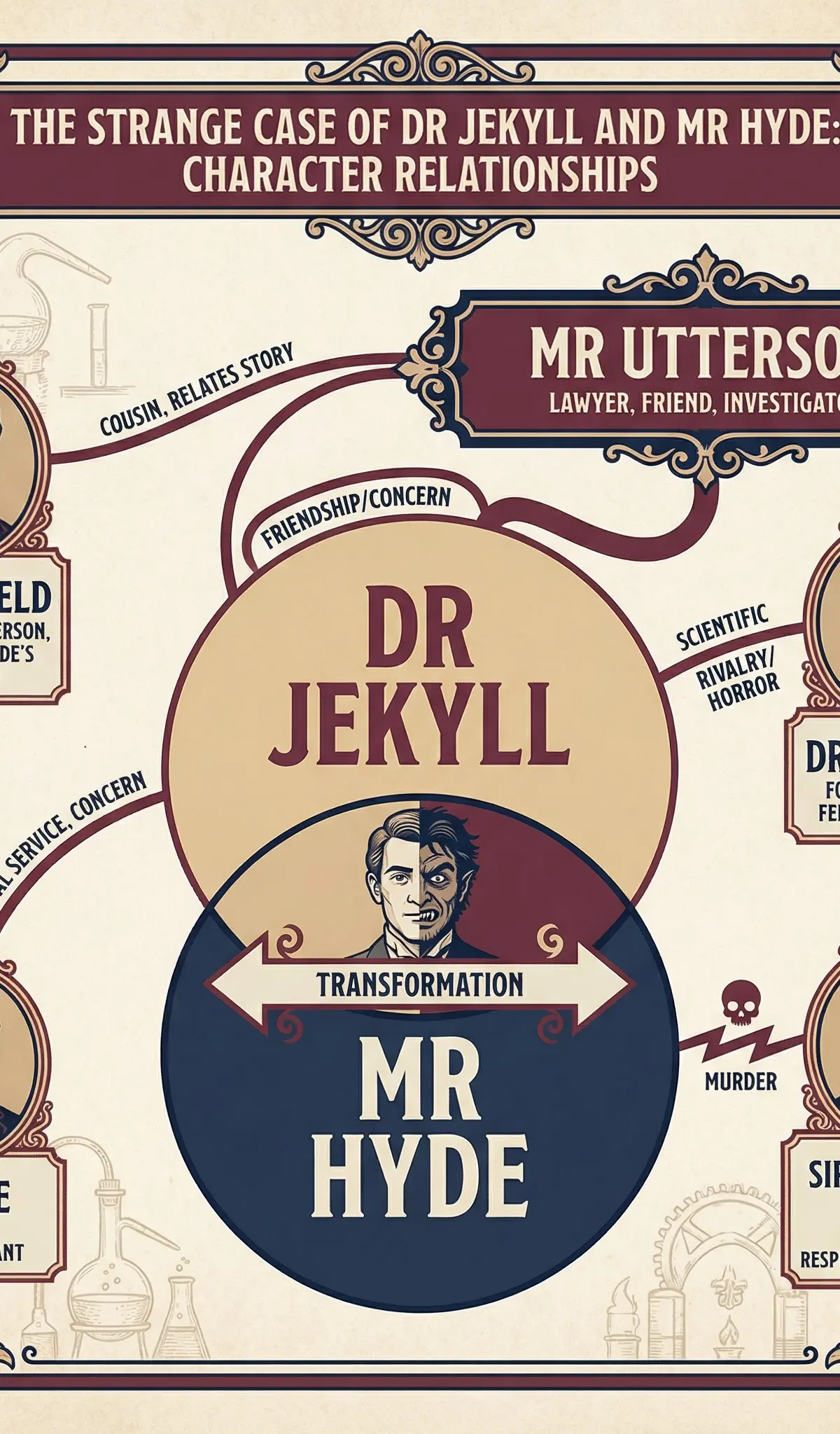
The story is primarily told through the eyes of the lawyer, Mr Utterson, as he investigates the strange relationship between his friend, the respectable Dr Henry Jekyll, and the monstrous Edward Hyde. The narrative unfolds through a series of key events:
- Chapter 1: Story of the Door: Mr Utterson and his cousin Mr Enfield are on their weekly walk when they pass a strange, neglected door. Enfield recounts how he saw a loathsome man named Hyde trample a young girl, only to pay off her family with a cheque signed by the reputable Dr Jekyll.
- Chapter 2: Search for Mr Hyde: Utterson, disturbed, examines Jekyll's will, which states that in the event of his death or disappearance, his entire fortune should go to Hyde. He seeks out Hyde and is repulsed by his appearance.
- Chapter 4: The Carew Murder Case: A year later, Sir Danvers Carew, a prominent MP, is brutally murdered. A maid witnesses the attack and identifies Hyde as the killer. A broken cane, belonging to Jekyll, is found at the scene.
- Chapter 5: Incident of the Letter: Jekyll, appearing ill, shows Utterson a letter from Hyde, claiming he has escaped. However, Utterson's clerk, Mr Guest, notices that Hyde's handwriting is remarkably similar to Jekyll's.
- Chapter 7: Incident at the Window: Utterson and Enfield see Jekyll at his window, who briefly converses with them before a look of terror seizes his face and he slams the window shut.
- Chapter 8: The Last Night: Jekyll's butler, Poole, begs Utterson for help, convinced that his master has been murdered and an imposter is locked in the laboratory. They break down the door to find Hyde, dead, in Jekyll's clothes. On the desk is a new will in Utterson's favour and a full confession from Jekyll.
- Chapter 9: Dr Lanyon's Narrative: A letter from the deceased Dr Lanyon reveals that he witnessed Hyde drink a potion and transform back into Jekyll, a shock from which he never recovered.
- Chapter 10: Henry Jekyll's Full Statement of the Case: Jekyll's confession explains his scientific experiments to separate his good and evil sides, resulting in the creation of Hyde. He details how Hyde grew stronger and eventually took over, leading to his ultimate despair and death.
Themes
Duality of Human Nature

This is the central theme. Stevenson explores the idea that every human being has a good and an evil side, constantly at war. Jekyll's experiment is a dangerous attempt to separate these two halves, but he ultimately learns they are inseparable. Examiners expect candidates to analyse how this duality is not a simple good vs. evil binary. Jekyll himself is not wholly good; his pride and ambition lead him to create Hyde. Hyde is the embodiment of pure, unrestrained evil, a vehicle for the desires Jekyll must repress.
Key Quotes:
- "man is not truly one, but truly two." (Chapter 10) - Jekyll's central thesis, revealing his belief that humanity is fundamentally dual.
- "all human beings... are commingled out of good and evil." (Chapter 10) - This quote clarifies that the two sides are mixed within a single person, not neatly separable.
The Repression of Victorian Society
Stevenson uses the novella to critique the strict moral codes and obsession with reputation in Victorian England. Gentlemen like Jekyll were expected to maintain a facade of perfect respectability, forcing them to repress their natural, and often darker, desires. Hyde represents the violent eruption of these repressed impulses. The more Jekyll tries to control his dark side, the more powerful Hyde becomes. Credit is given for linking this to the geography of the novel: Jekyll's respectable home in a wealthy square has a back entrance in a sordid, neglected street where Hyde comes and goes.
Key Quotes:
- "the fortress of identity... was shaken to its foundations." (Chapter 10) - Jekyll describes the profound psychological impact of his transformation, suggesting that the Victorian ideal of a stable, respectable self is fragile.
- "my devil had been long caged, he came out roaring." (Chapter 10) - This powerful metaphor illustrates the consequences of long-term repression. The longer desires are suppressed, the more violently they emerge.
Character Analysis
Dr Henry Jekyll
Role: The protagonist, a respected doctor and scientist whose experiments unleash his dark alter ego.
Key Traits: Ambitious, proud, intelligent, but also deeply conflicted and hypocritical. He wants to indulge his desires without consequence.
Character Arc: Jekyll begins as a confident, well-regarded scientist. His creation of Hyde is an act of hubris. As he loses control, he descends into despair, terror, and ultimately, self-destruction. His final statement is a document of profound psychological torment.
Essential Quotes:
- "A large, well-made, smooth-faced man of fifty, with something of a slyish cast perhaps, but every mark of capacity and kindness." (Chapter 3) - The initial description of Jekyll highlights his respectable exterior, with a subtle hint of something hidden.
- "If I am the chief of sinners, I am the chief of sufferers also." (Chapter 6) - Jekyll's words to Utterson reveal his internal torment and the dual nature of his experience.
Mr Edward Hyde
Role: The antagonist, Jekyll's purely evil alter ego who commits acts of violence and depravity.
Key Traits: Deformed, grotesque, violent, and remorseless. He is described as being less than human, embodying primitive, animalistic impulses.
Character Arc: Hyde begins as a smaller, weaker version of Jekyll but grows in stature and power as he is indulged. He represents the escalating nature of evil when it is given free rein, eventually dominating and destroying his creator.
Essential Quotes:
- "He is not easy to describe. There is something wrong with his appearance; something displeasing, something down-right detestable." (Chapter 1) - Enfield struggles to articulate Hyde's appearance, suggesting he is a perversion of nature.
- "with a transport of glee, I mauled the unresisting body, tasting delight from every blow." (Chapter 10) - From Jekyll's confession, this shows Hyde's sadistic pleasure in violence during the Carew murder.
Mr Gabriel John Utterson
Role: The narrator and moral centre of the story. A lawyer who acts as a detective, trying to uncover the truth about Jekyll and Hyde.
Key Traits: Rational, loyal, discreet, and deeply conventional. He represents the Victorian ideal of a reserved, professional gentleman.
Character Arc: Utterson's journey is one of dawning horror as his rational worldview is shattered by the supernatural events he investigates. He remains a steadfast friend to Jekyll, but his inability to comprehend the truth until the very end highlights the limitations of a purely rational perspective.
Essential Quotes:
- "a man of a rugged countenance that was never lighted by a smile; cold, scanty and embarrassed in discourse; backward in sentiment; lean, long, dusty, dreary and yet somehow lovable." (Chapter 1) - This detailed description establishes Utterson as a reserved but reliable figure.
- "If he be Mr. Hyde," he had thought, "I shall be Mr. Seek." (Chapter 2) - A rare moment of wordplay that reveals Utterson's determination to solve the mystery.
Writer's Methods
- Gothic Tropes: Stevenson employs classic Gothic elements: dark, mysterious settings (foggy London streets, locked rooms), supernatural events, and a sense of psychological terror. The fog, in particular, is a powerful symbol of moral ambiguity and hidden secrets.
- Narrative Structure: The story is told through a series of documents and perspectives (Enfield's story, Lanyon's narrative, Jekyll's confession). This creates suspense and mystery, as the reader, like Utterson, must piece together the truth from fragmented accounts. This is a key point for AO2 analysis.
- Symbolism: The door Hyde uses is a potent symbol of the hidden, disreputable side of Jekyll's life. Jekyll's house, with its respectable front and sordid back entrance, symbolises the dual nature of his character and Victorian society itself.
- Language of Duality: Stevenson constantly uses contrasting language: light and dark, good and evil, calm and agitated. Pay attention to how sentence structures and vocabulary change when describing Jekyll compared to Hyde.
Context
- Victorian Duality and Repression: The public image of the Victorian era was one of strict morality, religious observance, and social decorum. However, beneath this surface lay a world of crime, poverty, and vice. This hypocrisy is central to the novella. Jekyll's desire to separate his two sides is a metaphor for the Victorian gentleman's struggle to maintain a respectable facade.
- Science and Religion: The 19th century saw huge scientific advancements, particularly Darwin's theory of evolution (published 1859). This challenged religious beliefs about creation and the nature of humanity. Jekyll's experiments tap into fears about science "playing God" and unleashing primal, animalistic forces. Hyde is often described in atavistic terms ("ape-like"), reflecting Victorian anxieties about degeneration – the idea that humanity could revert to a more primitive state.
- Physiognomy: The Victorian belief that one's character was visible in one's physical appearance. Hyde's ugliness is a manifestation of his moral corruption. He is deformed because he is morally deformed."
Worked Examples
2 worked examples — open one to explore the question and available guidance.
Practice Questions
Test your understanding — click to reveal model answers
Explore how Stevenson presents Mr Utterson as a limited and conventional character.
Hint: Consider Utterson's profession as a lawyer, his friendships, and his reactions to the supernatural events. How does his rationalism prevent him from seeing the truth?
How does Stevenson use violence to explore the character of Mr Hyde?
Hint: Focus on the two main acts of violence: the trampling of the girl and the murder of Sir Danvers Carew. Analyse the language used to describe these acts and what they reveal about Hyde's nature.
Starting with this extract from Chapter 2, explore how Stevenson creates a sense of mystery around the character of Mr Hyde. Write about:
- how mystery is created in this extract
- how the mystery of Hyde is developed in the rest of the novella (30 marks + 4 AO4)
Hint: Focus on how other characters react to Hyde and the language they use to describe him. Why is he so hard to define?
Evaluate the view that Dr Lanyon is the true hero of the novella.
Hint: This is an evaluative question. You need to argue for and against this interpretation. Consider Lanyon's scientific principles, his actions, and his ultimate fate.
Test your understanding of The Strange Case of Dr Jekyll and Mr Hyde
Active recall beats re-reading. Take an instant quiz now to test what you’ve learned and lock it into long-term memory.
7 days Premium · Then free forever · No card, no charge