OCR · GCSE · English Literature
The Passionate Shepherd to His Love (Christopher Marlowe)
Unlock top marks for Marlowe's 'The Passionate Shepherd to His Love' with this guide. We'll deconstruct the speaker's persuasive tactics and idealized imagery, giving you the critical tools to analyse this classic pastoral poem and compare it effectively for your OCR GCSE exam.
- 7 min read
- 2 worked examples
- 4 practice questions
- 8 key terms
Study Notes

Overview
Christopher Marlowe's 'The Passionate Shepherd to His Love' is a quintessential example of the pastoral literary tradition, a form of poetry that idealizes rural life. The poem is a direct address from a shepherd to his beloved, attempting to persuade her to come and live with him. For the OCR GCSE English Literature exam, your primary task is not just to understand the poem in isolation, but to analyse its persuasive methods and compare them to another poem from the anthology. Examiners are looking for a sustained, critical comparison of how two poets present themes such as love, nature, or persuasion. Credit is given for detailed analysis of language, form, and structure (AO2) and the ability to construct a coherent, comparative argument (AO1). While context (AO3) is not formally assessed in this paper, understanding the pastoral tradition will significantly enhance your analysis of Marlowe's stylistic choices.
Plot/Content Overview
The poem doesn't have a traditional plot or narrative arc; instead, it's a single, sustained persuasive argument. It can be broken down by the shepherd's escalating promises:
- Stanza 1: The Invitation. The shepherd invites his love to come and experience the 'pleasures' of the countryside, listing the natural beauties of the valleys, groves, hills, and fields.
- Stanza 2: Shared Idleness. He imagines them sitting on rocks, watching other shepherds, and listening to birds sing 'madrigals' (a type of song). This establishes a world free from work and worry.
- Stanzas 3-5: A Catalogue of Gifts. The shepherd offers a series of increasingly fanciful gifts made from natural materials: a bed of roses, a cap of flowers, a 'kirtle' (dress) embroidered with myrtle leaves, a gown of fine wool, 'fair lined slippers', and a belt of straw and ivy buds. This technique, a 'blazon', is designed to overwhelm the beloved with beautiful imagery.
- Stanza 6: The Condition. The poem ends with a crucial 'If'. The shepherd makes his final plea conditional: 'If these delights thy mind may move, / Then live with me, and be my love.' The entire proposal rests on whether she is persuaded by this idealized vision.
Themes
Theme 1: The Ideal vs. The Real
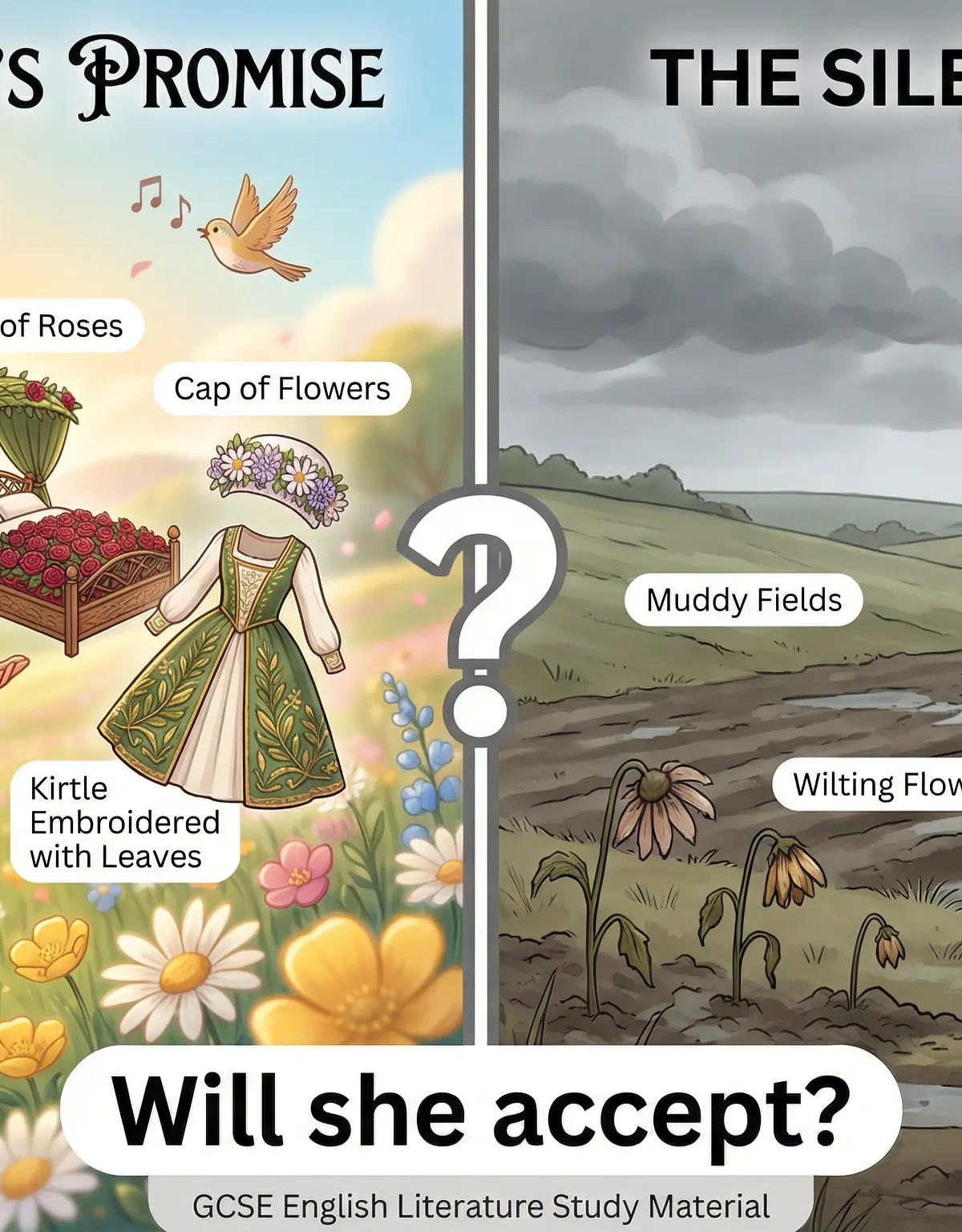
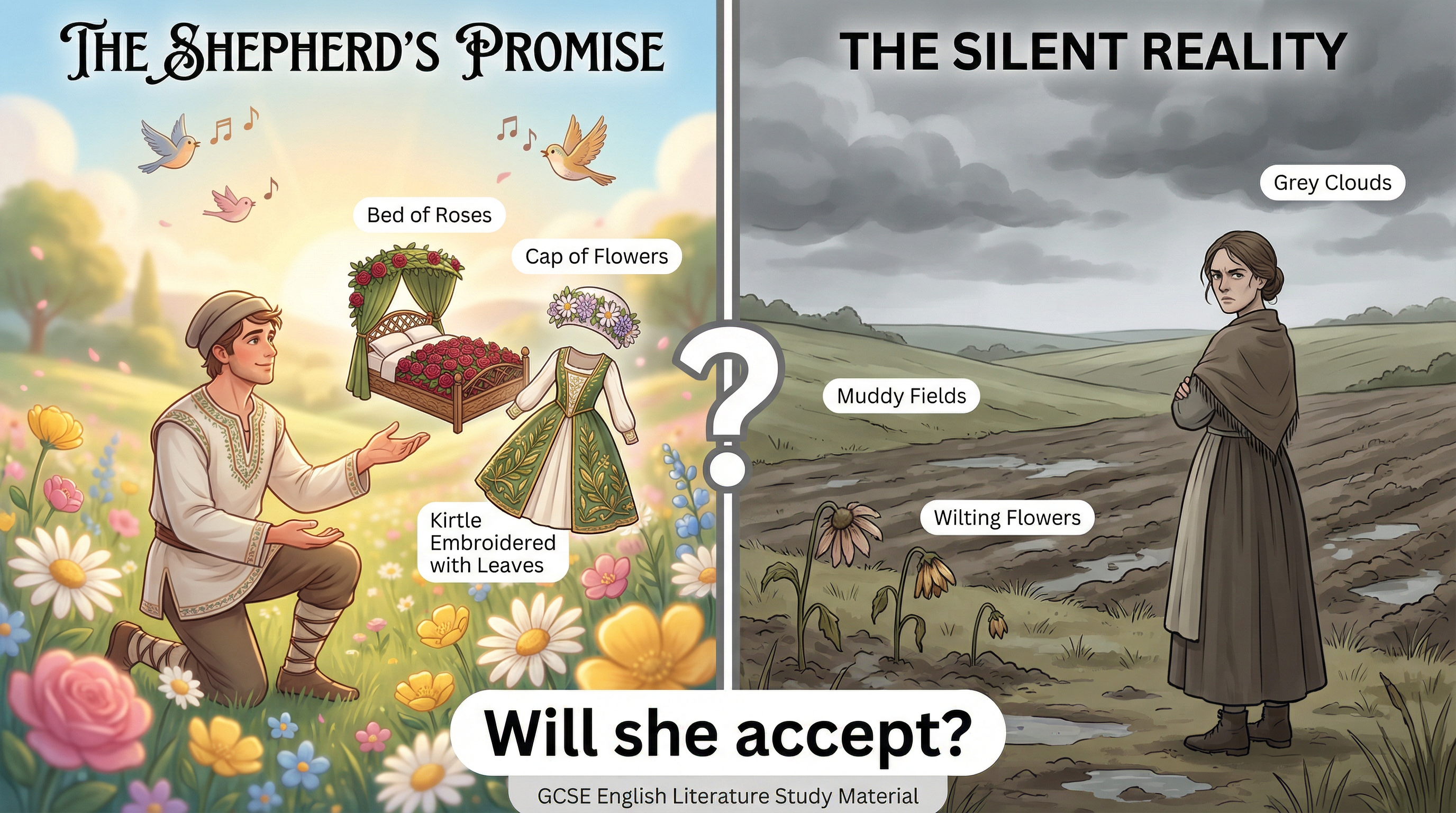
The central theme is the tension between the idealized world the shepherd describes and the unspoken reality of rural life. The shepherd's vision is a fantasy, a perfect world where nature is always beautiful and life is always easy. This contrasts sharply with the likely reality of a shepherd's life, which would have been hard, dirty, and subject to the whims of nature. The nymph's silence is key here; she doesn't accept or reject the offer, leaving the reader to question the sincerity and realism of the shepherd's promises.
Key Quotes:
- "And we will all the pleasures prove" - The word 'prove' means 'to test' or 'to experience'. The shepherd is offering an experiment in perfect happiness.
- "Melodious birds sing Madrigals" - This is a highly romanticized image. Birds don't sing complex part-songs; Marlowe is layering a sophisticated, courtly art form onto a supposedly simple, rural scene.
Theme 2: Persuasion and Seduction
The poem is a masterclass in rhetoric. The shepherd uses a variety of techniques to persuade his beloved. The poem is not a simple declaration of love; it is a carefully constructed argument designed to seduce. The speaker's voice is confident and insistent, but the final 'if' reveals a hint of uncertainty. He knows his success depends entirely on her willingness to believe his fantasy.
Key Quotes:
- "Come live with me and be my love" - This refrain acts as the poem's central argument, repeated to create a hypnotic, persuasive effect.
- "And I will make thee..." - The repetition of this phrase (anaphora) at the start of his promises creates a sense of abundance and generosity, making the offer seem irresistible.
Character Analysis
The Shepherd
Role: The speaker and protagonist. He is the active agent in the poem, driving the 'action' through his persuasive speech.
Key Traits: Idealistic, persuasive, romantic, perhaps deceptive. He is a skilled rhetorician, using beautiful language to create a fantasy world. He is either genuinely in love and naive, or he is a cynical seducer who knows his promises are empty.
Character Arc: The shepherd does not change or develop. He maintains his persuasive monologue from beginning to end. The only shift is the introduction of the conditional 'if' in the final stanza, which slightly undermines his earlier confidence.
Essential Quotes:
- "Come live with me and be my love"
- "And I will make thee beds of Roses"
- "If these delights thy mind may move..."
The Nymph (The Beloved)
Role: The silent addressee. Her role is passive, but her silence is one of the most important features of the poem.
Key Traits: Silent, mysterious, skeptical (perhaps). Because she never speaks, her character is a blank slate onto which the reader projects their own interpretation. Is she captivated, amused, or unconvinced?
Character Arc: She has no arc. Her importance lies in her lack of response, which creates the central tension of the poem.
Essential Quotes: None. Her silence is her defining feature.
Writer's Methods
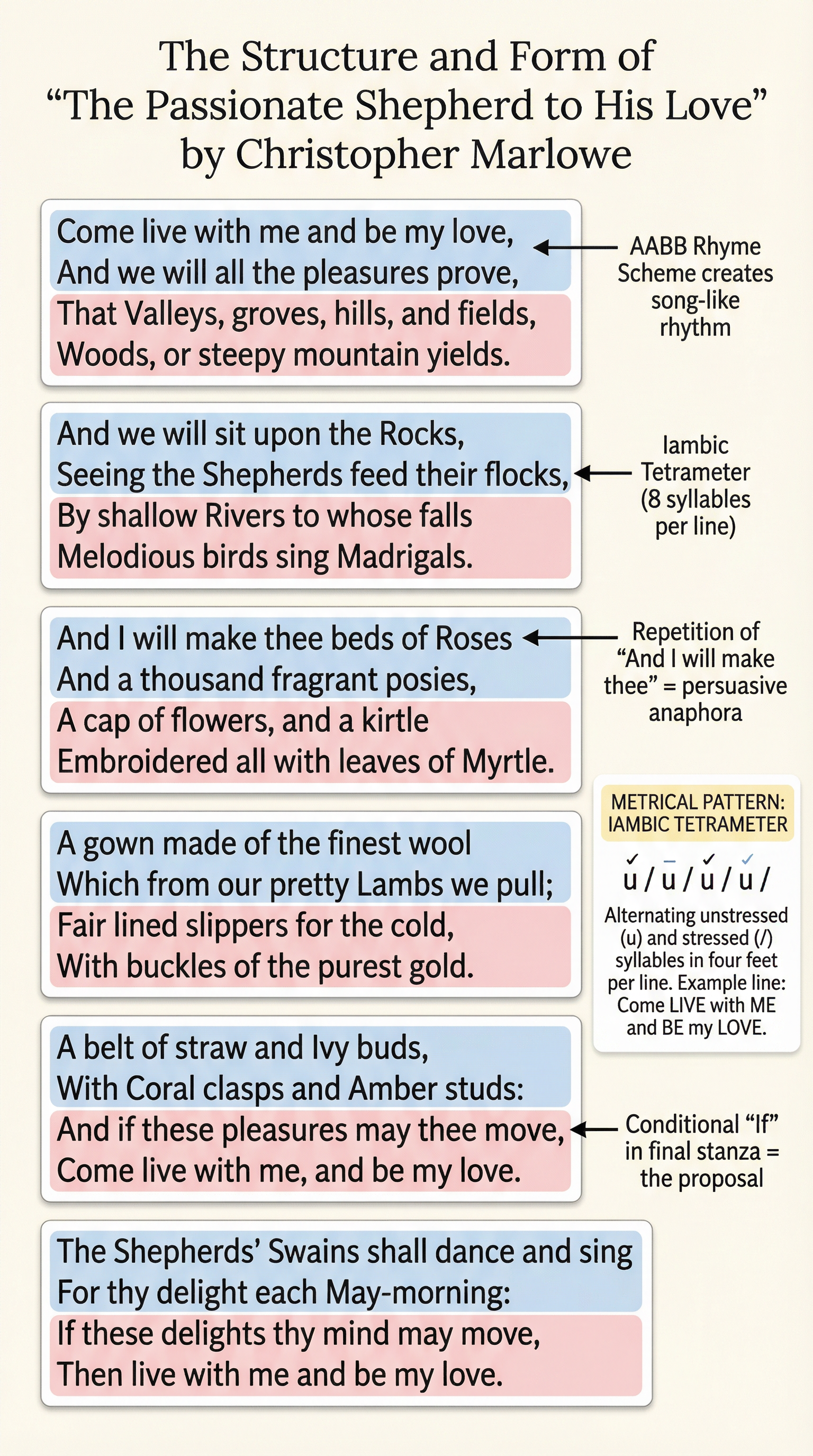
- Form and Structure: The poem is a lyric, composed of six quatrains (four-line stanzas). The regular AABB rhyme scheme and consistent iambic tetrameter (eight syllables per line, with an unstressed-stressed rhythm) create a simple, song-like quality. This musicality is a key part of the shepherd's persuasive strategy, making his plea sound charming and effortless. Examiners award credit for analysing how this predictable, harmonious structure mirrors the perfect world the shepherd describes.
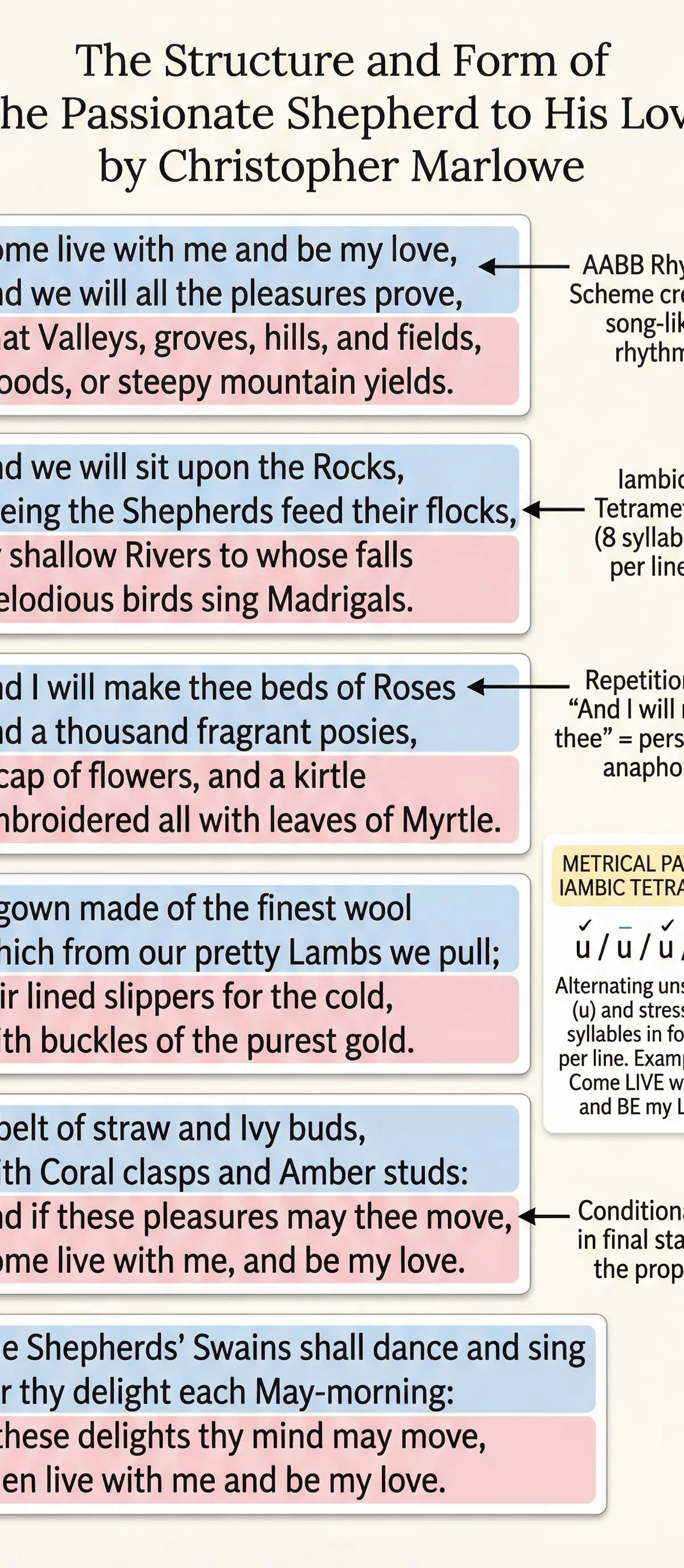
- Language: Marlowe uses hyperbole (exaggeration) throughout. The promises are deliberately excessive and unrealistic ('a thousand fragrant posies'). The language is simple and accessible, but the imagery is rich and evocative. The use of the 'blazon' (the catalogue of gifts) is a conventional poetic device used to praise a beloved, but here it's used to build the fantasy.
- Imagery: The imagery is drawn entirely from an idealized version of nature. Everything is beautiful, pleasant, and man-made for the nymph's delight ('beds of roses', 'cap of flowers'). There is no hint of the harshness or unpredictability of the real natural world. This is a key point of comparison with other poems that might present nature as powerful, dangerous, or indifferent.
Context
While AO3 is not assessed, understanding the 'Pastoral' tradition is vital for a high-level AO2 analysis. The pastoral was a popular genre in Renaissance England, inherited from classical poets like Virgil. It celebrated the idea of a rural 'Golden Age', a perfect, simple life away from the corruption and complexity of the city or court. By writing a pastoral poem, Marlowe was engaging in a fashionable literary game. His audience would have recognised the conventions and understood that the shepherd's world was a fantasy, not a documentary. Knowing this allows you to analyse the poem not as a sincere love letter, but as a clever, artful piece of rhetoric that plays with established literary conventions.
Visual Resources
2 diagrams and illustrations
Interactive Diagrams
1 interactive diagram to visualise key concepts
Conceptual Flow Outline
The Shepherd's Persuasive Argument Flowchart
Worked Examples
2 worked examples — open one to explore the question and available guidance.
Practice Questions
Test your understanding — click to reveal model answers
Compare how poets present the relationship between humanity and nature in ‘The Passionate Shepherd to His Love’ and one other poem.
Hint: Consider whether nature is presented as a servant to human desire, a powerful independent force, or something in between.
Explore the view that the shepherd’s promises are more foolish than romantic.
Hint: This is an 'evaluate' question. You need to argue for and against the statement before coming to a justified conclusion. Consider the poem in its historical context (pastoral tradition) vs. a modern reading.
How does Marlowe use language and form to create a persuasive tone in 'The Passionate Shepherd to His Love'?
Hint: Focus entirely on AO2. For each point, identify a technique and explain how it helps to persuade the listener.
Compare the presentation of the speaker in 'The Passionate Shepherd to His Love' with the speaker in one other poem.
Hint: Think about the speakers' attitudes, their tone, and the way they use language. Are they confident, uncertain, angry, reflective?
Test your understanding of The Passionate Shepherd to His Love (Christopher Marlowe)
Active recall beats re-reading. Take an instant quiz now to test what you’ve learned and lock it into long-term memory.
7 days Premium · Then free forever · No card, no charge