AQA · GCSE · French
Course version: 8658 · Version from Sept 2016
The termination [if] in French is -if and in English is often "-ive" eg…
Full specification wording
Near-cognates: the termination [if] in French is -if and in English is often "-ive" eg actif
Identifying near-cognates through suffix patterns is an effective strategy for expanding your French vocabulary.
- Point 5 of 9
- 4 key terms
Study notes
From the teaching notes for this specification point.
The idea
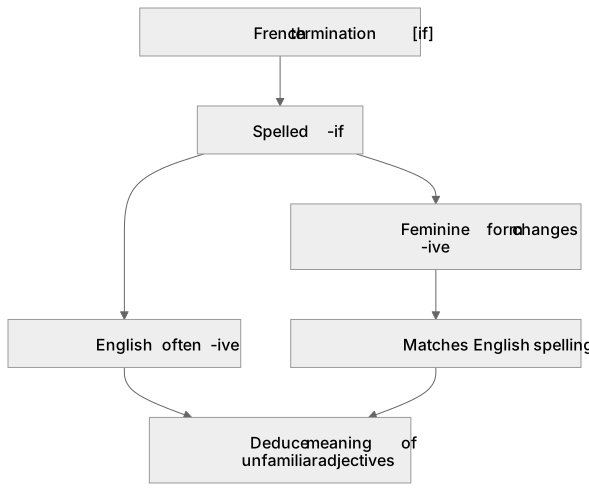
Identifying near-cognates through suffix patterns is an effective strategy for expanding your French vocabulary. The French phonetic termination [if] is spelled as -if. When translating these words into English, this suffix frequently corresponds to "-ive". For example, the French adjective actif translates to active in English. Recognising this consistent pattern allows you to deduce the meaning of unfamiliar adjectives in reading and listening tasks. It is also important to remember that the feminine form of these French adjectives changes to -ive, which perfectly matches the English spelling, further aiding comprehension of descriptive texts.
What earns the marks
- Identify the French suffix -if as corresponding to the phonetic sound [if].
- Translate French adjectives ending in -if to English adjectives ending in "-ive".
- Recognise that the feminine form of -if adjectives is -ive, matching the English spelling.
- Deduce the meaning of unfamiliar French adjectives ending in -if by applying this near-cognate rule.
Common mistakes and how to put them right
Translating the French -if directly as an English -if word.
Put it right by changing the suffix to "-ive".
Forgetting to make the adjective agree in gender.
Put it right by changing -if to -ive for feminine nouns in French.
Misinterpreting the meaning due to slight stem differences.
Put it right by focusing on the -if to "-ive" conversion to reveal the English root.
Exam tips
- When you see a French adjective ending in -if, mentally replace it with "-ive" to find the English equivalent.
- Look out for the feminine -ive ending in French texts, as it is a direct visual match for the English translation.
- Use this rule to quickly grasp the tone or descriptive qualities in reading comprehension passages.
Try the lesson
The start of the Near-cognates: the termination [if] in French is -if and in English is often "-ive" eg actif lesson, made from teaching notes for this specification point.
Have a go first
What is the English translation of the French adjective *créatif*?
Listen
Identifying near-cognates through suffix patterns is an effective strategy for expanding your French vocabulary. The French phonetic termination [if] is spelled as -if. When translating these words into English, this suffix frequently corresponds to "-ive". For example, the French adjective actif translates to active in English. Recognising this consistent pattern allows you to deduce the meaning of unfamiliar adjectives in reading and listening tasks. It is also important to remember that the feminine form of these French adjectives changes to -ive, which perfectly matches the English spelling, further aiding comprehension of descriptive texts. A strong answer earns marks for these points. Identify the French suffix -if as corresponding to the phonetic sound [if]. Translate French adjectives ending in -if to English adjectives ending in "-ive". Recognise that the feminine form of -if adjectives is -ive, matching the English spelling. Deduce the meaning of unfamiliar French adjectives ending in -if by applying this near-cognate rule. A common slip: Translating the French -if directly as an English -if word. Instead, changing the suffix to "-ive". Exam tip: When you see a French adjective ending in -if, mentally replace it with "-ive" to find the English equivalent.
See it
Key words
Say what each word means before you turn the card.
Near-cognates
Try answering aloud or in your head before turning the card.
Suffix patterns
Try answering aloud or in your head before turning the card.
Adjective endings
Try answering aloud or in your head before turning the card.
Vocabulary deduction
Try answering aloud or in your head before turning the card.
See every definition
- Near-cognates
- Words identified through suffix patterns, an effective strategy for expanding your French vocabulary.
- Suffix patterns
- Recognising a consistent pattern allows you to deduce the meaning of unfamiliar adjectives in reading and listening tasks.
- Adjective endings
- The French phonetic termination [if] is spelled as -if, and the feminine form of these French adjectives changes to -ive.
- Vocabulary deduction
- Applying the near-cognate rule lets you deduce the meaning of unfamiliar French adjectives ending in -if.
Label the diagram
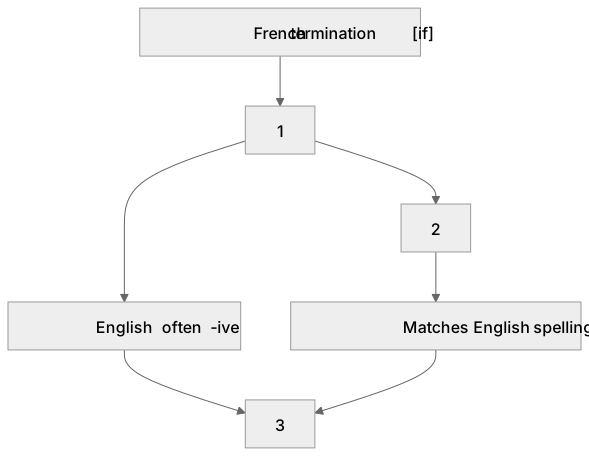
Some boxes have lost their names. Pick the right name for each number.
1Box 1
2Box 2
3Box 3
There is more to this lesson
The full lesson goes on to check your understanding and help you earn the marks. Create a free account to carry on, with your progress saved.
A week of Premium from your first lesson · Then the free plan continues · No card, no charge
Test your understanding of Near-cognates: the termination [if] in French is -if and in English is often "-ive" eg actif
Active recall beats re-reading. Take an instant quiz now to test what you’ve learned and lock it into long-term memory.
A week of Premium from your first lesson · Then the free plan continues · No card, no charge