AQA · GCSE · French
Course version: 8658 · Version from Sept 2016
Understand and respond to written language: deduce meaning from a variety…
Full specification wording
Reading: understand and respond to written language: deduce meaning from a variety of short and longer written texts from a range of specified contexts, including authentic sources involving some complex language and unfamiliar material, as well as short narratives and authentic material addressing relevant contemporary and cultural themes
This skill applies to both short and longer written texts across specified contexts, including authentic sources like articles, advertisements, or short narratives.
- Point 4 of 6
- 4 key terms
Study notes
From the teaching notes for this specification point.
The idea
This skill applies to both short and longer written texts across specified contexts, including authentic sources like articles, advertisements, or short narratives.
For example: If a text about contemporary cultural themes includes the unfamiliar word "hebdomadaire", a student might deduce it means "weekly" from the surrounding context of a magazine published every seven days.
What earns the marks
- Identifies the correct meaning of unfamiliar words using surrounding context.
- Recognises the overall purpose and message of short and longer written texts.
- Extracts key information from authentic sources, including contemporary and cultural themes.
- Demonstrates understanding of short narratives by identifying characters, settings, and events.
Common mistakes and how to put them right
Stopping at the first unfamiliar word.
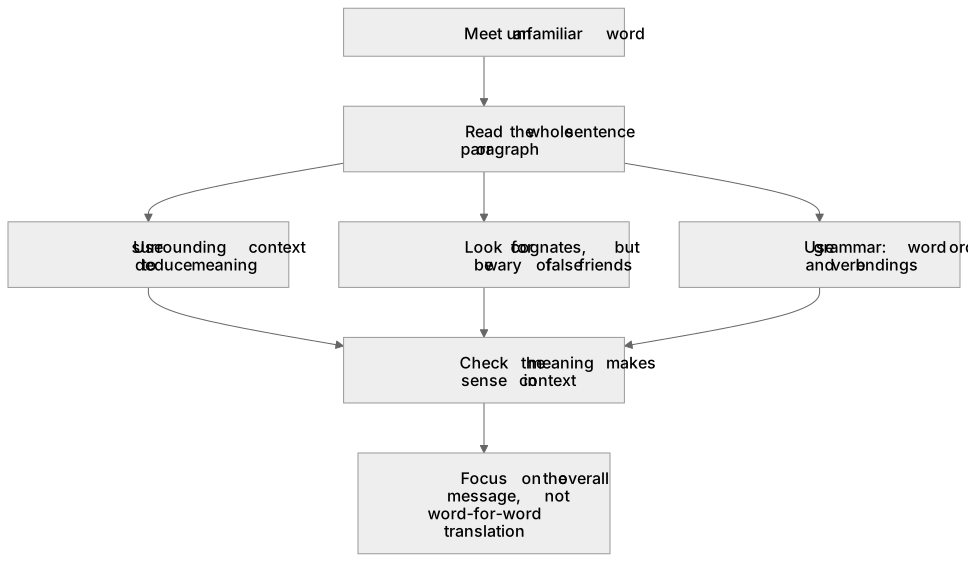
Put it right: Read the whole sentence or paragraph to deduce meaning from context.
Assuming a false friend has its English meaning (for example, "actuellement" meaning "actually").
Put it right: Learn common false friends and check if the English meaning makes sense in context ("actuellement" means "currently").
Ignoring the tense of verbs in narratives.
Put it right: Pay attention to verb endings to understand when events occurred.
Exam tips
- Look for cognates (words that look similar in English and French) but be wary of false friends.
- Use your knowledge of French grammar, such as word order and verb endings, to work out the function of an unfamiliar word.
- Read the questions before the text to focus your reading on the specific information required.
Try the lesson
The start of the Reading: understand and respond to written language: deduce meaning from a variety of short and longer written texts from a range of specified contexts, including authentic sources involving some complex language and unfamiliar material, as well as short narratives and authentic material addressing relevant contemporary and cultural themes lesson, made from teaching notes for this specification point.
Have a go first
Read the following text: "Bien que la technologie facilite la communication, beaucoup de jeunes se sentent isolés. Ils passent des heures sur leurs écrans au lieu de sortir." What is the main issue highlighted in this text?
Listen
This skill applies to both short and longer written texts across specified contexts, including authentic sources like articles, advertisements, or short narratives. For example, if a text about contemporary cultural themes includes the unfamiliar word "hebdomadaire", a student might deduce it means "weekly" from the surrounding context of a magazine published every seven days. A strong answer earns marks for these points. Identifies the correct meaning of unfamiliar words using surrounding context. Recognises the overall purpose and message of short and longer written texts. Extracts key information from authentic sources, including contemporary and cultural themes. Demonstrates understanding of short narratives by identifying characters, settings, and events. A common slip: Stopping at the first unfamiliar word. Instead, read the whole sentence or paragraph to deduce meaning from context. Exam tip: Look for cognates (words that look similar in English and French) but be wary of false friends.
See it
Key words
Say what each word means before you turn the card.
Deducing meaning from context
Try answering aloud or in your head before turning the card.
Authentic sources and complex language
Try answering aloud or in your head before turning the card.
Short narratives
Try answering aloud or in your head before turning the card.
Contemporary and cultural themes
Try answering aloud or in your head before turning the card.
See every definition
- Deducing meaning from context
- Working out what unfamiliar words mean by reading the whole sentence or paragraph around them rather than stopping at the first unknown word.
- Authentic sources and complex language
- Real materials that may contain idioms or complex structures, which students navigate by focusing on the overall message rather than translating word-for-word.
- Short narratives
- Texts whose characters, settings and events students show they understand, paying attention to verb endings to understand when events occurred.
- Contemporary and cultural themes
- Relevant themes addressed in authentic material, from which students extract key information.
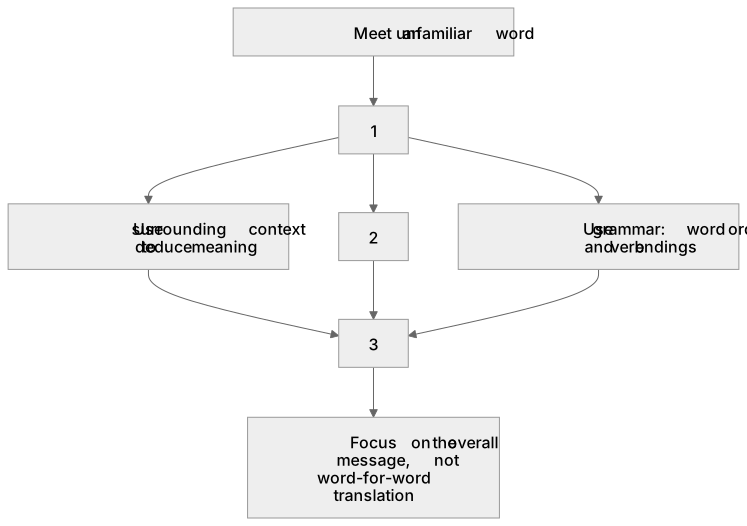
Label the diagram
Some boxes have lost their names. Pick the right name for each number.
1Box 1
2Box 2
3Box 3
There is more to this lesson
The full lesson goes on to check your understanding and help you earn the marks. Create a free account to carry on, with your progress saved.
A week of Premium from your first lesson · Then the free plan continues · No card, no charge
Test your understanding of Reading: understand and respond to written language: deduce meaning from a variety of short and longer written texts from a range of specified contexts, including authentic sources involving some complex language and unfamiliar material, as well as short narratives and authentic material addressing relevant contemporary and cultural themes
Active recall beats re-reading. Take an instant quiz now to test what you’ve learned and lock it into long-term memory.
A week of Premium from your first lesson · Then the free plan continues · No card, no charge