AQA · GCSE · French
Course version: 8658 · Version from Sept 2016
Understand and respond to written language: identify the overall message,…
Full specification wording
Reading: understand and respond to written language: identify the overall message, key points, details and opinions in a variety of short and longer written passages, involving some more complex language and recognising the relationship between past, present and future events
Advanced reading comprehension involves synthesising information from both brief and extended French texts that contain sophisticated vocabulary and structures.
- Point 3 of 6
- 4 key terms
Study notes
From the teaching notes for this specification point.
The idea
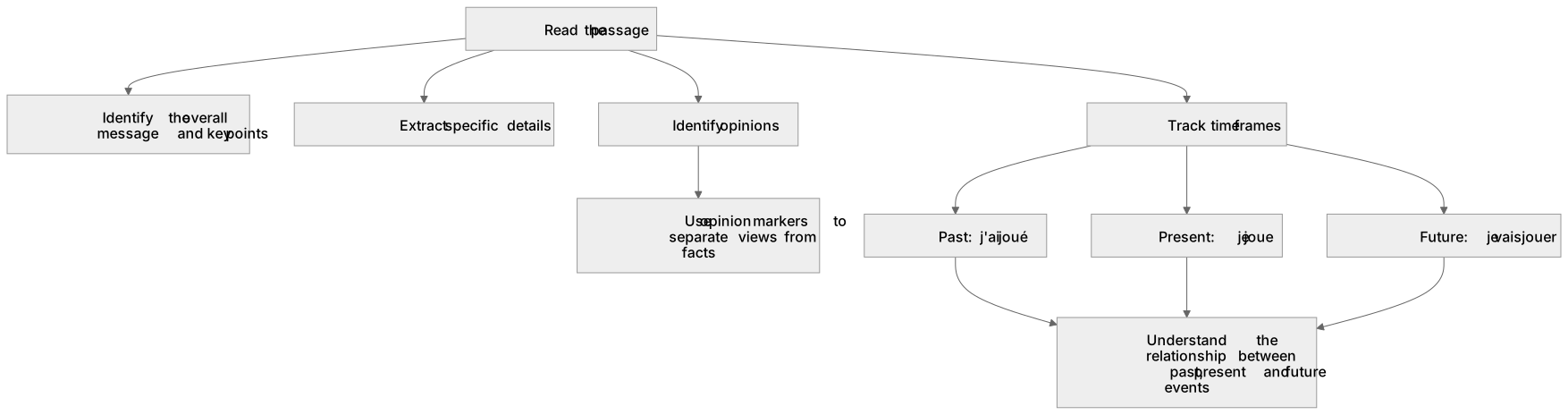
Advanced reading comprehension involves synthesising information from both brief and extended French texts that contain sophisticated vocabulary and structures. Learners must pinpoint the main idea, extract essential arguments, and distinguish factual details from subjective viewpoints. Crucially, they must track the chronology of events by identifying tense markers. For instance, distinguishing between the past tense j'ai joué, the present tense je joue, and the future tense je vais jouer is vital for understanding narratives. Recognising opinion indicators like à mon avis helps separate the author personal views from objective statements within complex passages.
What earns the marks
- Determine the overall message and key points of longer, more complex texts.
- Identify and extract specific details and opinions from written passages.
- Recognise different time frames and the relationship between past, present, and future events.
- Navigate complex language structures to comprehend the author intent.
Common mistakes and how to put them right
Confusing the author opinion with a factual statement.
Put it right: Look for opinion markers like je pense que to distinguish subjective views from facts.
Misidentifying the time frame of an event.
Put it right: Pay close attention to verb endings and time indicators like hier or demain to correctly identify past, present, or future events.
Losing the main thread in longer passages.
Put it right: Break longer texts down into paragraphs and identify the key point of each section.
Exam tips
- Highlight time phrases and verbs to keep track of when events are happening.
- Look out for contrasting conjunctions like cependant or mais, which often introduce a change in opinion or a new key point.
- Read the first and last sentences of a paragraph carefully, as they often contain the overall message.
Try the lesson
The start of the Reading: understand and respond to written language: identify the overall message, key points, details and opinions in a variety of short and longer written passages, involving some more complex language and recognising the relationship between past, present and future events lesson, made from teaching notes for this specification point.
Have a go first
Read the text: "Avant, je trouvais les maths ennuyeuses. Cependant, depuis que j'ai un nouveau professeur, je pense que c'est ma matière préférée. À l'avenir, je voudrais étudier les sciences." What is the writer's current opinion of maths?
Listen
Advanced reading comprehension involves synthesising information from both brief and extended French texts that contain sophisticated vocabulary and structures. Learners must pinpoint the main idea, extract essential arguments, and distinguish factual details from subjective viewpoints. Crucially, they must track the chronology of events by identifying tense markers. For instance, distinguishing between the past tense j'ai joué, the present tense je joue, and the future tense je vais jouer is vital for understanding narratives. Recognising opinion indicators like à mon avis helps separate the author personal views from objective statements within complex passages. A strong answer earns marks for these points. Determine the overall message and key points of longer, more complex texts. Identify and extract specific details and opinions from written passages. Recognise different time frames and the relationship between past, present, and future events. Navigate complex language structures to comprehend the author intent. A common slip: Confusing the author opinion with a factual statement. Instead, Look for opinion markers like je pense que to distinguish subjective views from facts. Exam tip: Highlight time phrases and verbs to keep track of when events are happening.
See it
Key words
Say what each word means before you turn the card.
Complex language structures
Try answering aloud or in your head before turning the card.
Time frames and tenses
Try answering aloud or in your head before turning the card.
Opinions and justifications
Try answering aloud or in your head before turning the card.
Extended reading comprehension
Try answering aloud or in your head before turning the card.
See every definition
- Complex language structures
- More sophisticated vocabulary and structures that learners must navigate to comprehend the author's intent in written passages.
- Time frames and tenses
- Recognising the relationship between past, present and future events by paying attention to verb endings and time indicators.
- Opinions and justifications
- Personal views that must be distinguished from factual details, helped by opinion markers such as je pense que and à mon avis.
- Extended reading comprehension
- Synthesising information from longer passages to identify the overall message and key points, breaking texts down into paragraphs where needed.
Label the diagram
Some boxes have lost their names. Pick the right name for each number.
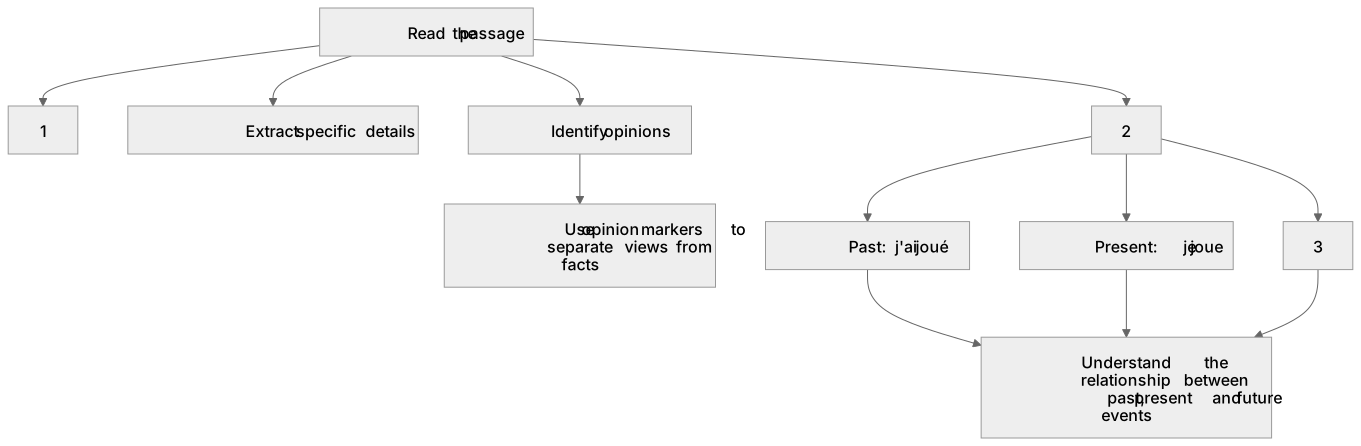
1Box 1
2Box 2
3Box 3
There is more to this lesson
The full lesson goes on to check your understanding and help you earn the marks. Create a free account to carry on, with your progress saved.
A week of Premium from your first lesson · Then the free plan continues · No card, no charge
Test your understanding of Reading: understand and respond to written language: identify the overall message, key points, details and opinions in a variety of short and longer written passages, involving some more complex language and recognising the relationship between past, present and future events
Active recall beats re-reading. Take an instant quiz now to test what you’ve learned and lock it into long-term memory.
A week of Premium from your first lesson · Then the free plan continues · No card, no charge